The Many Ways a Well-Optimized AI Agent Saves Time and Money for Ecommerce Businesses
Most ecommerce businesses are hemorrhaging time and money on tasks that a well-configured AI agent could handle in seconds.
Not a basic chatbot. Not a simple automation rule. A properly installed, optimized AI agent connected to your store data through Shopify MCP (Model Context Protocol) — one that understands your products, policies, customers, and operations as well as your best employee.
The difference between a mediocre AI implementation and a great one isn't the technology. It's the optimization — how deeply the agent is configured, how well it's connected to your data, and how intelligently it handles the hundreds of micro-tasks that consume your team's time every day.
This article breaks down every major category of time-saving and money-saving tasks a well-optimized AI agent handles — with real numbers on what each one is worth to your business.
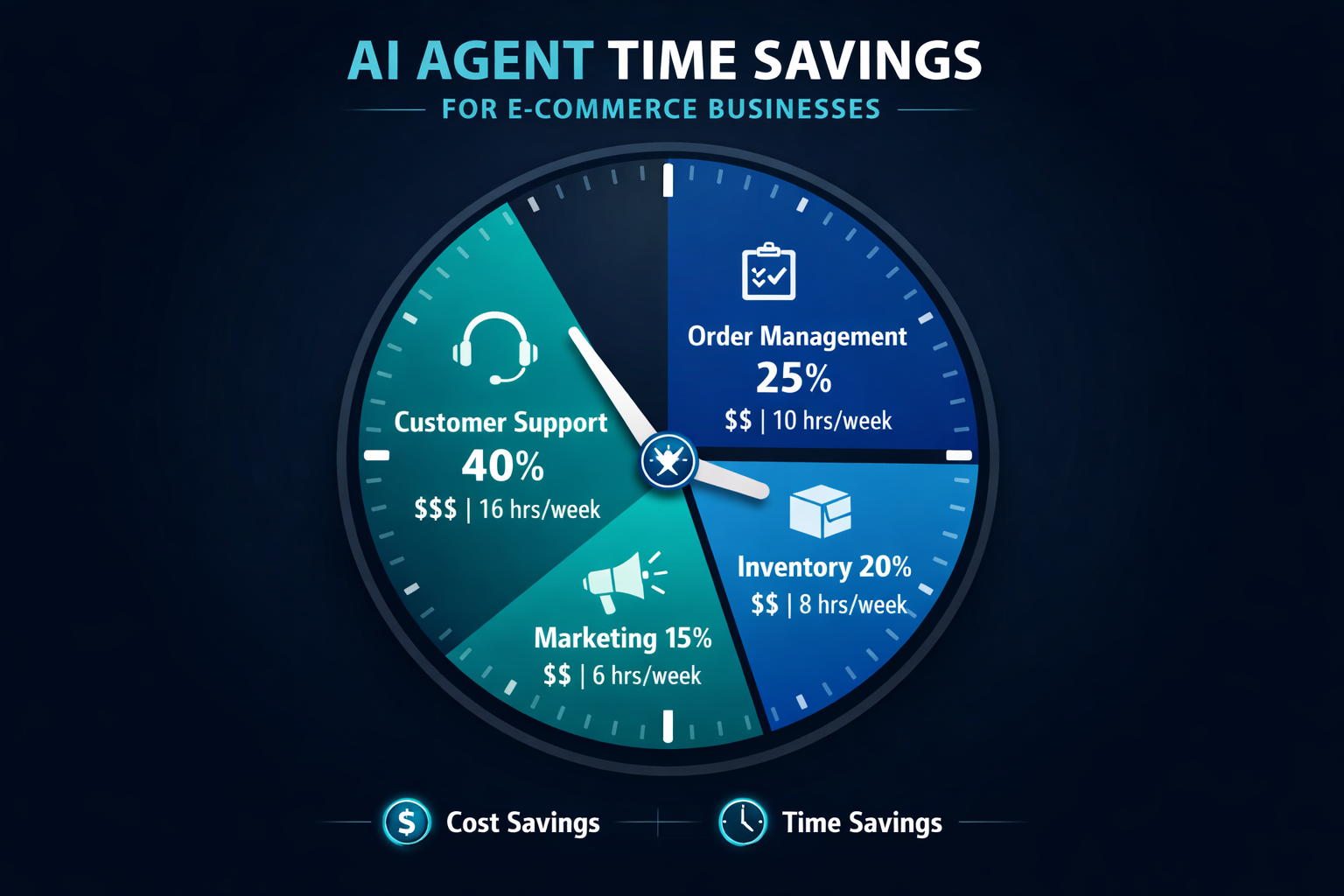 Figure: A well-optimized AI agent distributes its automation across multiple operational categories — customer support, order management, inventory, and marketing — saving 40+ hours per week for typical ecommerce businesses.
The Full Scope: What a Well-Optimized AI Agent Actually Does
Before diving into specifics, here's the complete picture of what's possible:
| Category | Tasks Automated | Weekly Time Saved | Monthly Cost Saved |
|---|---|---|---|
| Customer Support | Ticket resolution, FAQs, order inquiries | 15–25 hours | $3,000–$6,000 |
| Order Management | Status updates, modifications, routing | 8–12 hours | $1,500–$3,000 |
| Product Discovery | Recommendations, search, guided selling | 5–10 hours | $1,000–$2,500 |
| Inventory Operations | Alerts, forecasting, reorder triggers | 4–8 hours | $800–$2,000 |
| Marketing Automation | Segmentation, personalization, campaigns | 6–10 hours | $1,200–$2,500 |
| Returns & Refunds | Processing, eligibility, exchanges | 4–8 hours | $800–$2,000 |
| Content Generation | Product descriptions, emails, social | 5–8 hours | $1,000–$2,000 |
| Analytics & Reporting | Dashboards, insights, anomaly detection | 3–6 hours | $600–$1,500 |
| Total | 20+ task categories | 50–87 hours/week | $9,900–$21,500/month |
That's $118,800–$258,000 per year in combined time and cost savings for a mid-size ecommerce operation.
1. Customer Support Automation
Customer support is the single largest time sink for most ecommerce businesses — and the area where AI agents deliver the fastest, most measurable ROI.
What the Agent Handles
A well-optimized AI agent connected through MCP integration handles:
| Task | Manual Time | AI Time | Accuracy |
|---|---|---|---|
| "Where is my order?" inquiries | 5–8 min each | 3 seconds | 99%+ |
| Return eligibility checks | 3–5 min each | 2 seconds | 98%+ |
| Product availability questions | 2–4 min each | 1 second | 100% (live data) |
| Shipping policy explanations | 3–5 min each | 2 seconds | 100% |
| Size/fit recommendations | 5–10 min each | 5 seconds | 92%+ |
| Order modification requests | 8–15 min each | 10 seconds | 97%+ |
| Discount code issues | 3–5 min each | 3 seconds | 99%+ |
| Account/password help | 5–8 min each | 5 seconds | 99%+ |
The Numbers
| Metric | Without AI Agent | With AI Agent | Improvement |
|---|---|---|---|
| Average response time | 4–24 hours | Under 10 seconds | 99%+ faster |
| Cost per ticket | $8–$15 | $0.05–$0.25 | 95–99% cheaper |
| Tickets requiring human | 100% | 15–25% | 75–85% reduction |
| Customer satisfaction | 72–78% | 88–94% | +15–20 points |
| Available hours | 8–12 hrs/day | 24/7/365 | Always on |
| Simultaneous conversations | 1–3 per agent | Unlimited | Infinite scale |
Real-World Impact
For a store handling 500 support tickets per month:
- Before AI: 500 tickets × $12 average cost = $6,000/month
- After AI: 400 handled by AI ($0.15 each = $60) + 100 human ($12 each = $1,200) = $1,260/month
- Monthly savings: $4,740 ($56,880/year)
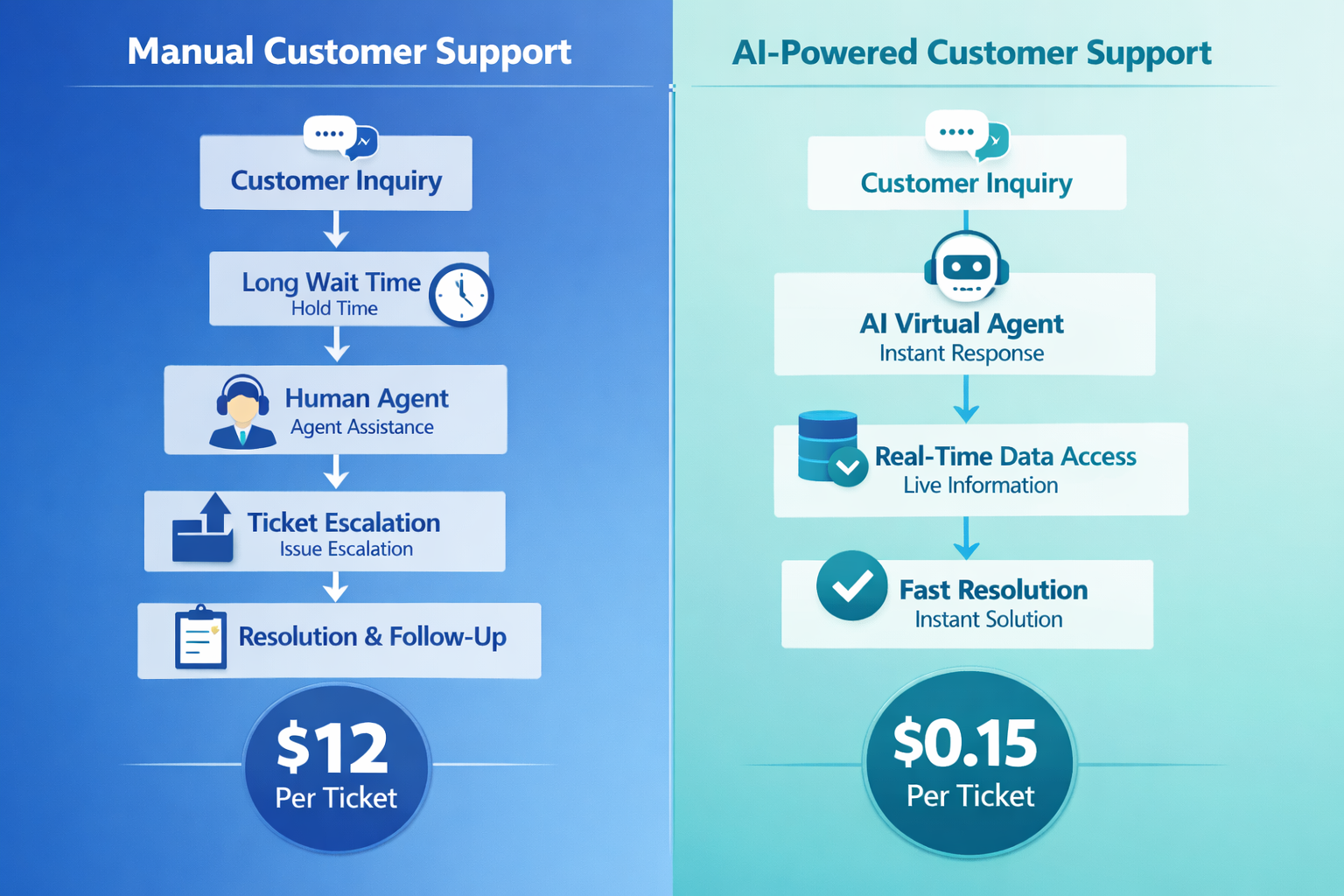 Figure: Manual support workflows involve multiple handoffs, wait times, and escalations. AI agents resolve most tickets instantly by accessing live store data through MCP.
2. Order Management & Processing
Order-related tasks consume enormous amounts of staff time — most of it repetitive and rule-based.
What the Agent Handles
| Task | Description | Time Saved Per Instance |
|---|---|---|
| Order status updates | Proactive notifications when orders ship, deliver, or delay | 3–5 min each |
| Address modifications | Catching and correcting address issues before shipping | 5–10 min each |
| Order cancellations | Processing cancellation requests within policy windows | 8–12 min each |
| Split shipment coordination | Managing multi-item orders with different fulfillment timelines | 10–15 min each |
| Payment issue resolution | Identifying and resolving declined payments, partial charges | 10–20 min each |
| Fraud flag review | Initial screening of flagged orders against risk patterns | 5–8 min each |
| Rush order processing | Prioritizing and routing expedited orders correctly | 5–8 min each |
| Gift order handling | Managing gift messages, separate shipping, gift receipts | 5–10 min each |
Automation Depth
A well-optimized agent doesn't just answer questions about orders — it actively manages them:
| Capability | Basic Chatbot | Optimized AI Agent |
|---|---|---|
| Look up order status | ✓ (scripted) | ✓ (contextual) |
| Modify shipping address | ✗ | ✓ |
| Cancel within policy | ✗ | ✓ |
| Apply discount retroactively | ✗ | ✓ |
| Coordinate with fulfillment | ✗ | ✓ |
| Flag potential fraud | ✗ | ✓ |
| Proactive delay notifications | ✗ | ✓ |
| Cross-reference customer history | ✗ | ✓ |
Monthly Impact
| Store Size | Orders/Month | AI-Handled Tasks | Time Saved | Cost Saved |
|---|---|---|---|---|
| Small ($50K/mo) | 500–1,000 | 300–600 | 25–50 hrs | $1,250–$2,500 |
| Mid ($200K/mo) | 2,000–4,000 | 1,200–2,400 | 100–200 hrs | $5,000–$10,000 |
| Large ($500K+/mo) | 5,000–10,000 | 3,000–6,000 | 250–500 hrs | $12,500–$25,000 |
3. Product Discovery & Sales Assistance
Traditional product discovery relies on customers navigating filters, categories, and search bars. AI agents transform this into conversational commerce — natural language shopping that converts significantly better.
What the Agent Handles
| Task | How It Works | Revenue Impact |
|---|---|---|
| Guided product selection | Asks clarifying questions, narrows options based on needs | +15–30% conversion |
| Cross-sell recommendations | Suggests complementary products based on cart contents | +12–25% AOV |
| Upsell suggestions | Recommends premium alternatives with clear value explanations | +8–18% AOV |
| Size/fit guidance | Uses product specs + customer history for accurate sizing | -30–50% returns |
| Comparison assistance | Helps customers compare similar products with pros/cons | +20% decision speed |
| Gift recommendations | Guides gift buyers through recipient-based discovery | +25% conversion for gift buyers |
| Bundle creation | Suggests custom bundles based on use case or budget | +15–35% AOV |
| Reorder facilitation | Identifies repeat purchase patterns and simplifies reordering | +40% repeat rate |
Why This Beats Traditional Tools
Traditional recommendation engines use basic collaborative filtering ("customers also bought"). An MCP-connected AI agent reasons through the why behind a purchase:
| Approach | Traditional Recs | AI Agent Discovery |
|---|---|---|
| Input | Past purchase data | Full conversation context |
| Logic | Statistical correlation | Reasoning about needs |
| Personalization | Segment-level | Individual-level |
| Explanation | "You might like..." | "Based on your apartment size and budget..." |
| Inventory awareness | Batch-updated | Real-time |
| Adaptability | Requires retraining | Instant adaptation |
Revenue Impact Example
For a store with 10,000 monthly visitors and $80 AOV:
| Metric | Without AI Discovery | With AI Discovery | Difference |
|---|---|---|---|
| Conversion rate | 2.5% | 3.5% | +40% |
| Average order value | $80 | $95 | +19% |
| Monthly revenue | $20,000 | $33,250 | +$13,250 |
| Annual revenue lift | — | — | +$159,000 |
4. Inventory Management & Operations
Inventory mistakes are expensive. Overselling creates angry customers. Understocking means lost revenue. AI agents monitor and manage inventory in ways that save both time and money.
What the Agent Handles
| Task | Manual Approach | AI Agent Approach | Benefit |
|---|---|---|---|
| Low stock alerts | Check spreadsheets daily | Real-time monitoring + auto-alerts | Never miss a reorder |
| Demand forecasting | Gut feeling + last year's data | Pattern analysis across all signals | 25–40% more accurate |
| Reorder recommendations | Manual calculation | Dynamic based on lead times + velocity | Optimal stock levels |
| Dead stock identification | Quarterly manual review | Continuous monitoring + markdown suggestions | Faster inventory turns |
| Seasonal preparation | Historical guesswork | Multi-signal trend analysis | Better seasonal planning |
| Supplier communication | Manual emails | Auto-generated PO drafts + follow-ups | 5–10 hrs/week saved |
| Stock discrepancy flags | Physical counts | Real-time variance detection | Catch issues early |
| Multi-location balancing | Manual transfers | Intelligent redistribution suggestions | Reduce stockouts 30% |
Cost of Inventory Mistakes (What AI Prevents)
| Mistake Type | Average Cost | AI Prevention Rate |
|---|---|---|
| Overselling (cancellations) | $25–$50 per incident | 95%+ |
| Stockouts (lost sales) | $100–$500 per day per SKU | 70–85% |
| Dead stock (markdowns) | 30–60% margin loss | 40–60% reduction |
| Emergency reorders (rush shipping) | 2–5x normal shipping cost | 80%+ |
| Inventory shrinkage (undetected) | 1–3% of revenue | 50%+ detection improvement |
5. Marketing Automation & Personalization
Marketing is where AI agents create compounding returns — every optimization builds on the last.
What the Agent Handles
| Task | Manual Effort | AI Agent Capability | Time Saved |
|---|---|---|---|
| Email segmentation | 2–4 hrs/week building segments | Auto-segments based on behavior patterns | 90% |
| Send time optimization | A/B testing over weeks | Individual-level optimal timing | 95% |
| Subject line generation | 30–60 min per campaign | Generates + tests multiple variants | 80% |
| Abandoned cart sequences | Set-and-forget templates | Dynamic, personalized recovery messages | 70% |
| Post-purchase flows | Generic thank-you emails | Personalized based on product + customer type | 85% |
| Win-back campaigns | Monthly manual identification | Continuous at-risk customer detection | 90% |
| Review request timing | Fixed delay after delivery | Optimal timing based on product + customer | 95% |
| Social content creation | 3–5 hrs/week | Auto-generated from product data + trends | 75% |
Marketing Efficiency Gains
| Metric | Manual Marketing | AI-Optimized Marketing | Improvement |
|---|---|---|---|
| Email open rate | 18–22% | 28–35% | +50–60% |
| Click-through rate | 2–3% | 4–6% | +100% |
| Abandoned cart recovery | 5–8% | 15–25% | +200–300% |
| Campaign creation time | 4–6 hours | 30–45 minutes | 85% faster |
| Personalization depth | 3–5 segments | Individual level | Infinite |
| Revenue per email | $0.08–$0.12 | $0.18–$0.30 | +125–150% |
6. Returns, Refunds & Exchanges
Returns processing is one of the most time-consuming and emotionally draining tasks for ecommerce teams. AI agents handle it with consistency and speed.
What the Agent Handles
| Task | Process | Time Saved |
|---|---|---|
| Return eligibility check | Verifies purchase date, condition, policy compliance | 3–5 min per request |
| RMA generation | Creates return authorization with shipping labels | 5–8 min per request |
| Exchange facilitation | Guides customer to replacement, checks availability | 8–12 min per request |
| Refund processing | Initiates refund after return receipt confirmation | 5–10 min per request |
| Return reason analysis | Categorizes and reports on return patterns | 2–4 hrs/week |
| Proactive size guidance | Reduces returns by improving pre-purchase fit advice | Prevents 20–30% of returns |
| Partial refund negotiation | Offers alternatives (store credit, discount on next) | 10–15 min per case |
| Warranty claim processing | Verifies warranty status, initiates replacement flow | 10–20 min per claim |
Return Cost Reduction
| Factor | Without AI | With AI Agent | Savings |
|---|---|---|---|
| Processing cost per return | $15–$25 | $2–$5 | 80–85% |
| Return rate (better pre-purchase guidance) | 20–30% | 14–22% | -25–30% |
| Exchange vs. refund ratio | 20% exchanges | 40% exchanges | +100% (retains revenue) |
| Time to process | 24–72 hours | Under 5 minutes | 99%+ faster |
| Customer satisfaction with returns | 65% | 89% | +24 points |
7. Content Generation & Management
Content creation is a never-ending task for ecommerce businesses. AI agents handle the repetitive content work that consumes hours every week.
What the Agent Handles
| Content Type | Manual Time | AI Generation Time | Quality Level |
|---|---|---|---|
| Product descriptions | 20–45 min each | 30 seconds each | 90%+ (needs light editing) |
| Meta titles & descriptions | 5–10 min each | 5 seconds each | 95%+ |
| Category page copy | 30–60 min each | 1 minute each | 85%+ |
| Email campaign copy | 1–2 hours each | 5 minutes each | 90%+ |
| Social media posts | 15–30 min each | 15 seconds each | 85%+ |
| FAQ updates | 1–2 hours/week | Automatic from support data | 95%+ |
| Blog content outlines | 1–2 hours each | 5 minutes each | 80%+ |
| Product comparison guides | 2–4 hours each | 10 minutes each | 90%+ |
Content Scaling Impact
| Store Size | Products | Manual Description Time | AI Description Time | Time Saved |
|---|---|---|---|---|
| Small (100 products) | 100 | 50–75 hours | 1 hour | 49–74 hours |
| Medium (500 products) | 500 | 250–375 hours | 4 hours | 246–371 hours |
| Large (2,000+ products) | 2,000 | 1,000–1,500 hours | 17 hours | 983–1,483 hours |
For seasonal catalog updates, new product launches, or marketplace expansion (where you need unique descriptions per channel), AI content generation saves weeks of work.
8. Analytics, Reporting & Business Intelligence
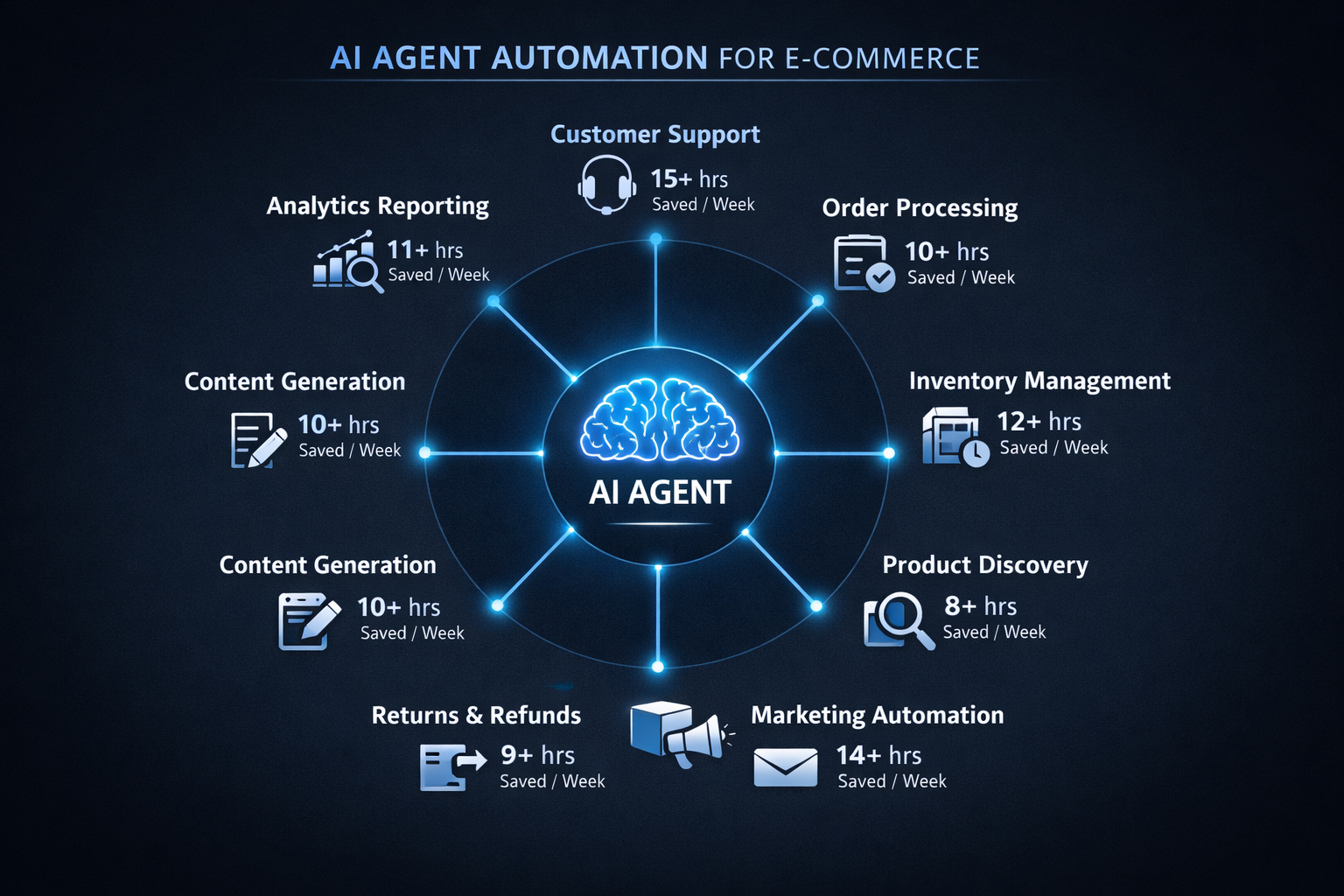 Figure: A well-optimized AI agent automates tasks across 8 major operational categories — each one saving hours per week and thousands per month.
What the Agent Handles
| Task | Manual Approach | AI Agent Approach | Value |
|---|---|---|---|
| Daily sales reporting | Pull data, format, distribute | Auto-generated, delivered to inbox | 30 min/day saved |
| Anomaly detection | Notice problems days later | Real-time alerts on unusual patterns | Catch issues 10x faster |
| Customer cohort analysis | Quarterly deep dives | Continuous segmentation updates | Always current |
| Product performance tracking | Weekly spreadsheet updates | Live dashboards with AI insights | 2–3 hrs/week saved |
| Competitor price monitoring | Manual checking | Automated tracking + alerts | 3–5 hrs/week saved |
| Conversion funnel analysis | Monthly review | Continuous optimization suggestions | Faster iteration |
| Customer lifetime value prediction | Annual calculation | Real-time scoring per customer | Better resource allocation |
| Inventory velocity reporting | Manual calculation | Auto-calculated with forecasts | 1–2 hrs/week saved |
Decision Speed Impact
| Decision Type | Without AI Analytics | With AI Analytics | Speed Improvement |
|---|---|---|---|
| Price adjustment | 1–2 weeks (data gathering) | Same day (instant analysis) | 7–14x faster |
| Underperforming product action | End of quarter | Within 48 hours | 30x faster |
| Marketing budget reallocation | Monthly review | Weekly or real-time | 4–30x faster |
| Stockout prevention | After the fact | 3–7 days advance warning | Proactive vs. reactive |
| Customer churn intervention | After they're gone | Before they leave | Saves the relationship |
9. Additional High-Value Automations
Beyond the 8 core categories, well-optimized AI agents handle dozens of additional tasks:
Pre-Sales Automation
| Task | Impact |
|---|---|
| Lead qualification from chat | Identifies high-intent buyers for priority follow-up |
| Quote generation for B2B | Instant custom pricing based on volume + history |
| Product availability notifications | Auto-alerts when wishlist items return to stock |
| Price drop alerts | Notifies interested customers when items go on sale |
| Pre-order management | Handles waitlists, deposits, and launch communications |
Post-Sales Automation
| Task | Impact |
|---|---|
| Delivery confirmation follow-up | Ensures satisfaction, catches issues early |
| Usage tips and onboarding | Reduces returns by helping customers use products correctly |
| Loyalty program management | Tracks points, suggests redemptions, drives engagement |
| Subscription management | Handles pause, skip, swap, cancel requests |
| Referral program facilitation | Identifies happy customers, simplifies referral sharing |
Internal Operations
| Task | Impact |
|---|---|
| Staff scheduling suggestions | Based on predicted traffic and support volume |
| Vendor communication | Auto-drafts purchase orders and follow-ups |
| Quality control flagging | Identifies products with unusual return/complaint rates |
| Compliance monitoring | Ensures listings meet marketplace requirements |
| Training material generation | Creates SOPs from successful interaction patterns |
The Compound Effect: Why Optimization Matters
The difference between a basic AI chatbot and a well-optimized AI agent isn't incremental — it's exponential.
Basic Chatbot vs. Optimized AI Agent
| Dimension | Basic Chatbot | Well-Optimized AI Agent |
|---|---|---|
| Data access | FAQ database only | Full store data via MCP |
| Task handling | Answer questions | Answer + take action |
| Learning | Static responses | Improves from interactions |
| Scope | Customer support only | Support + sales + ops + marketing |
| Integration | Standalone widget | Connected to all systems |
| ROI | 2–3x | 8–15x |
| Monthly savings | $500–$2,000 | $5,000–$20,000+ |
The Optimization Layers
Each layer of optimization compounds the value:
| Layer | What It Means | Value Multiplier |
|---|---|---|
| Layer 1: Connection | Agent connected to store data | 2x baseline |
| Layer 2: Context | Agent understands business rules + policies | 3x baseline |
| Layer 3: Action | Agent can take actions (modify orders, process returns) | 5x baseline |
| Layer 4: Learning | Agent improves from every interaction | 8x baseline |
| Layer 5: Proactive | Agent anticipates needs before customers ask | 12x baseline |
| Layer 6: Cross-functional | Agent operates across support, sales, and ops | 15x baseline |
ROI Calculator: What This Means for Your Business
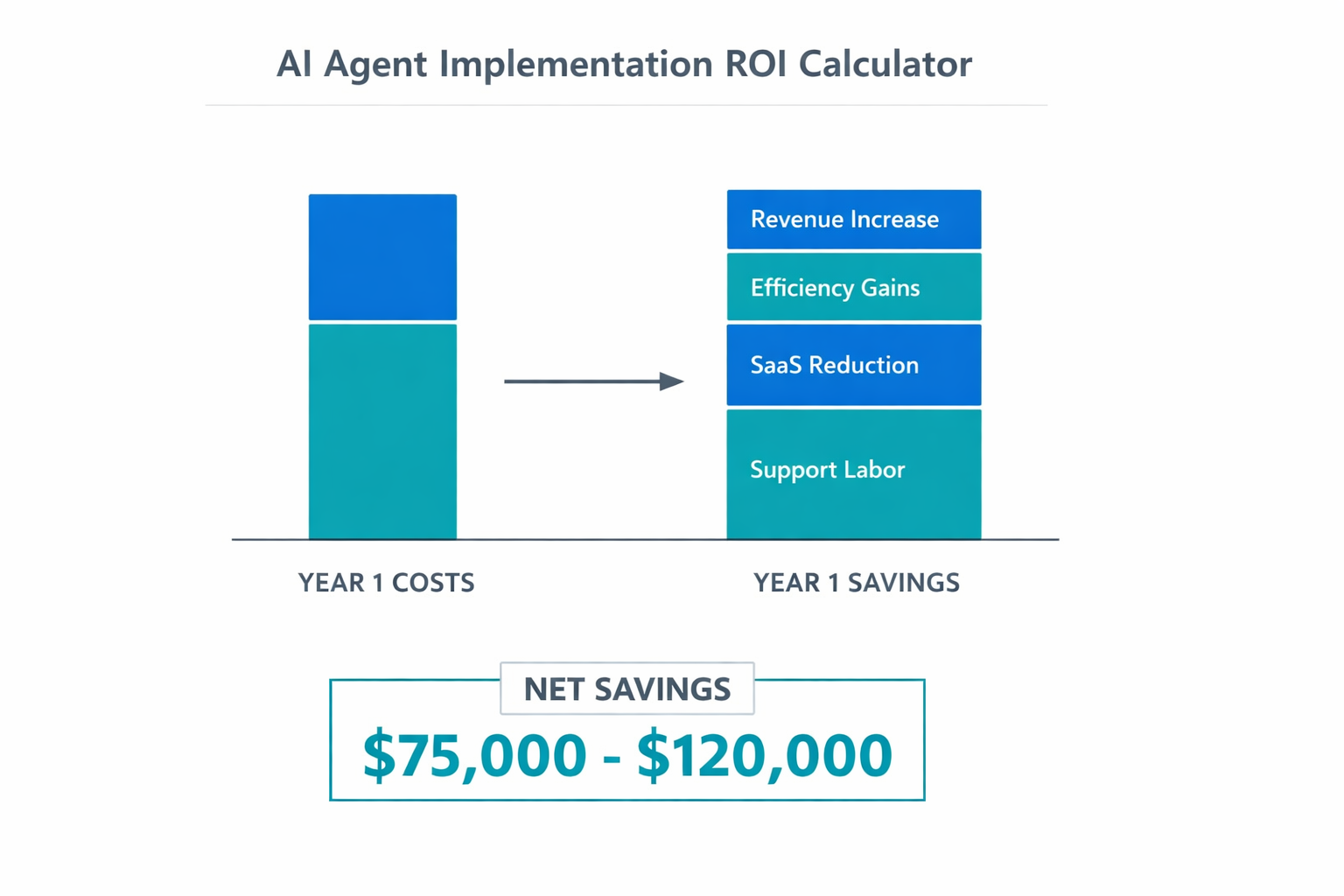 Figure: Year 1 ROI analysis for AI agent implementation — even accounting for setup costs, most ecommerce businesses see net savings of $75,000–$120,000 in the first year.
Investment vs. Return
| Component | Cost Range | Notes |
|---|---|---|
| Implementation | $5,000–$20,000 (one-time) | Depends on complexity and customization |
| Monthly operation | $300–$1,500/month | AI inference + maintenance + monitoring |
| Year 1 total cost | $8,600–$38,000 | Implementation + 12 months operation |
Year 1 Savings
| Savings Category | Conservative | Moderate | Aggressive |
|---|---|---|---|
| Support labor reduction | $36,000 | $54,000 | $72,000 |
| SaaS tool consolidation | $6,000 | $10,000 | $15,000 |
| Operational efficiency | $12,000 | $18,000 | $24,000 |
| Revenue increase (conversion + AOV) | $20,000 | $40,000 | $80,000 |
| Return rate reduction | $5,000 | $10,000 | $15,000 |
| Total Year 1 savings | $79,000 | $132,000 | $206,000 |
| Net ROI (after costs) | $41,000–$70,400 | $94,000–$123,400 | $168,000–$197,400 |
ROI Timeline
| Milestone | Timeline | What Happens |
|---|---|---|
| Implementation complete | Week 4–6 | Agent live and handling tickets |
| Break-even | Month 2–3 | Savings exceed total investment to date |
| 3x ROI | Month 4–6 | Compounding efficiency gains |
| 5x ROI | Month 6–9 | Full optimization across all categories |
| 10x+ ROI | Month 9–12 | Cross-functional automation at scale |
What "Well-Optimized" Actually Means
Not all AI agent implementations are equal. Here's what separates a mediocre deployment from one that delivers maximum time and money savings:
The Optimization Checklist
| Factor | Poorly Optimized | Well Optimized |
|---|---|---|
| Data connection | Basic FAQ import | Full MCP integration with live store data |
| Policy training | Generic ecommerce rules | Your specific policies, exceptions, edge cases |
| Brand voice | Default AI tone | Matches your brand personality exactly |
| Action capabilities | Read-only (answers only) | Read + write (can modify orders, process returns) |
| Escalation logic | Escalates everything complex | Handles 85%+ independently, smart escalation |
| Learning loop | Static after setup | Continuous improvement from interactions |
| Cross-system integration | Chat widget only | Connected to email, SMS, social, internal tools |
| Proactive capabilities | Reactive only | Anticipates issues, sends proactive updates |
| Performance monitoring | No tracking | Real-time accuracy, satisfaction, and savings metrics |
| Regular optimization | Set and forget | Monthly review and improvement cycles |
Implementation Quality Matters
The same AI technology can deliver wildly different results based on implementation quality:
| Implementation Quality | Ticket Resolution Rate | Monthly Savings | Customer Satisfaction |
|---|---|---|---|
| Poor (basic chatbot) | 20–30% | $500–$1,500 | 60–70% |
| Average (standard setup) | 45–55% | $2,000–$4,000 | 75–82% |
| Good (configured properly) | 65–75% | $4,000–$8,000 | 83–89% |
| Excellent (fully optimized) | 80–90% | $8,000–$20,000+ | 90–95% |
Industry-Specific Applications
Fashion & Apparel
| AI Agent Task | Specific Value |
|---|---|
| Size recommendation from measurements | Reduces returns 25–40% |
| Style matching from preferences | Increases AOV 15–25% |
| Outfit completion suggestions | Drives multi-item purchases |
| Seasonal wardrobe recommendations | Increases repeat purchase rate |
| Care instruction guidance | Reduces product complaints |
Health & Beauty
| AI Agent Task | Specific Value |
|---|---|
| Ingredient compatibility checking | Prevents negative reactions, builds trust |
| Routine building assistance | Increases basket size 30–50% |
| Subscription optimization | Reduces churn, optimizes delivery frequency |
| Shade/color matching | Reduces returns 20–35% |
| Reorder timing suggestions | Drives predictable recurring revenue |
Electronics & Tech
| AI Agent Task | Specific Value |
|---|---|
| Compatibility verification | Prevents wrong-product purchases |
| Technical specification comparison | Speeds purchase decisions |
| Setup and troubleshooting guidance | Reduces support tickets 40–60% |
| Upgrade path recommendations | Drives higher-value purchases |
| Warranty and repair coordination | Streamlines post-purchase support |
Food & Beverage
| AI Agent Task | Specific Value |
|---|---|
| Dietary restriction filtering | Personalized product discovery |
| Recipe-based recommendations | Increases items per order |
| Subscription box customization | Reduces skip/cancel rates |
| Freshness and expiry management | Reduces waste and complaints |
| Allergen verification | Builds trust and reduces liability |
Getting Started: The Implementation Path
For businesses ready to capture these time and money savings, here's what the implementation process typically looks like:
Phase 1: Foundation (Weeks 1–2)
| Step | What Happens | Outcome |
|---|---|---|
| Store audit | Review products, policies, customer patterns | Clear automation opportunity map |
| Data mapping | Identify all data sources the agent needs | MCP connection architecture |
| Priority setting | Rank tasks by time saved × frequency | Implementation roadmap |
| Success metrics | Define KPIs for each automation category | Measurement framework |
Phase 2: Core Implementation (Weeks 2–4)
| Step | What Happens | Outcome |
|---|---|---|
| MCP configuration | Connect agent to live store data | Real-time data access |
| Policy training | Teach agent your specific business rules | Accurate, brand-consistent responses |
| Action setup | Enable order modifications, returns, etc. | Full task automation |
| Testing | Validate against real customer scenarios | Production-ready system |
Phase 3: Optimization (Weeks 4–8)
| Step | What Happens | Outcome |
|---|---|---|
| Performance monitoring | Track accuracy, speed, satisfaction | Baseline metrics |
| Edge case handling | Address unusual scenarios the agent encounters | Higher resolution rate |
| Expansion | Add new task categories (marketing, inventory) | Broader automation |
| Learning loop | Implement continuous improvement from data | Compounding returns |
Phase 4: Scale (Months 3+)
| Step | What Happens | Outcome |
|---|---|---|
| Cross-channel deployment | Extend to email, SMS, social | Unified customer experience |
| Proactive automation | Agent anticipates needs before customers ask | Higher satisfaction |
| Advanced analytics | AI-driven business intelligence | Better decisions faster |
| Team augmentation | Agent supports internal team operations | Organization-wide efficiency |
Common Questions
"How long until we see ROI?"
Most businesses reach break-even within 60–90 days of deployment. The fastest wins come from customer support automation (immediate cost reduction) and product discovery (immediate revenue lift).
"Will this replace our team?"
No. AI agents handle the repetitive 70–85% of tasks so your team can focus on the high-value 15–30% that requires human creativity, empathy, and judgment. Most businesses that implement AI agents actually grow their teams — they just redeploy people to higher-value work.
"What if the AI makes mistakes?"
Well-optimized agents include guardrails, confidence thresholds, and smart escalation. When the agent isn't confident, it escalates to a human. Error rates for properly configured agents are typically lower than human error rates for repetitive tasks.
"Is this only for large businesses?"
No. The cost savings scale proportionally. A store doing $30K/month can save $3,000–$5,000/month. A store doing $500K/month can save $15,000–$25,000/month. The ROI percentage is similar regardless of size.
"Which AI model should we use?"
It depends on your use case. For most ecommerce applications, a multi-model approach works best — using different models for customer-facing interactions vs. backend operations.
The Bottom Line
A well-optimized AI agent isn't a single tool — it's an operational multiplier that touches every part of your ecommerce business.
The businesses capturing the most value aren't just using AI for customer support. They're using it across:
- Customer interactions (support, sales, discovery)
- Operations (orders, inventory, returns)
- Marketing (personalization, automation, content)
- Intelligence (analytics, forecasting, optimization)
The total impact for a mid-size ecommerce business:
| Metric | Annual Value |
|---|---|
| Direct cost savings | $60,000–$120,000 |
| Time savings (reinvested) | 2,000–4,000 hours/year |
| Revenue increase | $50,000–$200,000+ |
| Reduced errors and returns | $10,000–$30,000 |
| Total annual impact | $120,000–$350,000+ |
The technology exists today. The implementation expertise exists today. The only question is how much longer you'll keep paying for manual processes that an AI agent could handle in seconds.
Related Reading
Explore the technologies and strategies behind AI agent automation:
- What Is Shopify MCP? — The protocol that connects AI agents to your live store data, enabling all the automations described above.
- AI Agents for Shopify: Implementation Guide — A practical breakdown of the implementation process from audit to deployment.
- How Much Can Small E-Commerce Companies Save? — Detailed cost analysis of switching from legacy tech stacks to AI-powered systems.
- How Shopify MCP Could Replace Multiple SaaS Tools — How one AI agent consolidates quiz apps, chat tools, recommendation engines, and more.
- What Is Conversational Commerce? — The future of AI-powered shopping through natural language interactions.
- The Shift from SEO to GEO — How generative engine optimization ensures your AI-optimized store gets cited in AI search results.
← Back to Blog · ← Back to Home
Ready to Start Saving Time and Money?
At Shopify Agent AI, we help ecommerce businesses implement well-optimized AI agents that deliver measurable time and cost savings across every operational category — from customer support to inventory management to revenue optimization.
Our free AI Readiness Audit identifies your highest-impact automation opportunities and shows you exactly what a well-optimized agent could save your business.
Book a Discovery Call to get your personalized savings analysis.
Frequently Asked Questions
Quick answers to common questions about this topic.
Most businesses reach break-even within **60–90 days** of deployment. The fastest wins come from customer support automation (immediate cost reduction) and product discovery (immediate revenue lift).
No. AI agents handle the **repetitive 70–85%** of tasks so your team can focus on the **high-value 15–30%** that requires human creativity, empathy, and judgment. Most businesses that implement AI agents actually grow their teams — they just redeploy people to higher-value work.
Well-optimized agents include guardrails, confidence thresholds, and smart escalation. When the agent isn't confident, it escalates to a human. Error rates for properly configured agents are typically **lower** than human error rates for repetitive tasks.
No. The [cost savings scale proportionally](/blog/ecommerce-tech-stack-cost-savings-ai-automation/). A store doing $30K/month can save $3,000–$5,000/month. A store doing $500K/month can save $15,000–$25,000/month. The ROI percentage is similar regardless of size.
It depends on your use case. For most ecommerce applications, a [multi-model approach](/blog/claude-vs-chatgpt-shopify-mcp/) works best — using different models for customer-facing interactions vs. backend operations.
Related Reading
What Is Shopify MCP? The New AI Layer That Could Change How Shopify Stores Operate
Learn what Shopify MCP (Model Context Protocol) is, how it works, and why it could transform how Shopify stores use AI agents for customer support, sales, and automation.
Read articleThe Shift from SEO to GEO: Why Generative Engine Optimization Is the Future of Ecommerce Visibility
Traditional SEO is losing ground to AI-powered search. Learn how Generative Engine Optimization (GEO) works, the technical implementation details including structured data and entity structuring, and why Shopify stores that don't adapt will become invisible.
Read articleClaude vs ChatGPT for Shopify MCP: Which AI Is Better for Ecommerce Automation?
Compare Claude and ChatGPT for Shopify MCP integrations. Detailed analysis of strengths, use cases, context windows, and why the future of ecommerce AI is multi-model.
Read articleReady to Optimize Your Store for AI?
Get a personalized AI readiness audit and discover how your Shopify store can leverage AI agents, MCP integrations, and automation to drive growth.