What Is Conversational Commerce? The Future of AI Shopping
The way people shop online is about to fundamentally change.
For two decades, ecommerce has followed the same basic pattern: browse a catalog, use filters, compare products, add to cart, checkout. It works — but it's not how humans naturally make buying decisions.
Conversational commerce changes this entirely.
Conversational commerce is the practice of using AI-powered conversations — through chat, voice, or messaging — to guide customers through product discovery, recommendations, and purchasing without traditional browse-and-click interfaces.
Instead of navigating menus and filters, customers simply talk to your store.
"I need running shoes for flat feet, under $150, that work on trails."
And the AI doesn't just return a keyword search result — it reasons about the request, understands the constraints, checks live inventory, and presents personalized options with explanations.
This isn't science fiction. It's happening now.
 Figure: Conversational commerce replaces traditional browse-and-click shopping with natural language interactions powered by AI agents that understand context, preferences, and intent.
Why Traditional Ecommerce Is Hitting a Wall
The traditional ecommerce model has fundamental limitations that are becoming more apparent as customer expectations evolve:
| Problem | Traditional Ecommerce | Impact |
|---|---|---|
| Discovery friction | Browse → Search → Filter → Compare → Decide | 6+ steps before purchase |
| Search limitations | Keyword matching only | 30–40% of searches return poor results |
| No personalization context | Treats every visitor the same | Generic experience, low conversion |
| Decision paralysis | Too many options, no guidance | 60%+ cart abandonment |
| Support disconnect | Separate system from shopping | Context lost between interactions |
| Mobile friction | Tiny screens, complex navigation | 50%+ lower mobile conversion |
The Numbers Tell the Story
| Metric | Traditional Ecommerce | Conversational Commerce | Improvement |
|---|---|---|---|
| Average conversion rate | 2.5–3.5% | 8–15% (early data) | 3–5x |
| Product discovery time | 8–12 minutes | 2–3 minutes | 75% faster |
| Cart abandonment | 70% | 35–45% | 35–50% reduction |
| Customer satisfaction (CSAT) | 72% | 89% | +17 points |
| Return rate | 20–30% | 10–15% | 50% reduction |
| Average order value | Baseline | +15–35% | Significant uplift |
The reason returns drop is particularly telling: when an AI agent understands what a customer actually needs (not just what they searched for), it recommends products that genuinely fit — reducing mismatches.
The Evolution: From Chatbots to AI Commerce Agents
Conversational commerce isn't new as a concept — but the technology enabling it has transformed dramatically:
Generation 1: Rule-Based Chatbots (2016–2020)
| Feature | Capability |
|---|---|
| Response type | Scripted decision trees |
| Understanding | Keyword matching only |
| Store integration | None or basic |
| Personalization | None |
| Failure mode | "I don't understand, let me transfer you" |
| Customer satisfaction | Low (felt robotic) |
Generation 2: NLP Chatbots (2020–2023)
| Feature | Capability |
|---|---|
| Response type | Template-based with NLP |
| Understanding | Intent classification |
| Store integration | Basic API calls |
| Personalization | Segment-based |
| Failure mode | Generic fallback responses |
| Customer satisfaction | Moderate (better but limited) |
Generation 3: AI Agents with MCP (2024–Present)
| Feature | Capability |
|---|---|
| Response type | Dynamic reasoning with full context |
| Understanding | Deep semantic + contextual reasoning |
| Store integration | Full access via Shopify MCP |
| Personalization | Individual-level, real-time |
| Failure mode | Graceful reasoning + human escalation |
| Customer satisfaction | High (feels like expert human) |
The critical difference with Generation 3 is store-aware reasoning. Through protocols like Shopify MCP (Model Context Protocol), AI agents can access live product data, inventory levels, customer history, and order information — enabling them to have genuinely helpful commerce conversations.
This is what makes AI agents fundamentally different from traditional chatbots — they don't just respond, they reason and act.
How Conversational Commerce Actually Works
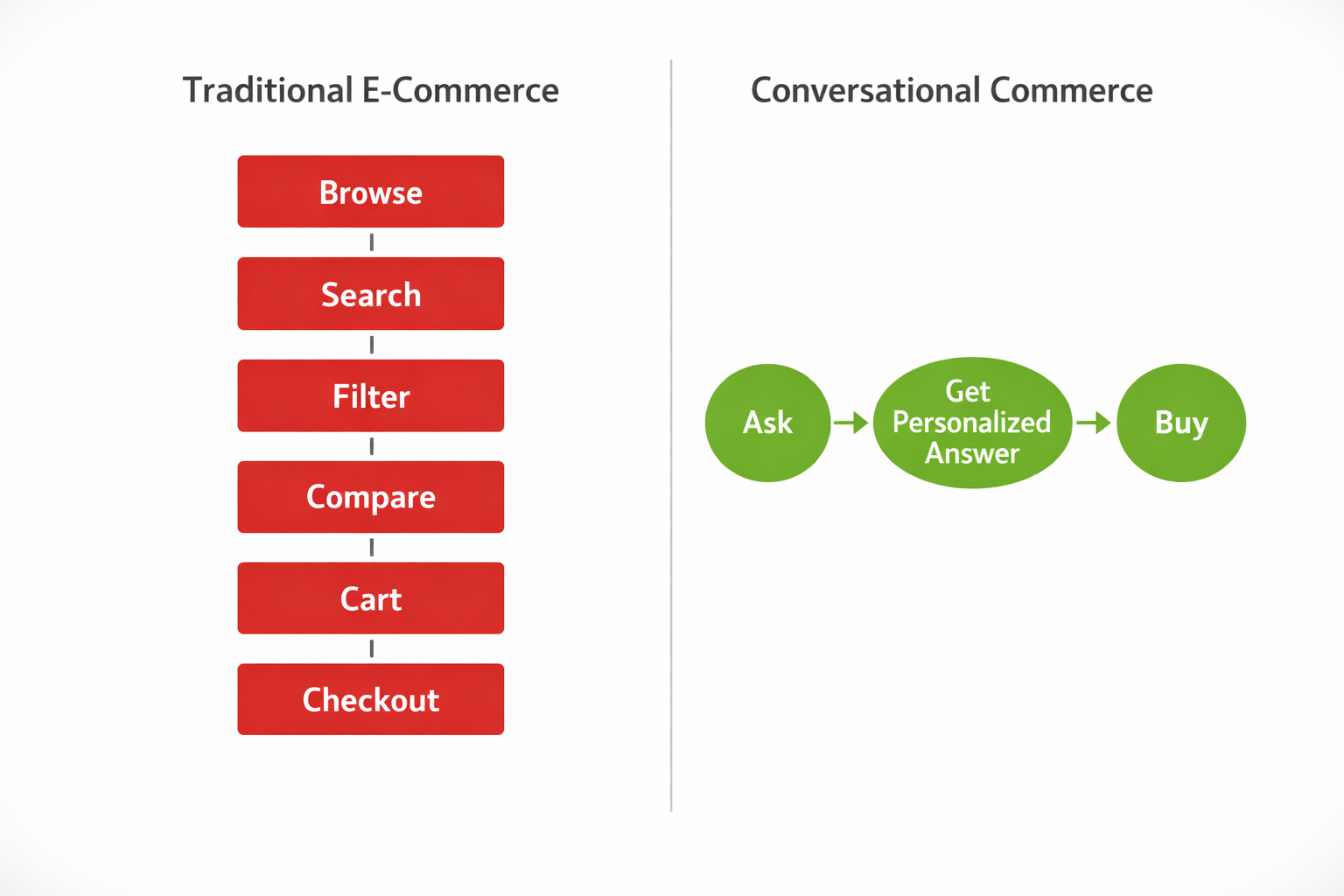 Figure: Traditional ecommerce requires 6+ steps through disconnected interfaces. Conversational commerce collapses this into a natural 3-step flow: ask, receive personalized guidance, and buy.
The Customer Experience
Here's what a conversational commerce interaction looks like in practice:
Traditional Shopping Flow:
- Land on homepage
- Navigate to category
- Apply filters (size, color, price)
- Scroll through 40+ results
- Click into 3–5 products
- Read reviews
- Compare specifications
- Decide (or abandon)
- Add to cart
- Checkout
Conversational Commerce Flow:
- "I'm looking for a birthday gift for my wife — she loves cooking, budget around $100"
- AI agent reasons: cooking enthusiast + gift + $100 budget → suggests premium knife set, artisan cutting board, cooking class voucher — with explanations for each
- Customer: "She already has good knives — what about the cutting board?"
- AI shows options, explains materials, checks stock, offers gift wrapping
- Purchase complete
Same outcome. 10 steps → 5 natural exchanges. 12 minutes → 3 minutes.
The Technical Architecture
For conversational commerce to work at a production level, it needs:
| Layer | Function | Technology |
|---|---|---|
| Conversation Interface | Customer-facing chat/voice | Web widget, messaging apps, voice |
| AI Reasoning Engine | Understanding intent, planning responses | LLMs (Claude, ChatGPT, or both) |
| Store Connection | Real-time access to store data | Shopify MCP |
| Action Layer | Cart building, order creation, returns | MCP tool calls |
| Memory Layer | Customer context, conversation history | Vector databases, session storage |
| Guardrails | Safety, accuracy, brand voice | Policy enforcement, validation |
The Model Context Protocol (MCP) is what makes this architecture viable at scale — it provides a standardized way for AI models to securely access and interact with Shopify store data without custom API development for every integration.
Five Pillars of Conversational Commerce
1. Conversational Product Discovery
Instead of filters and categories, customers describe what they want in natural language.
| Traditional Discovery | Conversational Discovery |
|---|---|
| Category: Women's → Dresses → Summer | "I need a dress for a beach wedding in July" |
| Filter: Size M, Color: Blue, Price: $50–$100 | "Something flowy, not too formal, under $100" |
| Sort by: Best selling | AI considers occasion, weather, formality, budget |
| Browse 47 results | Sees 3 curated options with reasoning |
Why it's better: The AI understands intent (beach wedding) and constraints (not too formal, budget) simultaneously — something no filter system can do.
2. Contextual Recommendations
Traditional recommendation engines use collaborative filtering ("customers also bought"). Conversational commerce uses reasoning.
| Recommendation Type | How It Works | Quality |
|---|---|---|
| Collaborative filtering | "People who bought X also bought Y" | Generic, often irrelevant |
| Content-based | "Similar products to what you viewed" | Better, still surface-level |
| Conversational AI | "Based on your beach wedding, July weather, and preference for flowy styles..." | Deeply personalized |
The AI can ask clarifying questions, understand nuance, and explain why it's recommending something — building trust and reducing returns.
3. Guided Selling Through Dialogue
Complex purchases (electronics, furniture, skincare) benefit enormously from guided conversations:
| Purchase Type | Traditional Approach | Conversational Approach |
|---|---|---|
| Skincare routine | Read 50 product descriptions, guess | "I have oily skin, some acne, sensitive to fragrance" → complete routine recommended |
| Laptop selection | Compare spec sheets | "I need it for video editing, travel frequently, budget $1500" → 2–3 perfect matches |
| Gift shopping | Browse "gifts for him" category | "My dad is turning 60, loves golf and whiskey" → thoughtful, specific suggestions |
| Home furniture | Measure, browse, hope it fits | "I have a 12x14 living room, modern style, need seating for 6" → layout suggestions |
This is where conversational commerce creates the most value — in purchases where customers don't know exactly what they want and need expert guidance.
4. Seamless Support-to-Sales
In traditional ecommerce, support and sales are completely separate systems. A customer asking about a return can't easily be helped with their next purchase.
Conversational commerce unifies these:
| Scenario | Traditional | Conversational |
|---|---|---|
| Customer returns a shirt (too small) | Processes return. End of interaction. | Processes return + suggests correct size + offers discount on exchange |
| Customer asks about shipping | Gives tracking number | Gives tracking + "While you wait, we have matching accessories for your order" |
| Customer complains about product | Apologizes, offers refund | Understands issue, suggests better alternative, offers loyalty credit |
Every support interaction becomes a potential sales opportunity — handled naturally, not pushily.
5. Proactive Commerce
The most advanced form of conversational commerce doesn't wait for customers to initiate:
| Trigger | Proactive Message | Value |
|---|---|---|
| Customer browsed 3x without buying | "I noticed you're looking at running shoes — can I help you find the right fit?" | Reduces abandonment |
| Reorder timing | "You bought coffee beans 3 weeks ago — ready for a refill?" | Increases LTV |
| Price drop on wishlist item | "Good news — that jacket you saved is now 20% off" | Drives conversion |
| Complementary timing | "Your new camera arrives tomorrow — want a memory card to go with it?" | Increases AOV |
The Market Opportunity
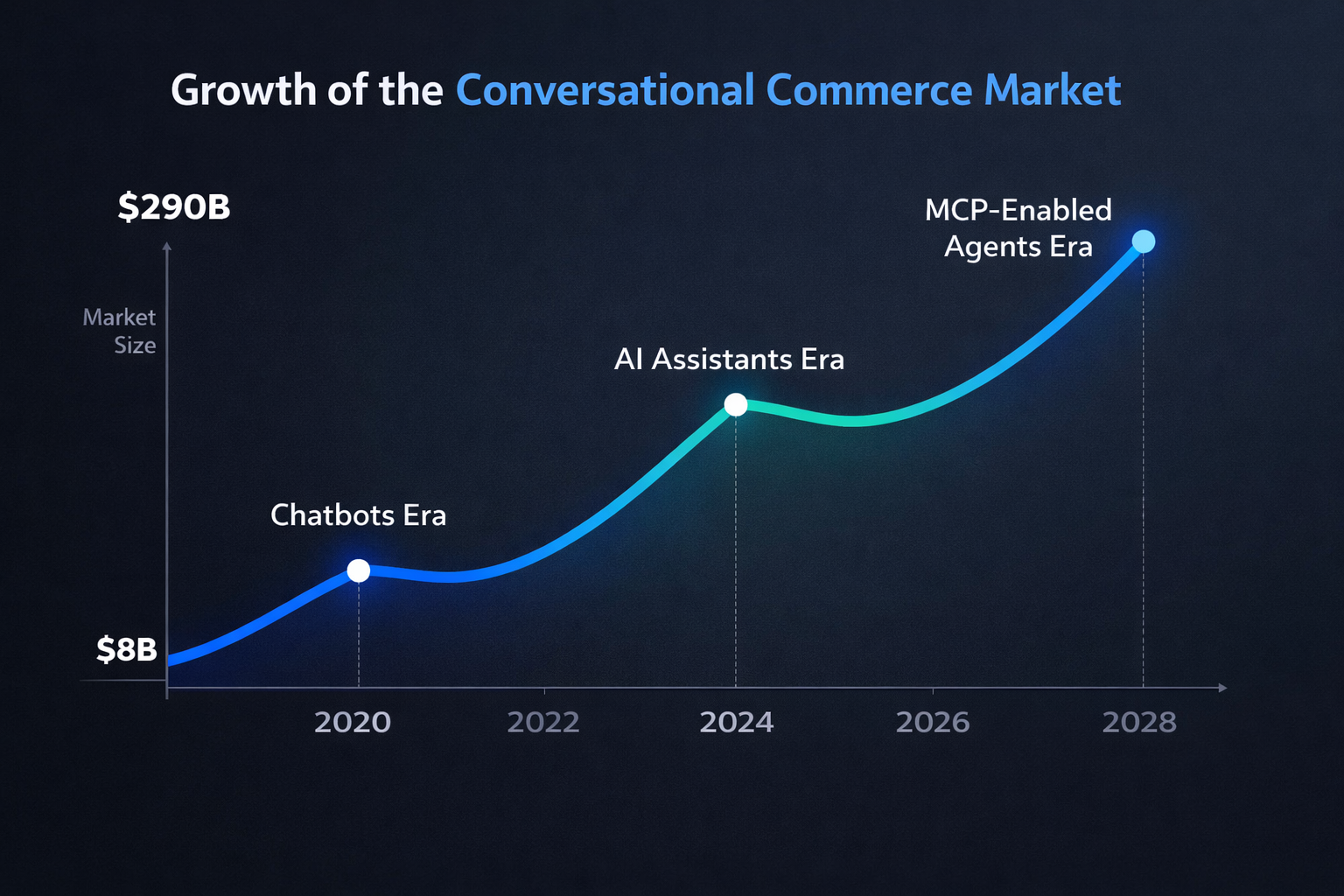 Figure: The conversational commerce market is experiencing exponential growth — from $8B in 2020 to a projected $290B by 2028 — driven by advances in AI reasoning, protocol standardization (MCP), and consumer preference for natural interactions.
Market Size and Growth
| Year | Market Size | Key Driver |
|---|---|---|
| 2020 | $8B | Basic chatbots, messaging commerce |
| 2022 | $18B | Improved NLP, WhatsApp Commerce |
| 2024 | $45B | GPT-era AI assistants |
| 2025 | $78B | MCP protocol, production AI agents |
| 2026 | $130B | Mainstream adoption, multi-modal |
| 2028 (projected) | $290B | AI-native commerce standard |
Consumer Preference Data
| Statistic | Value | Source Context |
|---|---|---|
| Consumers preferring chat over phone for support | 73% | Growing annually |
| Shoppers who want personalized recommendations | 80% | Across all demographics |
| Millennials/Gen Z preferring messaging to browse | 65% | Highest in 18–35 age group |
| Customers willing to buy through chat | 47% | Up from 18% in 2022 |
| Businesses planning conversational AI investment | 85% | Within next 2 years |
| Consumers who've abandoned due to poor search | 68% | Would have bought with better discovery |
Conversational Commerce Across Channels
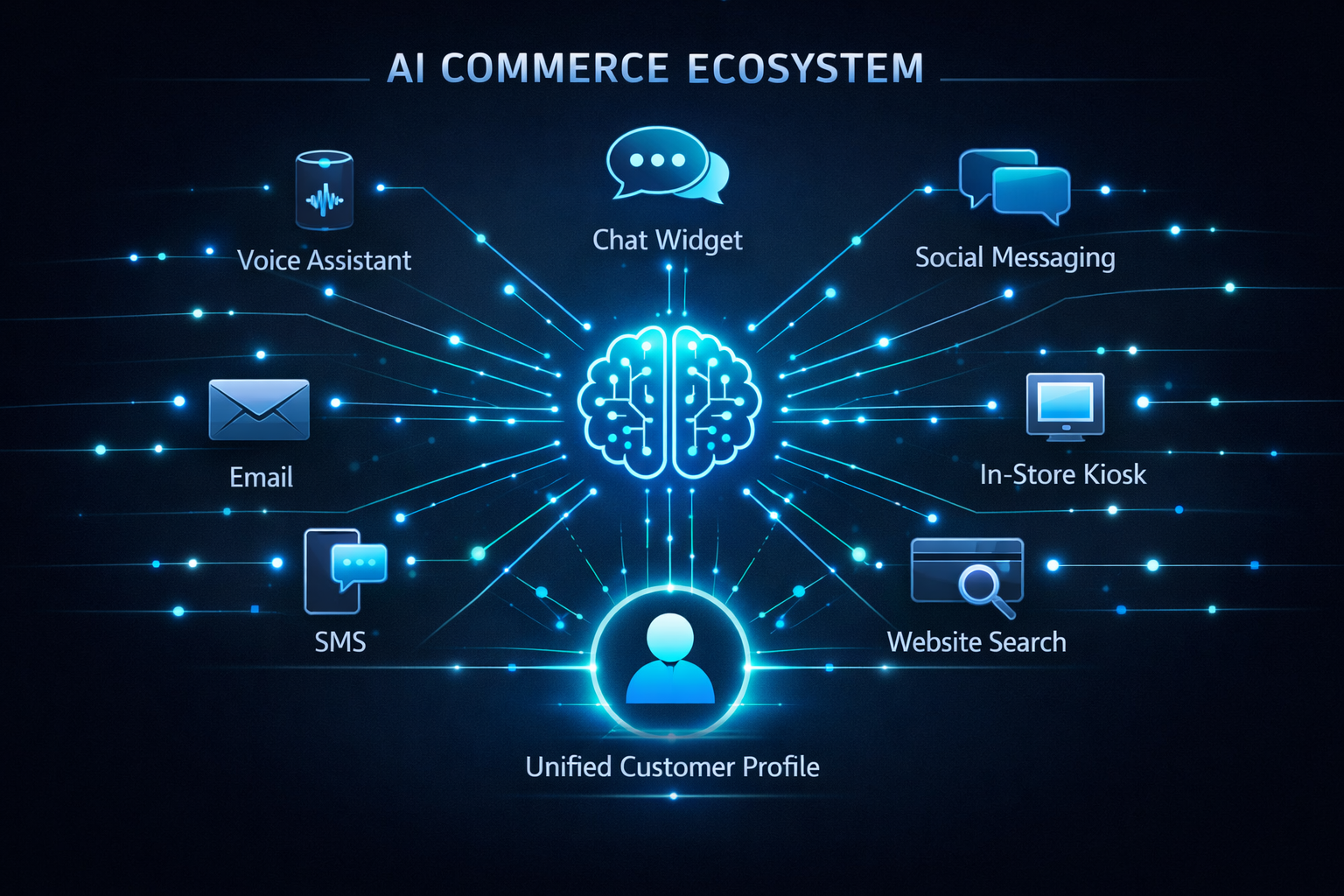 Figure: A unified AI commerce agent connects across all customer touchpoints — web chat, voice, social messaging, email, SMS, and in-store — maintaining consistent context and personalization everywhere.
Channel Comparison
| Channel | Best For | Conversion Rate | Customer Preference |
|---|---|---|---|
| Website chat widget | Active shoppers, product questions | 8–12% | High for desktop users |
| WhatsApp/Messenger | Re-engagement, reorders | 10–15% | Highest in mobile-first markets |
| Voice (Alexa, Google) | Reorders, simple queries | 5–8% | Growing for hands-free scenarios |
| SMS | Proactive outreach, time-sensitive | 12–18% | High open rates (98%) |
| Personalized recommendations | 3–5% | Best for considered purchases | |
| In-store kiosk | Product finding, availability | 15–20% | Reduces staff dependency |
| Social DMs | Discovery, impulse purchases | 6–10% | Gen Z preferred channel |
The key insight: one AI agent, trained once, deployed everywhere — maintaining consistent knowledge and personality across all channels.
The Role of AI Models in Conversational Commerce
Not all AI models are equal for commerce applications. The choice of model significantly impacts the quality of conversational commerce experiences.
For a detailed comparison of how different AI models perform in ecommerce contexts, see our analysis: Claude vs ChatGPT for Shopify MCP: Which AI Is Better for Ecommerce Automation?
Quick Model Comparison for Commerce
| Capability | Best Model Choice | Why |
|---|---|---|
| Customer-facing conversations | ChatGPT / GPT-4o | Natural, engaging dialogue |
| Complex product reasoning | Claude | Careful, accurate analysis |
| Backend workflow orchestration | Claude | Structured, reliable execution |
| Multi-modal (image + text) | GPT-4o / Gemini | Visual product understanding |
| Cost-sensitive high-volume | DeepSeek / Gemini Flash | Efficient for simple queries |
| Full-stack commerce agent | Multi-model architecture | Best of each for different tasks |
Many production conversational commerce systems use a multi-model approach — routing different types of queries to the most appropriate model for cost and quality optimization.
How Shopify MCP Enables Conversational Commerce
The Model Context Protocol (MCP) is the infrastructure layer that makes production-grade conversational commerce possible on Shopify.
Without MCP, building a conversational commerce agent requires:
- Custom API integrations for every data source
- Complex middleware for security and authentication
- Manual data formatting for AI consumption
- Ongoing maintenance as APIs change
With MCP:
- Standardized connection to all Shopify data
- Secure, authenticated access out of the box
- AI-optimized data formatting
- Protocol-level maintenance (not per-store)
What MCP Gives a Commerce Agent
| MCP Capability | Commerce Application | Customer Experience |
|---|---|---|
| Product catalog access | Real-time product knowledge | Always accurate recommendations |
| Inventory checking | Live stock awareness | Never recommends out-of-stock items |
| Customer history | Purchase and preference context | Personalized from first interaction |
| Order management | Create, modify, track orders | Complete transactions in chat |
| Collection browsing | Category understanding | Natural navigation assistance |
| Price/variant access | Size, color, pricing awareness | Accurate, complete information |
This is why implementing AI agents on Shopify is becoming increasingly accessible — the protocol layer handles the complex integration work.
Conversational Commerce vs. Traditional Tools
Many merchants currently use separate tools for functions that conversational commerce can unify. For a detailed analysis of how MCP-powered agents can replace multiple SaaS tools, see our comprehensive breakdown.
Quick Comparison
| Function | Traditional Tool | Conversational Commerce Agent |
|---|---|---|
| Product discovery | Quiz apps ($39–$99/mo) | Natural language exploration |
| Customer chat | Chat apps ($49–$149/mo) | Intelligent, store-aware conversations |
| Recommendations | Rec engines ($79–$199/mo) | Context-aware, reasoning-based suggestions |
| Support | Help desk ($89–$249/mo) | Automated resolution with full store access |
| Search | Search tools ($49–$149/mo) | Intent-based natural language search |
| Total monthly cost | $305–$845 | $150–$350 (unified system) |
Implementation Roadmap
For merchants ready to explore conversational commerce, here's a phased approach:
Phase 1: Foundation (Month 1–2)
| Task | Details | Investment |
|---|---|---|
| Audit current customer journey | Identify friction points, common questions | Time only |
| Evaluate AI readiness | Catalog quality, data structure | Time only |
| Choose AI model strategy | Single vs. multi-model (see comparison) | Research |
| Set up MCP infrastructure | Connect AI to store data | $500–$2,000 |
Phase 2: MVP Launch (Month 2–4)
| Task | Details | Investment |
|---|---|---|
| Deploy basic commerce agent | Product Q&A, simple recommendations | $1,000–$3,000 |
| Train on product catalog | Ensure accurate knowledge | Time + compute |
| Add to website as chat widget | Primary channel deployment | Included |
| Monitor and iterate | Track conversations, improve responses | Ongoing |
Phase 3: Full Conversational Commerce (Month 4–8)
| Task | Details | Investment |
|---|---|---|
| Enable transactional capabilities | Cart building, checkout in chat | $1,000–$2,000 |
| Add proactive engagement | Trigger-based outreach | $500–$1,000 |
| Multi-channel deployment | SMS, social, email | $500–$1,500 |
| Advanced personalization | Individual customer models | $1,000–$2,000 |
Expected ROI Timeline
| Month | Status | Expected Impact |
|---|---|---|
| Month 1–2 | Setup + learning | Investment phase |
| Month 3 | Basic agent live | 5–10% support cost reduction |
| Month 4–5 | Transactional capabilities | 10–20% conversion lift on engaged users |
| Month 6–8 | Full deployment | 25–40% support automation, 15–30% AOV increase |
| Month 9–12 | Optimization | 3–5x ROI on investment |
The Future: What's Coming Next
Conversational commerce is still early. Here's what the next 2–3 years likely bring:
| Timeline | Development | Impact |
|---|---|---|
| 2026 H2 | Multi-modal agents (text + image + voice) | Customers can show photos, get visual recommendations |
| 2027 H1 | Predictive commerce | AI initiates purchases before customers ask |
| 2027 H2 | Cross-store agents | One AI shops across multiple stores for best options |
| 2028 | Autonomous commerce | AI manages routine purchases entirely (groceries, supplies) |
| 2028+ | AR/VR conversational shopping | Spatial commerce with AI guides |
The Search Paradigm Shift
Perhaps the most significant long-term impact: conversational commerce will change how people search for products entirely.
| Current Behavior | Future Behavior |
|---|---|
| Google "best running shoes 2026" | Ask AI agent "I need shoes for my marathon training" |
| Browse Amazon category pages | Tell agent your needs, get curated options |
| Read 10 review articles | Agent synthesizes reviews + your preferences |
| Compare products in spreadsheets | Agent explains trade-offs in conversation |
| Visit 5 stores to compare prices | Agent checks availability and pricing across sources |
This is why positioning for conversational commerce now matters — it's not just a feature, it's the future interface of online shopping.
Key Takeaways
| Insight | Detail |
|---|---|
| What conversational commerce is | AI-powered shopping through natural language instead of browse-and-click |
| Market size (2026) | $130B and growing rapidly |
| Conversion improvement | 3–5x over traditional ecommerce |
| Key enabler | Shopify MCP for store-aware AI agents |
| Best AI approach | Multi-model architecture for different commerce tasks |
| Implementation timeline | 4–8 months for full deployment |
| ROI expectation | 3–5x within 12 months |
| Biggest opportunity | Stores with complex products, high support volume, or discovery-heavy catalogs |
Start Building Your Conversational Commerce Strategy
The merchants who implement conversational commerce infrastructure today will have compounding advantages as AI-native shopping becomes the standard.
At Shopify Agent AI, we help stores implement production-grade AI agents powered by Shopify MCP — turning your store into a conversational commerce experience that converts, supports, and delights customers through natural language.
Book a Discovery Call to explore how conversational commerce could transform your store's customer experience and revenue.
Related Reading
Explore the technologies and strategies powering conversational commerce:
- What Is Shopify MCP? — The protocol layer that gives AI agents real-time access to store data for conversational experiences.
- Claude vs ChatGPT for Shopify MCP — Which AI model is best for customer-facing vs. backend commerce applications?
- AI Agents for Shopify: Implementation Guide — What implementation looks like in practice — from audit to deployment.
- How Shopify MCP Could Replace Multiple SaaS Tools — How conversational commerce consolidates quiz apps, chat, search, and recommendations.
- How Much Can Small E-Commerce Companies Save? — The financial case for switching to AI-powered commerce systems.
- The Shift from SEO to GEO — How generative engine optimization is changing product discovery and brand visibility.
Related Reading
What Is Shopify MCP? The New AI Layer That Could Change How Shopify Stores Operate
Learn what Shopify MCP (Model Context Protocol) is, how it works, and why it could transform how Shopify stores use AI agents for customer support, sales, and automation.
Read articleThe Shift from SEO to GEO: Why Generative Engine Optimization Is the Future of Ecommerce Visibility
Traditional SEO is losing ground to AI-powered search. Learn how Generative Engine Optimization (GEO) works, the technical implementation details including structured data and entity structuring, and why Shopify stores that don't adapt will become invisible.
Read articleClaude vs ChatGPT for Shopify MCP: Which AI Is Better for Ecommerce Automation?
Compare Claude and ChatGPT for Shopify MCP integrations. Detailed analysis of strengths, use cases, context windows, and why the future of ecommerce AI is multi-model.
Read articleReady to Optimize Your Store for AI?
Get a personalized AI readiness audit and discover how your Shopify store can leverage AI agents, MCP integrations, and automation to drive growth.