Claude vs ChatGPT for Shopify MCP: Which AI Is Better for Ecommerce Automation?
The rise of Shopify MCP (Model Context Protocol) is changing how AI systems interact with ecommerce stores. Instead of acting like simple chatbots, AI models can now connect directly to Shopify environments, tools, and workflows — opening the door to true AI-powered commerce agents.
But one question keeps coming up:
Which AI model is actually better for Shopify MCP integrations — Claude or ChatGPT?
The answer depends heavily on what you're trying to build. Both models are extremely capable, but they currently excel in different areas of ecommerce AI infrastructure.
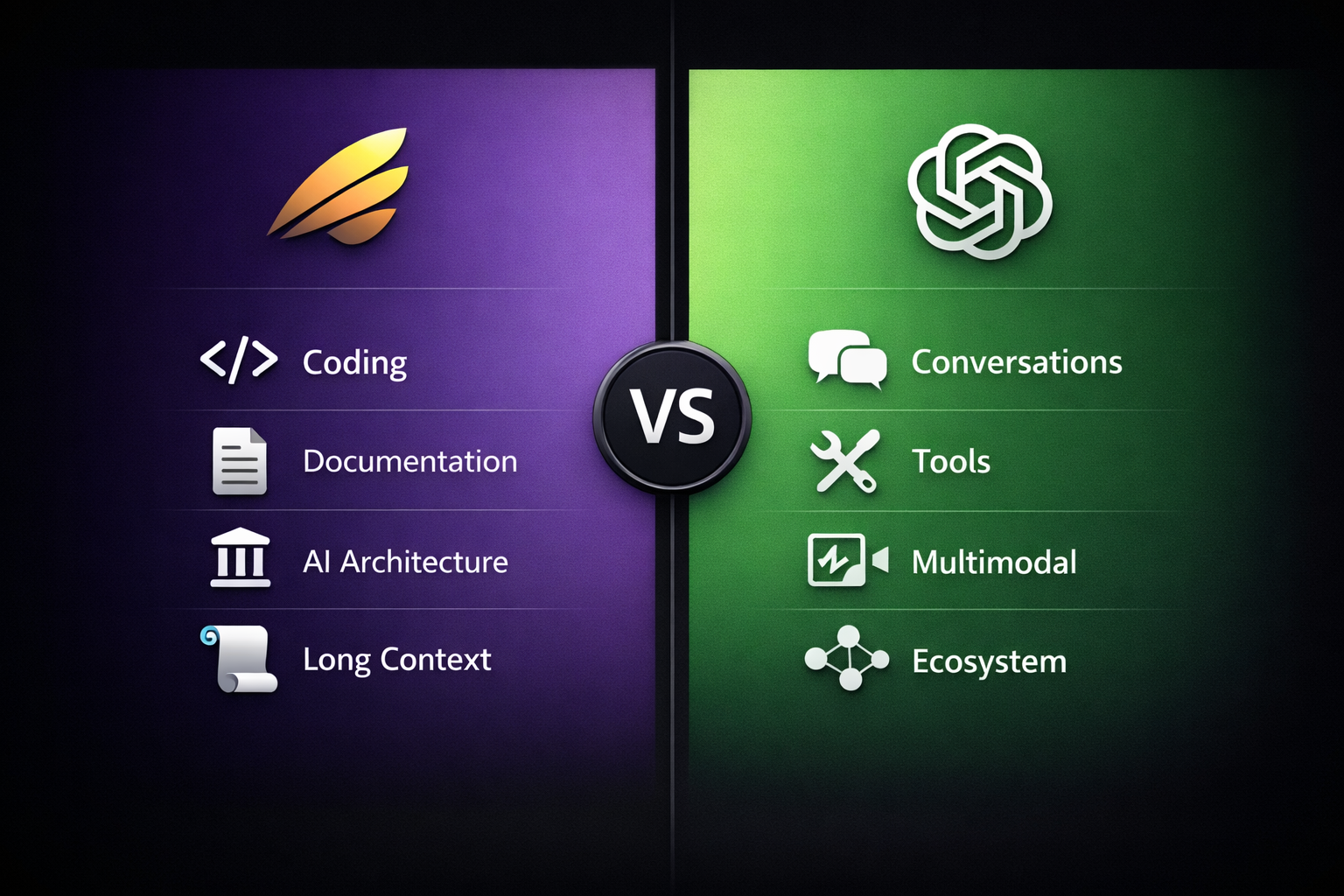 Figure: Claude and ChatGPT bring different strengths to Shopify MCP implementations — understanding these differences is key to choosing the right model for your use case.
What Is Shopify MCP?
Shopify MCP (Model Context Protocol) allows AI systems to securely communicate with Shopify stores and related tools.
This enables AI agents to:
- Access product catalogs
- Understand inventory
- Assist with customer support
- Trigger workflows
- Recommend products
- Build carts
- Interact with APIs
- Connect with backend systems
Instead of static chatbot flows, MCP creates a framework for AI agents that can actively work within ecommerce ecosystems — enabling true conversational commerce.
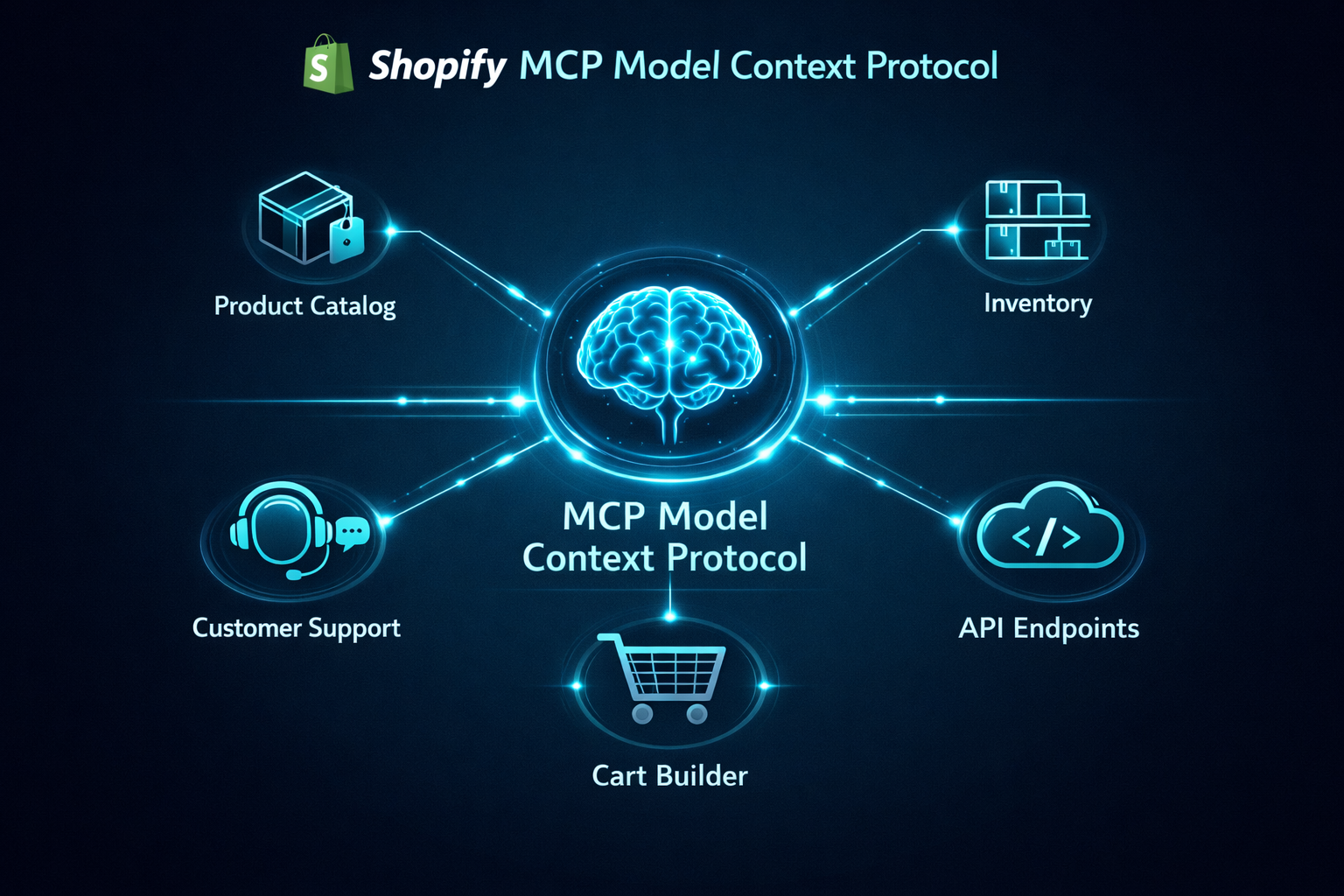 Figure: Shopify MCP architecture — AI models connect to store systems through a structured protocol layer enabling real-time commerce interactions.
Claude vs ChatGPT: Core Strengths Comparison
| Capability | Claude | ChatGPT |
|---|---|---|
| Long-context reasoning | ★★★★★ | ★★★☆☆ |
| Structured analysis | ★★★★★ | ★★★★☆ |
| Technical documentation | ★★★★★ | ★★★★☆ |
| Multi-step workflow understanding | ★★★★★ | ★★★★☆ |
| Large codebase interpretation | ★★★★★ | ★★★☆☆ |
| Instruction following | ★★★★★ | ★★★★☆ |
| Tool integration ecosystems | ★★★☆☆ | ★★★★★ |
| Real-time usability | ★★★★☆ | ★★★★★ |
| Multimodal interaction | ★★★☆☆ | ★★★★★ |
| Conversational fluidity | ★★★★☆ | ★★★★★ |
| Faster iteration workflows | ★★★☆☆ | ★★★★★ |
| Broader integration flexibility | ★★★☆☆ | ★★★★★ |
For Shopify MCP specifically, those differences matter quite a bit depending on whether you're building backend infrastructure or customer-facing experiences.
Why Claude Is Strong for Shopify MCP
Claude has become popular among developers because of its impressive context handling and architectural reasoning.
For complex Shopify MCP environments, Claude often performs extremely well when:
- Reading large implementation docs
- Understanding workflow logic
- Mapping backend systems
- Writing structured code
- Analyzing API relationships
- Managing long technical conversations
Claude's Best Shopify MCP Use Cases
| Use Case | Why Claude Excels |
|---|---|
| Architecture planning | Handles complex system diagrams and multi-layer dependencies |
| Workflow orchestration | Reasons through multi-step automation logic with precision |
| API documentation analysis | Processes large API specs without losing context |
| Backend system mapping | Understands relationships between inventory, orders, and fulfillment |
| Implementation debugging | Methodical approach to identifying integration issues |
| Technical documentation | Produces clear, structured technical guides |
This makes Claude particularly attractive for:
- Developers building MCP servers
- Technical architects designing AI commerce systems
- Backend workflow design and orchestration
- Infrastructure planning and documentation
Key insight: Claude feels highly methodical and detail-oriented — ideal for the engineering phase of MCP implementations.
Why ChatGPT Is Strong for Shopify MCP
ChatGPT currently has advantages in ecosystem maturity and real-world deployment flexibility.
Particularly important strengths:
- Tool integrations and plugin ecosystem
- Agent frameworks (GPTs, Assistants API)
- Multimodal support (voice, vision, browsing)
- Custom GPT workflows
- Broad third-party compatibility
- Faster consumer-facing experiences
ChatGPT's Best Shopify MCP Use Cases
| Use Case | Why ChatGPT Excels |
|---|---|
| Conversational commerce | Natural, fluid shopping conversations that feel human |
| AI shopping assistants | Multimodal product discovery with images and voice |
| Customer-facing agents | Polished UX with real-time responsiveness |
| Support experiences | Broad tool access for order lookups, returns, tracking |
| Dynamic storefront interactions | Seamless integration with existing commerce tools |
| Rapid prototyping | Faster iteration on customer-facing AI features |
For Shopify merchants, ChatGPT often feels more operationally flexible for front-of-house experiences.
Key insight: ChatGPT shines in customer-facing deployment — where conversational fluidity and ecosystem integrations matter most.
Context Window: A Critical Factor for Ecommerce AI
One major factor in Shopify MCP environments is context length. AI agents may need to understand:
| Data Type | Typical Size | Why It Matters |
|---|---|---|
| Product catalogs | 50K–500K+ tokens | AI must reason across entire inventory |
| Customer histories | 10K–100K tokens | Personalization requires full purchase context |
| Workflow documentation | 20K–200K tokens | Complex automation logic needs full visibility |
| Product metadata | 30K–300K tokens | Attributes, variants, SEO data for recommendations |
| Operational logic | 15K–100K tokens | Business rules, shipping logic, pricing tiers |
| Support documentation | 25K–250K tokens | FAQs, policies, return procedures |
Context Window Comparison
| Model | Effective Context Window | Best For |
|---|---|---|
| Claude 3.5 Sonnet | 200K tokens | Enterprise catalogs, full documentation analysis |
| Claude 3 Opus | 200K tokens | Complex reasoning over large codebases |
| GPT-4o | 128K tokens | Balanced performance with multimodal support |
| GPT-4 Turbo | 128K tokens | Cost-effective large context processing |
Claude has built a strong reputation for handling very large context windows effectively — a major advantage for enterprise ecommerce systems with large product catalogs and complex technical implementations.
However, ChatGPT continues improving rapidly in this area while offering broader ecosystem tooling.
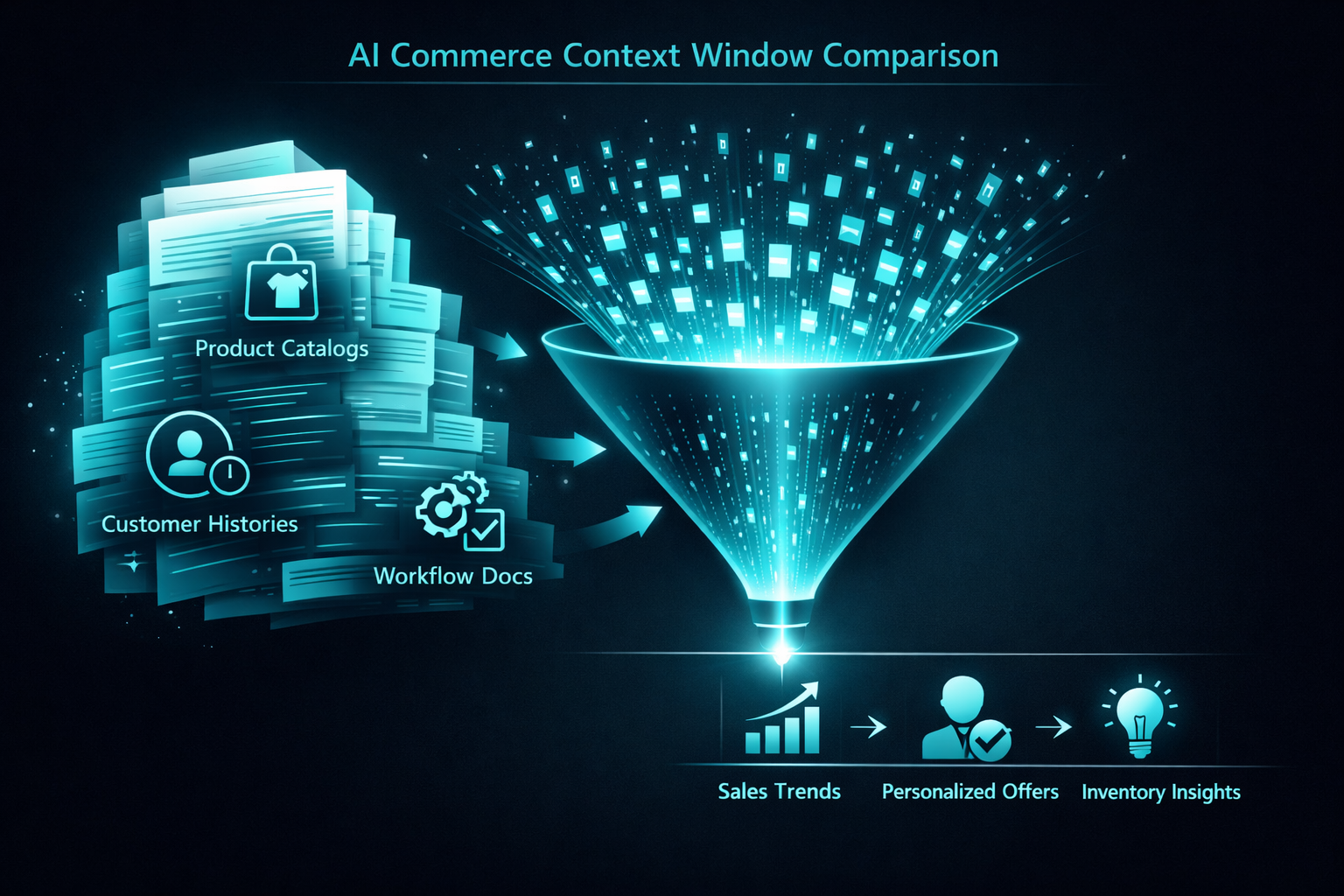 Figure: Ecommerce AI agents must process massive amounts of store data — product catalogs, customer histories, and operational documentation — making context window capacity a critical differentiator.
Customer-Facing AI Shopping Agents: Which Wins?
For customer-facing AI shopping assistants, the comparison breaks down like this:
| Factor | Claude | ChatGPT | Winner |
|---|---|---|---|
| Conversational fluidity | Good | Excellent | ChatGPT |
| Response speed | Fast | Very fast | ChatGPT |
| Multimodal (voice/vision) | Limited | Full support | ChatGPT |
| Consumer UX polish | Good | Excellent | ChatGPT |
| Accuracy on complex queries | Excellent | Good | Claude |
| Handling edge cases | Excellent | Good | Claude |
| Tool use ecosystem | Growing | Mature | ChatGPT |
Verdict: If your goal is "Create an AI shopping assistant customers interact with directly" — ChatGPT currently has a strong edge in user-facing experiences, especially when combined with voice, vision, browsing, and dynamic tool use.
Technical Shopify MCP Development: Which Wins?
For backend development and MCP infrastructure:
| Factor | Claude | ChatGPT | Winner |
|---|---|---|---|
| Debugging complex integrations | Excellent | Good | Claude |
| Technical writing | Excellent | Good | Claude |
| API architecture design | Excellent | Good | Claude |
| Structured reasoning | Excellent | Good | Claude |
| Long implementation sessions | Excellent | Moderate | Claude |
| Code generation quality | Excellent | Very good | Claude |
| Rapid prototyping | Good | Excellent | ChatGPT |
| Ecosystem integrations | Moderate | Excellent | ChatGPT |
Verdict: For backend systems, workflow orchestration, long technical implementation sessions, and architecture planning — Claude often performs exceptionally well. Many developers prefer Claude for the planning and engineering phases of MCP implementations.
The Real Answer: Multi-Model AI Stacks
This is where ecommerce AI infrastructure is heading. Instead of choosing Claude OR ChatGPT, many companies will use Claude AND ChatGPT.
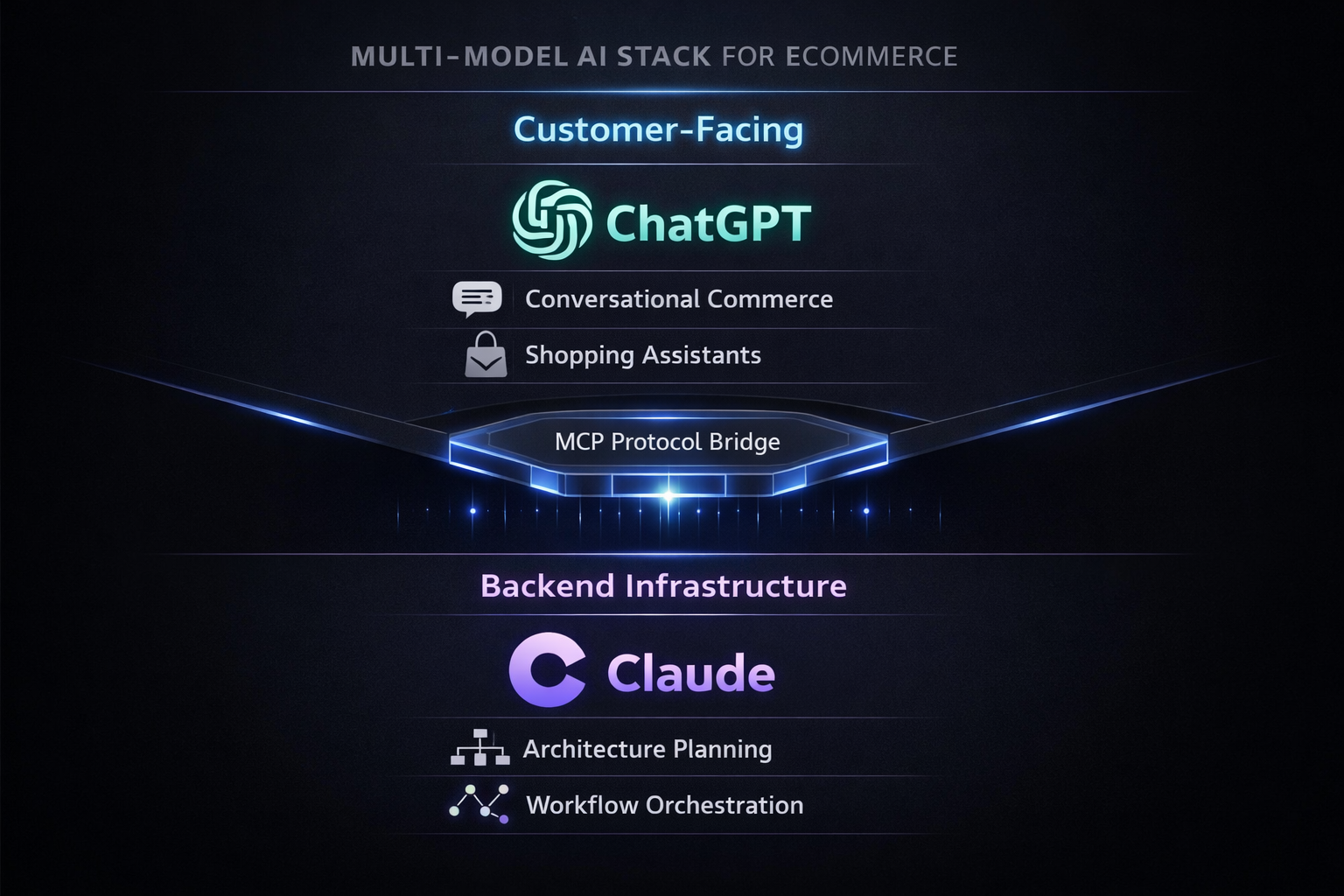 Figure: The future ecommerce AI stack is multi-model — ChatGPT handles customer-facing interactions while Claude powers backend infrastructure, connected through the MCP protocol layer.
Recommended Multi-Model Architecture
| Layer | Model | Responsibility |
|---|---|---|
| Customer-facing agents | ChatGPT | Conversational commerce, shopping assistants, support |
| Backend infrastructure | Claude | Architecture planning, workflow reasoning, implementation |
| MCP protocol bridge | Both | Secure communication between AI and Shopify systems |
| Documentation & analysis | Claude | Technical docs, API analysis, system mapping |
| Operational integrations | ChatGPT | Third-party tools, multimodal experiences, rapid deployment |
Cost-Efficiency Comparison
| Metric | Claude (Sonnet) | ChatGPT (GPT-4o) | Notes |
|---|---|---|---|
| Input cost (per 1M tokens) | ~$3.00 | ~$2.50 | Similar pricing tier |
| Output cost (per 1M tokens) | ~$15.00 | ~$10.00 | ChatGPT slightly cheaper |
| Context utilization efficiency | Higher | Moderate | Claude uses large contexts better |
| Batch processing cost | Lower for large docs | Lower for many small requests | Depends on workload pattern |
| Best value for MCP | Backend/planning | Customer-facing/ops | Use both strategically |
Shopify MCP Is Bigger Than One Model
The more important shift isn't necessarily which AI wins — it's that ecommerce systems are becoming AI-native.
Shopify MCP represents a major move toward:
- Conversational commerce
- Intelligent storefronts
- AI-driven customer journeys
- Agentic ecommerce systems
AI Commerce Adoption Timeline
| Phase | Timeline | What Happens |
|---|---|---|
| Phase 1: Experimentation | 2024–2025 | Early adopters test MCP integrations |
| Phase 2: Infrastructure | 2025–2026 | Multi-model stacks become standard |
| Phase 3: Mainstream | 2026–2027 | Plug-and-play AI agents for all merchants |
| Phase 4: AI-Native Commerce | 2027+ | Stores designed around AI-first experiences |
The brands experimenting now are positioning themselves early for a potentially massive transformation in online retail.
Decision Framework: Choosing Your AI Model
Use this framework to decide which model fits your Shopify MCP project:
| If You Need... | Choose | Reason |
|---|---|---|
| Customer-facing shopping assistant | ChatGPT | Better conversational UX, multimodal |
| Backend MCP server development | Claude | Superior long-context reasoning |
| Technical architecture planning | Claude | Methodical, detail-oriented analysis |
| Rapid prototype deployment | ChatGPT | Faster ecosystem integrations |
| Large catalog processing | Claude | Better context window utilization |
| Voice/visual commerce | ChatGPT | Full multimodal support |
| Complex workflow automation | Claude | Multi-step reasoning excellence |
| Third-party tool orchestration | ChatGPT | Broader integration ecosystem |
| Enterprise-scale implementation | Both | Multi-model stack for full coverage |
Final Thoughts
So — which AI is better for Shopify MCP?
Claude may currently have advantages in:
- Technical reasoning and long-context workflows
- Implementation architecture and code quality
- Backend system design and debugging
ChatGPT may currently have advantages in:
- Ecosystem integrations and tool use
- Customer-facing experiences and conversational commerce
- Operational flexibility and multimodal interactions
But the bigger takeaway is this:
AI commerce infrastructure is evolving extremely quickly. And Shopify MCP may become one of the foundational technologies powering the next generation of ecommerce experiences.
The stores building around these systems early could gain significant advantages in:
- Automation efficiency
- Personalization quality
- Operational cost reduction
- AI search visibility
- Conversational commerce readiness
Related Reading
Explore more about Shopify MCP and AI commerce infrastructure:
- What Is Shopify MCP? — A complete guide to Model Context Protocol and why it's transforming ecommerce.
- What Is Conversational Commerce? — How AI models power the future of natural language shopping experiences.
- AI Agents for Shopify: Implementation Guide — What AI agents do in practice and how implementation works.
- How Shopify MCP Could Replace Multiple SaaS Tools — See how AI consolidates your tool stack regardless of which model you choose.
- How Much Can Small E-Commerce Companies Save? — The financial impact of switching to AI-powered architectures.
- The Shift from SEO to GEO — How structured data and AI-optimized content determine which brands get cited in generative search.
← Back to Blog · ← Back to Home
Looking to Explore AI Agents for Shopify?
At Shopify Agent AI, we help Shopify stores implement AI-powered ecommerce systems, Shopify MCP integrations, conversational commerce workflows, and next-generation AI shopping experiences built for modern online retail.
Whether you need Claude for backend architecture or ChatGPT for customer-facing agents — or both — we can help you build the right multi-model AI stack for your store.
Book a Discovery Call to discuss how we can help your store leverage the power of Shopify MCP.
Related Reading
What Is Shopify MCP? The New AI Layer That Could Change How Shopify Stores Operate
Learn what Shopify MCP (Model Context Protocol) is, how it works, and why it could transform how Shopify stores use AI agents for customer support, sales, and automation.
Read articleThe Shift from SEO to GEO: Why Generative Engine Optimization Is the Future of Ecommerce Visibility
Traditional SEO is losing ground to AI-powered search. Learn how Generative Engine Optimization (GEO) works, the technical implementation details including structured data and entity structuring, and why Shopify stores that don't adapt will become invisible.
Read articleShopify MCP Installation Guide (Step-by-Step Setup for 2026)
Learn how to install Shopify MCP step-by-step. Connect Shopify, Claude, ChatGPT, analytics, CRM, support tools, and AI agents using Model Context Protocol.
Read articleReady to Optimize Your Store for AI?
Get a personalized AI readiness audit and discover how your Shopify store can leverage AI agents, MCP integrations, and automation to drive growth.