How Shopify MCP Could Replace Multiple Ecommerce SaaS Tools
If you run a Shopify store, you probably know the feeling.
Another monthly invoice. Another app update that breaks something. Another tool that doesn't quite talk to the others. Another subscription you're paying for but barely using.
SaaS fatigue is real — and it's costing ecommerce merchants thousands of dollars every month in overlapping tools, integration headaches, and operational friction.
But something is changing.
Shopify MCP (Model Context Protocol) could consolidate many of these disconnected tools into a single intelligent AI system.
Here's how — and why it matters for merchants who are tired of managing a bloated tech stack.
 Figure: The average Shopify merchant manages 6–12 separate SaaS subscriptions — each adding cost, complexity, and potential conflicts to their store.
The SaaS Stack Problem for Shopify Merchants
Most Shopify stores today rely on a patchwork of specialized tools:
| Tool Category | What It Does | Typical Monthly Cost | Common Pain Points |
|---|---|---|---|
| Quiz Apps | Product discovery, guided selling | $39–$99/mo | Limited AI, rigid flows, poor personalization |
| Chat Apps | Customer messaging, live chat | $49–$149/mo | Scripted responses, can't access store data |
| Recommendation Engines | Product suggestions, upsells | $79–$199/mo | Generic algorithms, no context awareness |
| Support Software | Tickets, FAQs, help desk | $89–$249/mo | Disconnected from store, manual workflows |
| Search Tools | Site search, filtering | $49–$149/mo | Keyword-only, no conversational understanding |
The Hidden Costs Add Up Fast
| Cost Category | Monthly Impact | Annual Impact |
|---|---|---|
| Combined SaaS subscriptions | $305–$845 | $3,660–$10,140 |
| Integration maintenance (dev hours) | $500–$2,000 | $6,000–$24,000 |
| App conflicts & site speed issues | Lost conversions | $5,000–$50,000+ |
| Data silos (no unified customer view) | Missed personalization | Unquantifiable |
| Staff time managing multiple dashboards | 10–20 hrs/week | $15,000–$30,000 |
| Total estimated annual cost | — | $29,660–$114,140+ |
That's not just expensive — it's operationally exhausting.
And for small-to-mid-size merchants, it's often unsustainable.
What Shopify MCP Changes
Shopify MCP (Model Context Protocol) creates a standardized bridge between AI systems and your Shopify store. Understanding how MCP integration works is key to seeing why consolidation is now possible.
Instead of each tool operating in isolation, an MCP-connected AI agent can potentially:
- Access your full product catalog
- Understand customer context
- Handle support conversations
- Recommend products intelligently
- Guide product discovery
- Search your store conversationally
- Trigger workflows and automations
- Connect to backend systems
One intelligent system. Multiple capabilities. No app conflicts.
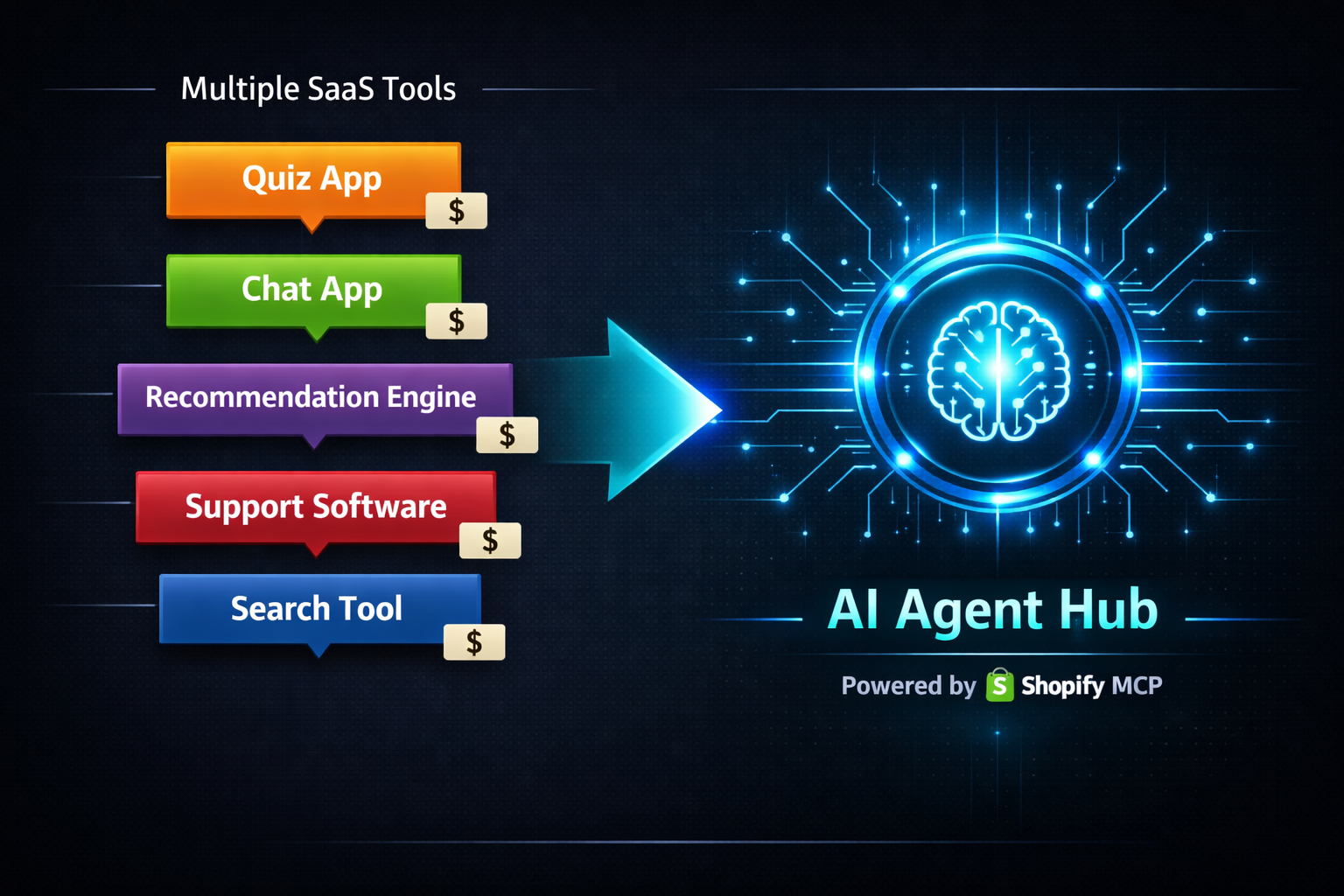 Figure: Shopify MCP enables a single AI agent to consolidate the capabilities of multiple disconnected SaaS tools into one unified system.
Tool-by-Tool Replacement Analysis
Let's look at how an MCP-powered AI agent could replace or enhance each category of tool.
1. Quiz Apps → AI-Powered Product Discovery
Traditional quiz apps use rigid decision trees:
- Pre-built question flows
- Limited branching logic
- Static recommendations
- No learning or adaptation
- Break when inventory changes
MCP-enabled AI agents offer dynamic discovery:
- Natural language conversations
- Real-time catalog awareness
- Contextual recommendations based on actual inventory
- Learns from customer interactions
- Adapts to new products automatically
| Feature | Quiz Apps | MCP AI Agent |
|---|---|---|
| Question flexibility | Fixed flows | Dynamic, conversational |
| Product awareness | Manual mapping | Real-time catalog access |
| Personalization depth | Basic (3–5 questions) | Deep (full conversation context) |
| Inventory awareness | None or delayed | Live stock checking |
| Maintenance required | High (rebuild flows) | Low (self-adapting) |
| Customer experience | Formulaic | Natural, engaging |
2. Chat Apps → Intelligent Conversational Commerce
Traditional chat apps are limited:
- Scripted responses and canned replies
- Can't access order data in real time
- Require human agents for complex queries
- No product knowledge beyond FAQs
- Break when conversations go off-script
MCP-enabled AI agents are contextual:
- Access live order, product, and customer data
- Handle complex multi-step requests
- Build carts, check inventory, process returns
- Understand nuanced questions
- Maintain conversation context across sessions
| Feature | Chat Apps | MCP AI Agent |
|---|---|---|
| Data access | None (or limited API) | Full store access via MCP |
| Complex queries | Fails or escalates | Handles independently |
| Cart building | Not possible | Native capability |
| Order lookups | Manual or basic | Instant, contextual |
| Conversation memory | Session-only | Persistent context |
| Human escalation needed | Frequently | Rarely |
3. Recommendation Engines → Contextual AI Suggestions
Traditional recommendation engines use basic algorithms:
- Collaborative filtering ("customers also bought")
- Rule-based upsells
- No understanding of customer intent
- Generic, often irrelevant suggestions
- Require manual merchandising rules
MCP-enabled AI agents understand context:
- Reason about why a customer wants something
- Consider budget, style, use case
- Cross-reference inventory availability
- Explain recommendations naturally
- Adapt in real time to conversation flow
| Feature | Recommendation Engines | MCP AI Agent |
|---|---|---|
| Understanding intent | None | Deep contextual reasoning |
| Explanation ability | None ("you might like") | Natural ("Based on your apartment size...") |
| Real-time adaptation | Slow (batch updates) | Instant |
| Cross-selling intelligence | Rule-based | Reasoning-based |
| Inventory awareness | Often delayed | Live |
| Customer trust | Low (feels generic) | High (feels personalized) |
4. Support Software → AI-Native Customer Service
Traditional support software creates friction:
- Ticket systems with slow response times
- FAQ pages customers don't read
- Canned responses that feel robotic
- Disconnected from store operations
- Expensive human agent staffing
MCP-enabled AI agents resolve issues:
- Instant responses with full store context
- Look up orders, track shipments, process returns
- Understand policies and apply them correctly
- Handle edge cases with reasoning
- Escalate only when truly necessary
| Feature | Support Software | MCP AI Agent |
|---|---|---|
| Response time | Hours (tickets) | Seconds |
| Store data access | Limited or none | Full access |
| Return processing | Manual workflow | Automated with reasoning |
| Policy application | Rigid rules | Contextual understanding |
| Cost per interaction | $5–$15 (human) | $0.01–$0.10 (AI) |
| 24/7 availability | Requires staffing | Always on |
| Customer satisfaction | Variable | Consistently high |
5. Search Tools → Conversational Product Search
Traditional search tools are keyword-limited:
- Exact match or basic fuzzy matching
- No understanding of natural language
- Can't handle complex queries
- Filter-based, not intent-based
- Poor results for descriptive searches
MCP-enabled AI agents understand language:
- Process natural language queries
- Understand intent, not just keywords
- Handle complex, multi-attribute searches
- Conversational refinement
- Context-aware results
| Feature | Search Tools | MCP AI Agent |
|---|---|---|
| Query type | Keywords only | Natural language |
| Complex queries | Fails | Handles naturally |
| Intent understanding | None | Deep |
| Refinement | Filters only | Conversational |
| Zero-result handling | Dead end | Suggests alternatives |
| Personalization | Basic | Full context awareness |
The Cost Comparison
Here's what the numbers could look like for a typical mid-size Shopify store:
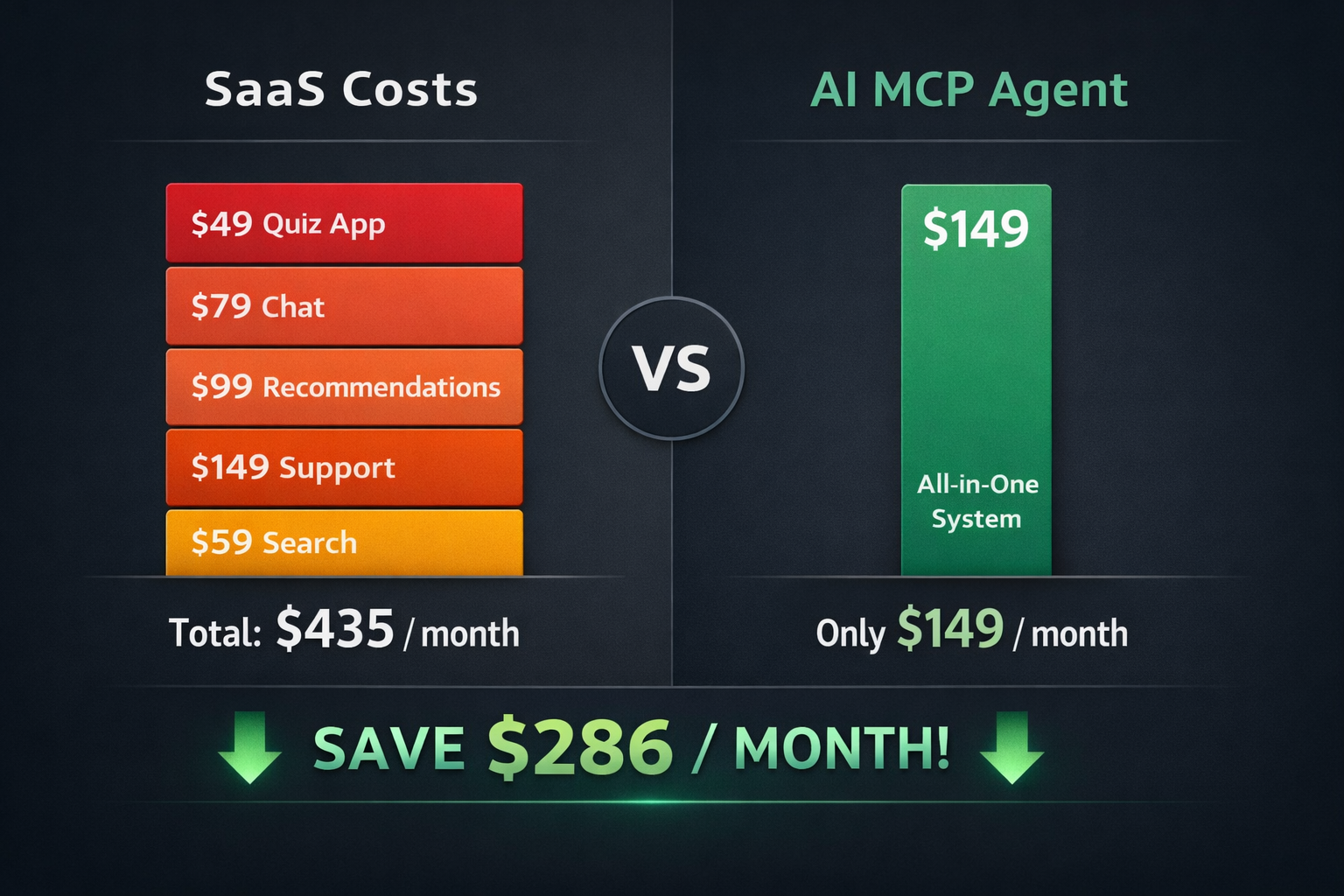 Figure: Consolidating five separate SaaS tools into one MCP-powered AI agent could reduce monthly software costs by 60–80% while improving capabilities.
Monthly Cost Breakdown
| Approach | Tools | Monthly Cost | Annual Cost |
|---|---|---|---|
| Traditional SaaS Stack | 5 separate tools | $435–$845 | $5,220–$10,140 |
| MCP AI Agent System | 1 unified system | $150–$350 | $1,800–$4,200 |
| Potential Savings | — | $285–$495/mo | $3,420–$5,940/year |
Total Cost of Ownership (Including Hidden Costs)
| Cost Factor | Traditional Stack | MCP AI System | Savings |
|---|---|---|---|
| Software subscriptions | $435–$845/mo | $150–$350/mo | 60–75% |
| Integration maintenance | $500–$2,000/mo | $0–$200/mo | 80–100% |
| Staff dashboard management | 15 hrs/week | 2 hrs/week | 87% |
| App conflict resolution | $200–$1,000/mo | $0 | 100% |
| Site speed impact | -0.5 to -2s load time | Minimal impact | Significant |
| Total monthly cost | $1,135–$3,845 | $150–$550 | 65–85% |
Why This Matters Now
Three converging trends make this shift increasingly relevant:
1. AI Model Capabilities Are Exploding
The choice between Claude and ChatGPT matters less than the overall trajectory — both are becoming powerful enough for full tool consolidation.
| Year | AI Capability Level | Ecommerce Impact |
|---|---|---|
| 2023 | Basic chatbots, simple automation | Limited replacement potential |
| 2024 | Advanced reasoning, tool use | Partial tool consolidation possible |
| 2025 | Multi-step agents, MCP protocol | Full tool replacement becoming viable |
| 2026 | Production-grade AI agents | Enterprise-ready consolidation |
2. SaaS Pricing Is Increasing
Most ecommerce SaaS tools have raised prices 15–30% over the past two years. Meanwhile, AI inference costs have dropped 80–90% in the same period. For a detailed cost analysis, see our breakdown of how much small ecommerce companies can save.
| Trend | Direction | Impact on Merchants |
|---|---|---|
| SaaS subscription costs | ↑ Rising 15–30%/year | Increasing operational burden |
| AI inference costs | ↓ Dropping 80–90%/year | AI alternatives becoming cheaper |
| Integration complexity | ↑ More tools = more conflicts | Growing maintenance overhead |
| Customer expectations | ↑ Expecting instant, personalized | Traditional tools falling behind |
3. Shopify MCP Creates the Infrastructure
Without MCP, connecting AI to Shopify required:
- Custom API development
- Complex middleware
- Security engineering
- Ongoing maintenance
With MCP, the connection layer is standardized — making AI agent deployment dramatically simpler.
What a Unified AI Commerce System Looks Like
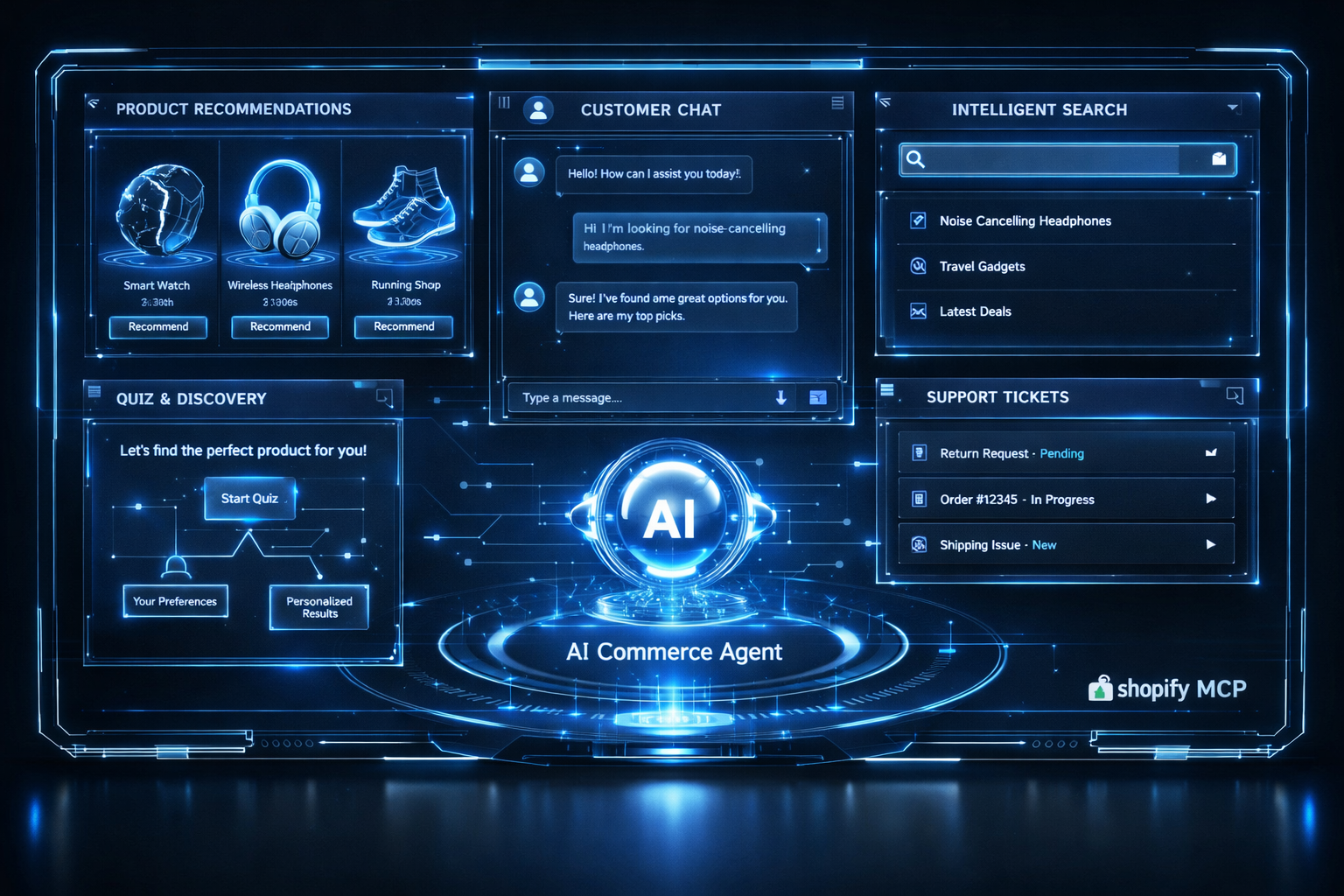 Figure: A unified AI commerce system powered by Shopify MCP — one intelligent agent handling product discovery, customer support, recommendations, search, and guided selling from a single interface.
Capabilities of a Unified MCP Agent
| Capability | Replaces | How It Works |
|---|---|---|
| Guided product discovery | Quiz apps | Conversational exploration based on customer needs |
| Intelligent chat | Chat apps | Full store-aware conversations with cart building |
| Smart recommendations | Recommendation engines | Context-aware suggestions with reasoning |
| Automated support | Support software | Order lookups, returns, policy application |
| Natural search | Search tools | Intent-based product finding with refinement |
| Workflow automation | Zapier/Flow apps | Triggered actions based on customer interactions |
| Personalization | Personalization tools | Unified customer understanding across touchpoints |
Implementation Readiness Assessment
Not every store is ready for full consolidation today. Here's how to assess your readiness:
| Factor | Ready | Not Yet Ready |
|---|---|---|
| Product catalog size | 50+ products | Under 10 products |
| Monthly traffic | 5,000+ visitors | Under 1,000 visitors |
| Current SaaS spend | $300+/month | Under $100/month |
| Technical comfort | Basic API understanding | No technical resources |
| Customer support volume | 50+ tickets/week | Under 10 tickets/week |
| Pain level with current tools | High frustration | Tools working fine |
Recommended Migration Path
| Phase | Timeline | What to Consolidate | Expected Savings |
|---|---|---|---|
| Phase 1 | Month 1–2 | Search + Product Discovery | $88–$248/mo |
| Phase 2 | Month 2–4 | Chat + Support | $138–$398/mo |
| Phase 3 | Month 4–6 | Recommendations + Personalization | $79–$199/mo |
| Full consolidation | Month 6+ | All tools unified | $305–$845/mo |
Risks and Considerations
This isn't a magic bullet. Important considerations:
| Risk | Mitigation | Likelihood |
|---|---|---|
| AI hallucinations in customer interactions | Guardrails, testing, human oversight | Medium (decreasing) |
| Vendor lock-in to AI provider | MCP is an open protocol | Low |
| Learning curve for team | Phased rollout, training | Medium |
| Edge cases AI can't handle | Human escalation paths | Low-medium |
| Cost unpredictability (usage-based) | Usage caps, monitoring | Low |
The Bottom Line for Merchants
If you're currently spending $300–$800+ per month on disconnected ecommerce tools and experiencing:
- App conflicts slowing your site
- Data silos preventing personalization
- Integration maintenance eating dev hours
- Generic experiences that don't convert
- Dashboard fatigue from managing 5+ tools
Then Shopify MCP represents a potential path to:
- 60–85% reduction in software costs
- One unified system instead of 5–8 disconnected tools
- Better customer experiences through contextual AI
- Less maintenance with standardized infrastructure
- Faster iteration without rebuilding integrations
The technology is maturing rapidly. And the merchants who explore this infrastructure early will likely have significant advantages as AI-native commerce becomes the standard.
Key Takeaways
| Insight | Detail |
|---|---|
| Average merchant SaaS spend | $305–$845/month on 5+ tools |
| Potential MCP consolidation savings | 60–85% cost reduction |
| Tools most ready for replacement | Search, chat, basic recommendations |
| Timeline to full consolidation | 4–6 months (phased approach) |
| Biggest non-cost benefit | Unified customer experience |
| Primary risk | AI maturity for edge cases (improving rapidly) |
Related Reading
Explore the broader AI commerce ecosystem and how it connects to SaaS consolidation:
- What Is Shopify MCP? — A complete guide to the protocol that makes AI tool consolidation possible.
- Claude vs ChatGPT for Shopify MCP — Which AI model should power your unified commerce agent?
- What Is Conversational Commerce? — How natural language shopping replaces traditional browse-and-click interfaces.
- AI Agents for Shopify: Implementation Guide — What the implementation process looks like when deploying a unified AI agent.
- How Much Can Small E-Commerce Companies Save? — The full financial picture of AI-powered tech stack optimization.
- The Shift from SEO to GEO — Why your consolidated AI stack also needs to optimize for generative engine citations.
← Back to Blog · ← Back to Home
Ready to Explore SaaS Consolidation With AI?
At Shopify Agent AI, we help Shopify merchants evaluate their current tool stack, identify consolidation opportunities, and implement MCP-powered AI systems that can replace multiple disconnected SaaS subscriptions with one intelligent commerce agent.
Book a Discovery Call to discuss how we can help reduce your SaaS overhead while improving your customer experience.
Related Reading
What Is Shopify MCP? The New AI Layer That Could Change How Shopify Stores Operate
Learn what Shopify MCP (Model Context Protocol) is, how it works, and why it could transform how Shopify stores use AI agents for customer support, sales, and automation.
Read articleThe Shift from SEO to GEO: Why Generative Engine Optimization Is the Future of Ecommerce Visibility
Traditional SEO is losing ground to AI-powered search. Learn how Generative Engine Optimization (GEO) works, the technical implementation details including structured data and entity structuring, and why Shopify stores that don't adapt will become invisible.
Read articleClaude vs ChatGPT for Shopify MCP: Which AI Is Better for Ecommerce Automation?
Compare Claude and ChatGPT for Shopify MCP integrations. Detailed analysis of strengths, use cases, context windows, and why the future of ecommerce AI is multi-model.
Read articleReady to Optimize Your Store for AI?
Get a personalized AI readiness audit and discover how your Shopify store can leverage AI agents, MCP integrations, and automation to drive growth.