Answer Engine Optimization (AEO) for Shopify: How to Get Your Store Recommended by AI in 2026
Want your Shopify store to appear in ChatGPT, Claude, Gemini, Perplexity, and the next generation of AI shopping assistants? Traditional SEO alone is no longer enough. In 2026, merchants must optimize for Answer Engine Optimization (AEO) — the practice of making your content easy for AI systems to understand, trust, and recommend.
What Is Answer Engine Optimization (AEO)?
Answer Engine Optimization (AEO) is the process of optimizing your website so artificial intelligence platforms can confidently answer questions using your content.
Instead of simply ranking webpages like Google has traditionally done, answer engines generate direct responses by analyzing trusted sources across the web.
These AI platforms include:
- ChatGPT
- Claude
- Google Gemini
- Microsoft Copilot
- Perplexity AI
- AI shopping assistants
- Voice assistants
- Future autonomous shopping agents
When someone asks:
"What's the best wall-mounted wine rack for a small apartment?"
An AI assistant isn't just searching keywords — it evaluates product information, structured data, reviews, expertise, authority, pricing, specifications, and context before generating an answer.
That means your Shopify store must become a trusted source — not just another indexed webpage. Understanding how AI shopping agents discover products is the first step toward earning those recommendations.
Traditional SEO vs Answer Engine Optimization
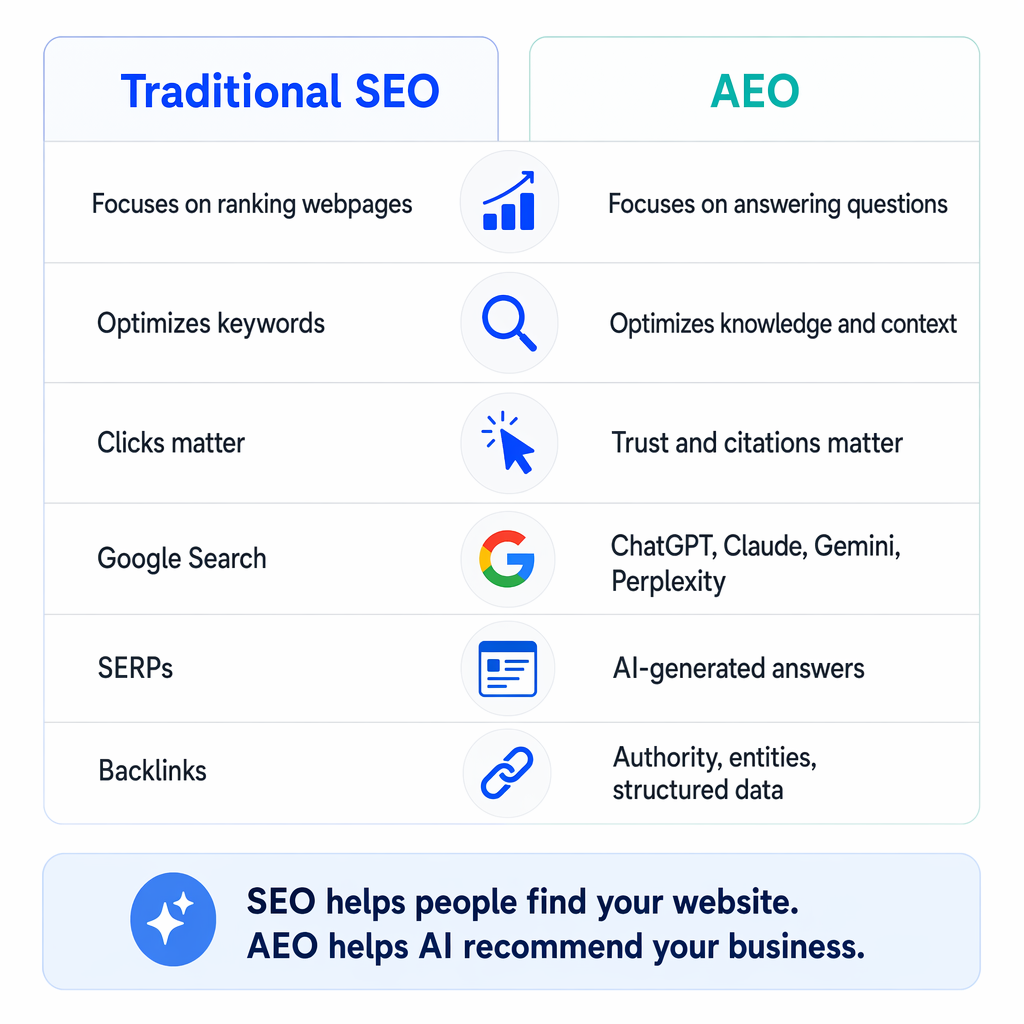
| Traditional SEO | Answer Engine Optimization |
|---|---|
| Focuses on ranking webpages | Focuses on answering questions |
| Optimizes keywords | Optimizes knowledge and context |
| Clicks matter | Trust and citations matter |
| Google Search | ChatGPT, Claude, Gemini, Perplexity |
| SERPs | AI-generated answers |
| Backlinks | Authority, entities, structured data |
SEO isn't disappearing.
AEO simply builds upon it.
Think of SEO as helping people find your website.
Think of AEO as helping AI recommend your business.
For a deeper comparison of how these approaches work together, see our complete guide on SEO vs AEO vs GEO: What Ecommerce Brands Need to Know.
Why Shopify Merchants Should Care
Shopping behavior is changing rapidly.
Customers increasingly ask AI assistants questions like:
- "What's the best wine rack under $300?"
- "Compare VintageView vs traditional wood racks."
- "Which Shopify apps help automate inventory?"
- "Recommend sustainable wine storage."
Instead of scrolling through ten search results, users receive one comprehensive recommendation.
If your store isn't included in that recommendation, you've lost visibility before the customer ever visits Google. This shift from traditional search to AI-powered discovery is transforming how brands get mentioned in purchase decisions.
How AI Decides Which Shopify Stores to Recommend
AI models evaluate many trust signals simultaneously. Here's what matters most:
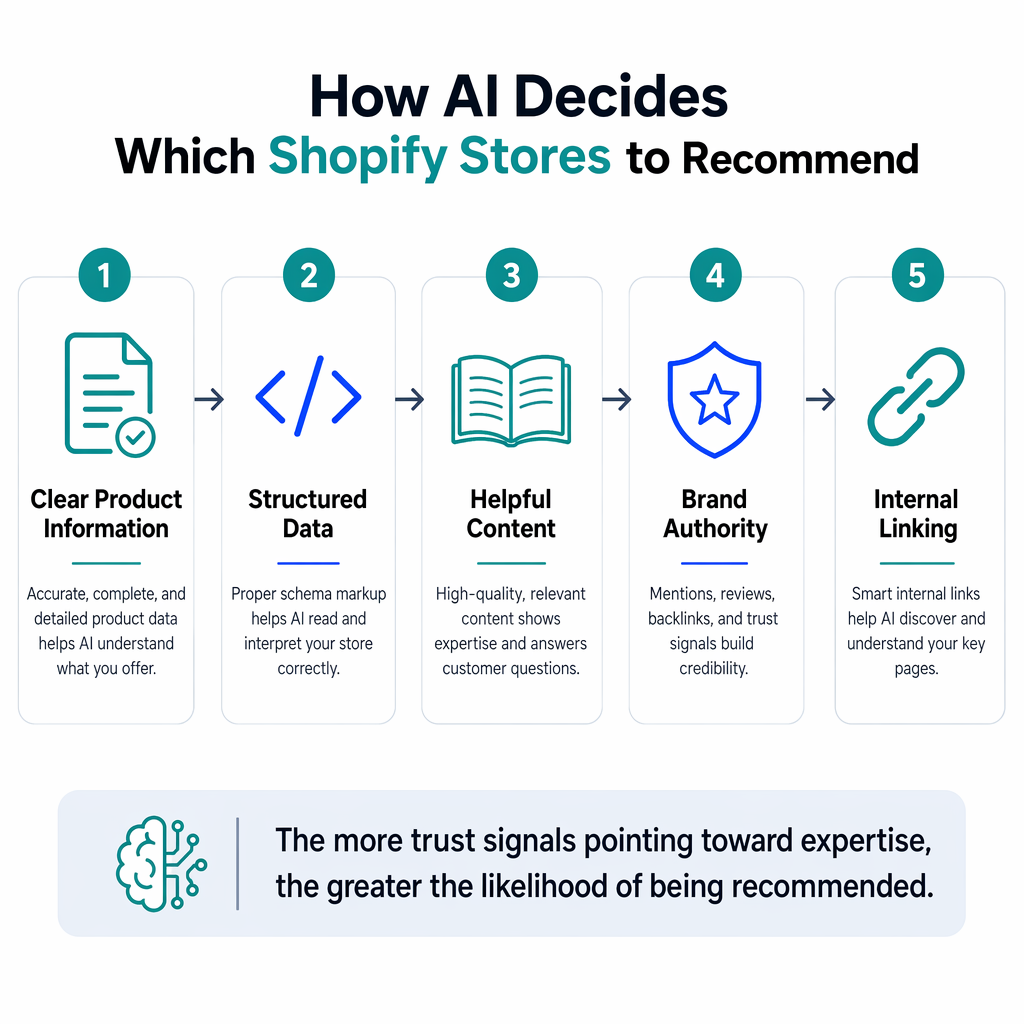
Clear Product Information
Every product should clearly explain:
- Features and benefits
- Dimensions and materials
- Compatibility and installation
- Warranty information
- Frequently asked questions
The more complete your information, the easier it is for AI to understand and recommend your products.
Structured Data
Structured data helps machines understand exactly what every page represents.
Important schema types include:
| Schema Type | Purpose |
|---|---|
| Product | Product details, pricing, availability |
| Organization | Business identity and credentials |
| Article | Blog content and expertise signals |
| FAQ | Question-answer pairs for direct AI extraction |
| Review | Customer feedback and social proof |
| Breadcrumb | Site hierarchy and navigation context |
| Offer | Pricing, discounts, and availability |
| AggregateRating | Overall product/service ratings |
Without structured data, AI has to guess. With structured data, you're giving it a blueprint.
Helpful Content
AI prefers content that genuinely answers questions.
Strong examples include:
- Buying guides
- Comparison articles
- Installation instructions
- Troubleshooting guides
- Product FAQs
- Knowledge centers
This is one reason educational Shopify stores tend to perform exceptionally well with AI discovery. Creating comprehensive content that AI can cite is essential for AEO success.
Brand Authority
AI systems evaluate whether your business appears credible.
Authority comes from:
- Authentic customer reviews
- Expert content and original research
- Consistent branding across platforms
- Industry mentions and citations
- Case studies and success stories
- Detailed "About" pages with credentials
The more signals pointing toward expertise, the greater the likelihood of being recommended.
Internal Linking
Every article should connect logically to create topical clusters:
Buying Guide
    ↓
Comparison Guide
    ↓
Installation Guide
    ↓
Product Collection
    ↓
Individual Product
This helps both search engines and AI understand relationships between topics, building the topical authority that drives AI recommendations.
The Shopify AEO Checklist
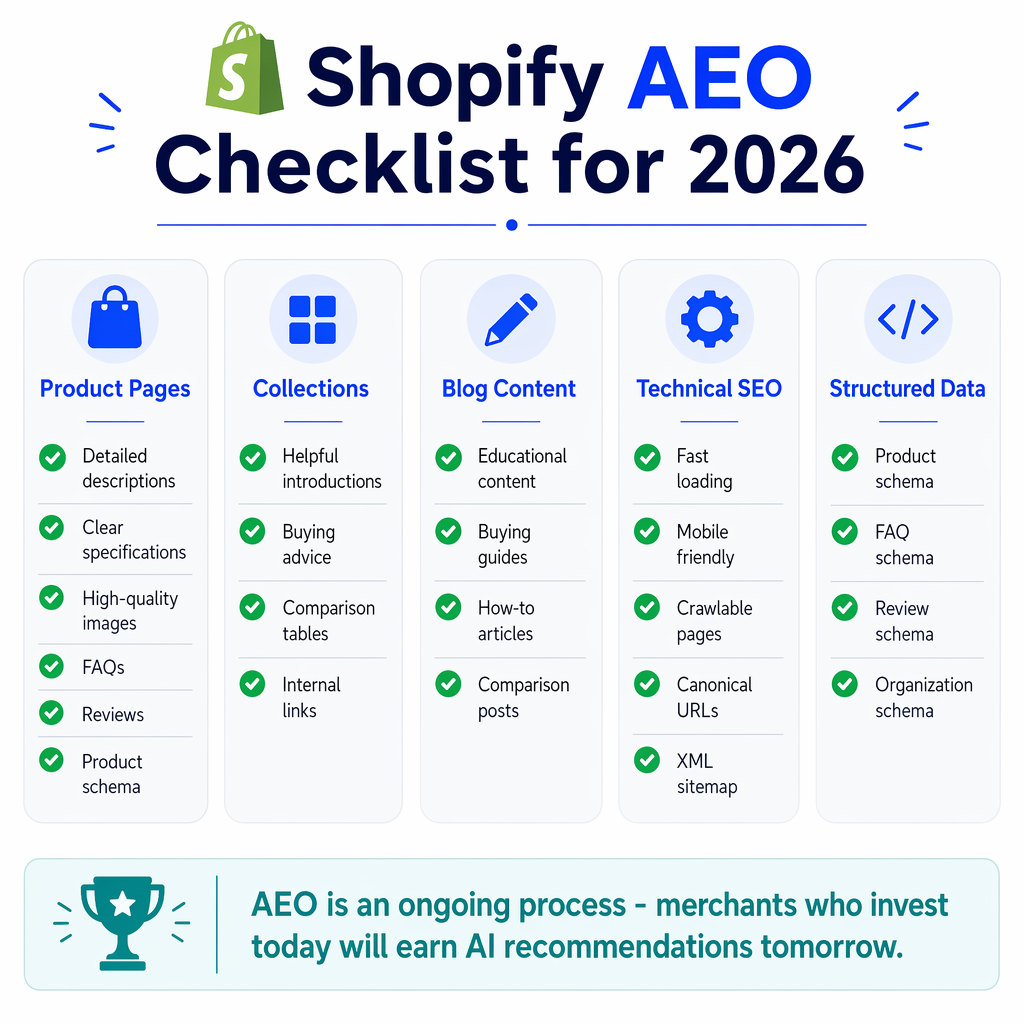
Product Pages
✅ Detailed descriptions (not manufacturer copy)
✅ Clear specifications with dimensions and materials
✅ High-quality images with descriptive alt text
✅ FAQ sections addressing common questions
✅ Authentic customer reviews
✅ Complete Product schema markup
Collections
✅ Helpful introductions explaining the category
✅ Buying advice for different use cases
✅ Comparison tables between products
✅ Internal links to related guides and articles
Blog Content
Publish educational content answering customer questions:
- Best [product type] for [use case]
- [Product A] vs [Product B] comparisons
- How to [install/use/maintain] guides
- Sizing and compatibility guides
- Expert recommendations and curated lists
Technical SEO
| Requirement | Why It Matters for AEO |
|---|---|
| Fast loading (<3s) | AI crawlers prioritize accessible content |
| Mobile friendly | Most AI training data comes from mobile-first sites |
| Crawlable pages | AI can't recommend what it can't access |
| Clean navigation | Helps AI understand site structure |
| Canonical URLs | Prevents duplicate content confusion |
| XML sitemap | Guides AI crawlers to important pages |
| Robots.txt configured | Controls what AI systems can access |
Structured Data Validation
Validate your schema regularly using:
- Google's Rich Results Test
- Schema Markup Validator
- Structured Data Testing Tool
Regular validation ensures AI systems can reliably parse your store's information.
Common AEO Mistakes
Many Shopify stores still make these critical errors:
| Mistake | Impact on AI Visibility |
|---|---|
| ❌ Thin product descriptions | AI can't extract meaningful information |
| ❌ Ignoring FAQs | Misses direct question-answer extraction |
| ❌ Skipping structured data | Forces AI to guess page meaning |
| ❌ Using duplicate manufacturer copy | No unique value for AI to cite |
| ❌ Disconnected blog content | Breaks topical authority signals |
| ❌ Lacking topical authority | AI prefers niche experts over generalists |
| ❌ Writing only for keywords | AI detects low-value content patterns |
These issues make it harder for AI to understand and trust your store. Fixing them is often the fastest path to earning AI recommendations.
Where Shopify MCP Fits In
One of the biggest developments in AI commerce is the Shopify Model Context Protocol (MCP).
Shopify MCP enables AI assistants to interact with Shopify stores more intelligently by providing structured access to product catalogs, inventory, pricing, and store capabilities.
Combined with strong AEO practices, Shopify MCP helps prepare merchants for the future of AI-powered shopping experiences.
Think of it this way:
| Layer | Function |
|---|---|
| AEO | Helps AI understand your content |
| Shopify MCP | Helps AI interact with your store |
| Together | Creates a complete AI visibility foundation |
When AI assistants can both understand your content (AEO) and interact with your store systems (MCP), you're positioned for the full spectrum of AI commerce opportunities.
For implementation details, see our guides on Shopify MCP Server architecture and required connectors.
AEO Best Practices for 2026
Prioritize these areas for maximum AI visibility:
Write for questions, not just keywords. Structure content around the questions customers actually ask.
Add FAQ sections throughout your site. Every product page, collection, and article should have relevant FAQs.
Expand product descriptions with useful context. Go beyond specs — explain use cases, comparisons, and benefits.
Publish original educational content. Unique insights and expertise signal authority to AI systems.
Implement comprehensive structured data. Schema markup is the language AI uses to understand your pages.
Build topical authority around your niche. Depth beats breadth — become the definitive source in your category.
Strengthen internal linking. Connect related content to build topical clusters AI can navigate.
Earn authentic reviews and mentions. Third-party validation is a powerful trust signal for AI.
Keep product information accurate and current. Outdated data erodes AI trust over time.
Monitor AI referral traffic alongside traditional analytics. Track which AI platforms send traffic and optimize accordingly.
Measuring AEO Success
Unlike traditional SEO where rankings are visible, AEO success requires different measurement approaches:
| Metric | How to Track |
|---|---|
| AI referral traffic | UTM parameters, referrer analysis in analytics |
| Brand mentions in AI | Regular testing across ChatGPT, Claude, Gemini |
| Structured data coverage | Schema validation tools, coverage reports |
| Content completeness | FAQ coverage, description depth audits |
| Citation appearances | Monitor AI responses for your brand/products |
| Topical authority growth | Content cluster depth, internal link density |
Frequently Asked Questions
Is AEO replacing SEO?
No. SEO remains essential. AEO complements SEO by helping AI assistants understand and recommend your content. Think of AEO as the next layer on top of a solid SEO foundation.
Does Shopify support AEO?
Yes. Shopify provides a strong technical foundation, but merchants still need to optimize content, structured data, internal linking, and site authority. The platform handles the basics — you need to handle the strategy.
Does structured data improve AI visibility?
While structured data alone doesn't guarantee recommendations, it gives AI systems clear, machine-readable information about your products, articles, reviews, and business, making interpretation more reliable and recommendations more likely.
Can ChatGPT recommend Shopify products?
Yes. Depending on the AI platform, it may draw on indexed web content, structured data, publicly available information, shopping integrations, or connected merchant data to recommend products that appear relevant and trustworthy.
How long does AEO take to show results?
AEO is a medium to long-term investment. Most merchants see initial improvements in AI visibility within 2-4 months of implementing comprehensive structured data and content optimization. Full topical authority typically takes 6-12 months to establish.
What's the difference between AEO and GEO?
AEO focuses on making your content answerable by AI systems. GEO (Generative Engine Optimization) focuses specifically on appearing in generative AI outputs. They overlap significantly — AEO is the broader strategy, while GEO targets specific generative platforms.
Do I need Shopify MCP for AEO?
Not strictly, but Shopify MCP significantly enhances your AI commerce readiness. AEO makes your content understandable to AI, while MCP makes your store interactive for AI agents. Together, they create a comprehensive AI visibility strategy.
Final Thoughts
The future of ecommerce isn't just about ranking on Google — it's about becoming a trusted source for AI.
As answer engines become a primary way customers research and shop, Shopify merchants who invest in AEO today will be better positioned to earn recommendations tomorrow.
By combining high-quality content, structured data, technical optimization, topical authority, and emerging technologies like Shopify MCP, you can make it easier for AI systems to understand your store and surface it when shoppers ask the right questions.
If you're preparing your Shopify store for AI search, now is the time to build a strategy that goes beyond traditional SEO and focuses on earning trust from the next generation of search and shopping experiences.
Need Help Implementing AEO for Your Shopify Store?
At Shopify Agent AI, we specialize in preparing Shopify stores for AI-powered discovery.
Our AEO services include:
- GEO & AI Search Optimization — Complete AEO strategy and implementation
- Schema Implementation — Comprehensive structured data for AI readability
- AI Readiness Audit — Assessment of your store's AI visibility gaps
- Shopify MCP Installation — Connect your store to AI assistants
If you'd rather have experts handle the optimization, we're here to help you earn AI recommendations faster.
Related Reading
SEO vs AEO vs GEO: What Ecommerce Brands Need to Know — Complete comparison of the three search optimization layers.
How to Optimize Your Shopify Store for AI Search (GEO) — Technical implementation guide for generative engine optimization.
How ChatGPT, Gemini & Perplexity Choose Which Brands to Mention — Understanding AI brand selection criteria.
How AI Shopping Agents Discover Shopify Products — The discovery pipeline from crawl to recommendation.
What Is Shopify MCP? — Introduction to Model Context Protocol for Shopify merchants.
The SEO to GEO Shift — How generative engine optimization is changing ecommerce visibility.
Shopify MCP Server Explained — Architecture and connectors for AI-store integration.
The 12 Best Shopify AI Agents in 2026 — Comprehensive comparison of AI tools for Shopify.
Frequently Asked Questions
Quick answers to common questions about this topic.
No. SEO remains essential. AEO complements SEO by helping AI assistants understand and recommend your content. Think of AEO as the next layer on top of a solid SEO foundation.
Yes. Shopify provides a strong technical foundation, but merchants still need to optimize content, structured data, internal linking, and site authority. The platform handles the basics — you need to handle the strategy.
While structured data alone doesn't guarantee recommendations, it gives AI systems clear, machine-readable information about your products, articles, reviews, and business, making interpretation more reliable and recommendations more likely.
Yes. Depending on the AI platform, it may draw on indexed web content, structured data, publicly available information, shopping integrations, or connected merchant data to recommend products that appear relevant and trustworthy.
AEO is a medium to long-term investment. Most merchants see initial improvements in AI visibility within 2-4 months of implementing comprehensive structured data and content optimization. Full topical authority typically takes 6-12 months to establish.
AEO focuses on making your content answerable by AI systems. [GEO (Generative Engine Optimization)](/blog/seo-to-geo-shift-generative-engine-optimization/) focuses specifically on appearing in generative AI outputs. They overlap significantly — AEO is the broader strategy, while GEO targets specific generative platforms.
Not strictly, but [Shopify MCP](/blog/what-is-shopify-mcp/) significantly enhances your AI commerce readiness. AEO makes your content understandable to AI, while MCP makes your store interactive for AI agents. Together, they create a comprehensive AI visibility strategy.
Related Reading
What Is Shopify MCP? The New AI Layer That Could Change How Shopify Stores Operate
Learn what Shopify MCP (Model Context Protocol) is, how it works, and why it could transform how Shopify stores use AI agents for customer support, sales, and automation.
Read articleThe Shift from SEO to GEO: Why Generative Engine Optimization Is the Future of Ecommerce Visibility
Traditional SEO is losing ground to AI-powered search. Learn how Generative Engine Optimization (GEO) works, the technical implementation details including structured data and entity structuring, and why Shopify stores that don't adapt will become invisible.
Read articleClaude vs ChatGPT for Shopify MCP: Which AI Is Better for Ecommerce Automation?
Compare Claude and ChatGPT for Shopify MCP integrations. Detailed analysis of strengths, use cases, context windows, and why the future of ecommerce AI is multi-model.
Read articleReady to Optimize Your Store for AI?
Get a personalized AI readiness audit and discover how your Shopify store can leverage AI agents, MCP integrations, and automation to drive growth.