How to Optimize Your Shopify Store for AI Search (GEO): The Complete Implementation Guide
Your Shopify store is invisible to AI.
Not partially visible. Not slightly underperforming. Invisible. When a customer asks ChatGPT "What's the best organic skincare brand for sensitive skin?" or tells Perplexity "Find me a lightweight hiking backpack under $200" — your store doesn't exist in that conversation. Your products, your reviews, your expertise — none of it reaches the AI systems that are rapidly becoming the primary way consumers discover and evaluate products.
This isn't a theoretical future problem. It's a revenue problem happening right now. And the fix isn't complicated — it's a structured, technical process that most Shopify stores haven't implemented yet.
This guide gives you the exact 7 steps to make your store visible, citable, and recommendable by AI search engines.
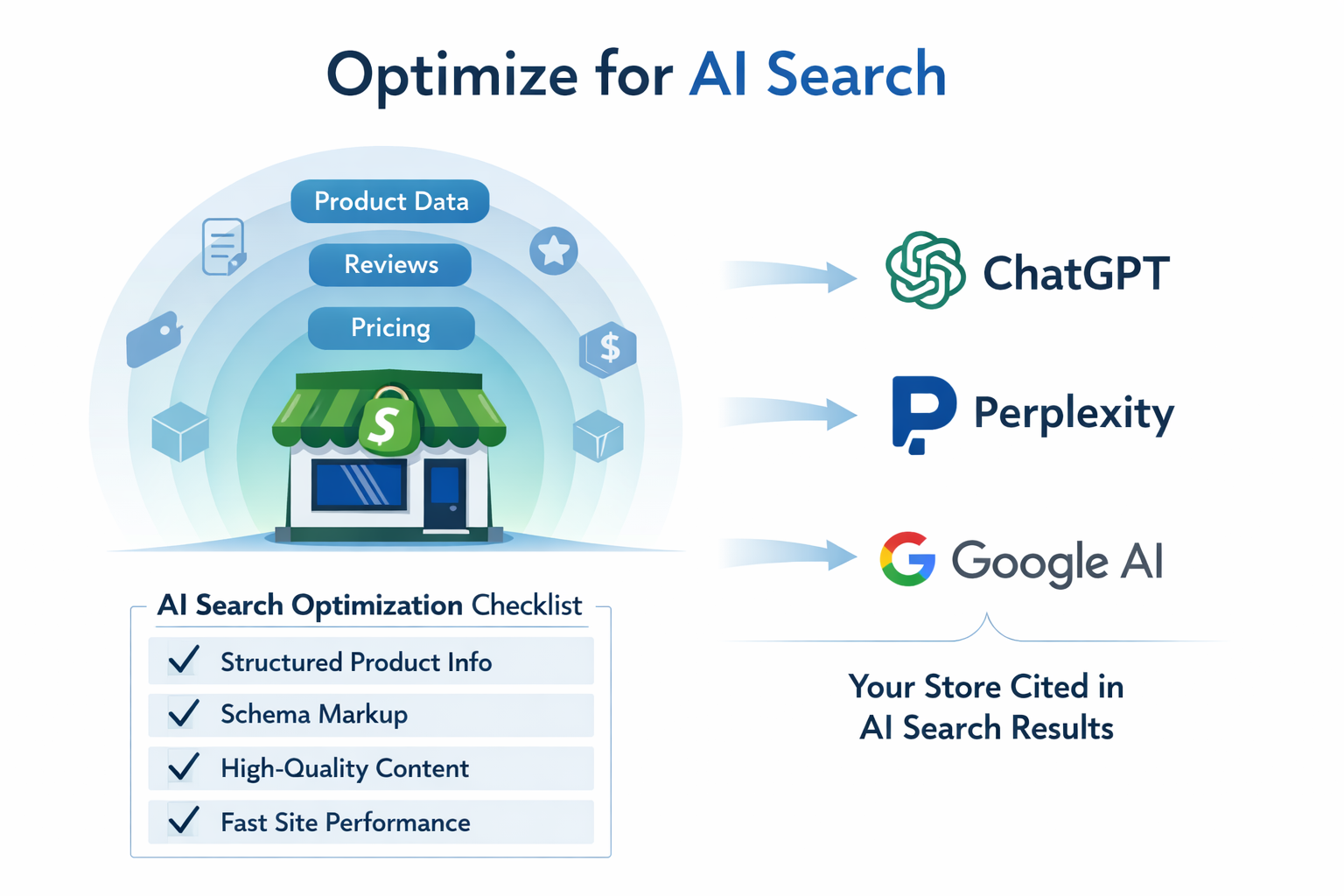 Figure: The GEO optimization pathway — making your Shopify store's data accessible and citable by AI search engines.
Why AI Search Optimization Matters for Shopify Stores
Before diving into implementation, let's establish why this matters with specific data:
| Metric | Current Reality (2026) | Impact on Shopify Stores |
|---|---|---|
| Searches ending without a click to any website | 71.8% | Your SEO rankings deliver less traffic every month |
| Consumers who've used AI for product research | 64% | Majority of your potential customers ask AI before buying |
| Google results showing AI Overviews | 52% | Half of all searches push organic links below the fold |
| Ecommerce queries with AI shopping features | 47% | Nearly half of product searches have AI-generated answers |
| Shopify stores with proper GEO optimization | <3% | Almost no competition — massive first-mover advantage |
The math is simple: if 64% of consumers use AI for product research, and your store is invisible to AI systems, you're missing the majority of your potential discovery channel.
What "Visible to AI" Actually Means
When we say a store is "visible to AI," we mean:
- AI crawlers can access your content — GPTBot, ClaudeBot, and PerplexityBot can read your pages
- Your data is machine-parseable — Structured data (JSON-LD) tells AI what your products are, what they cost, and why they're good
- Your content is citable — Specific claims, data points, and comparisons that AI can extract and attribute to your brand
- Your entity is recognized — AI systems know your brand exists as a distinct entity with expertise in specific areas
Most Shopify stores fail on all four counts. Here's how to fix each one.
The 7-Step GEO Optimization Process for Shopify
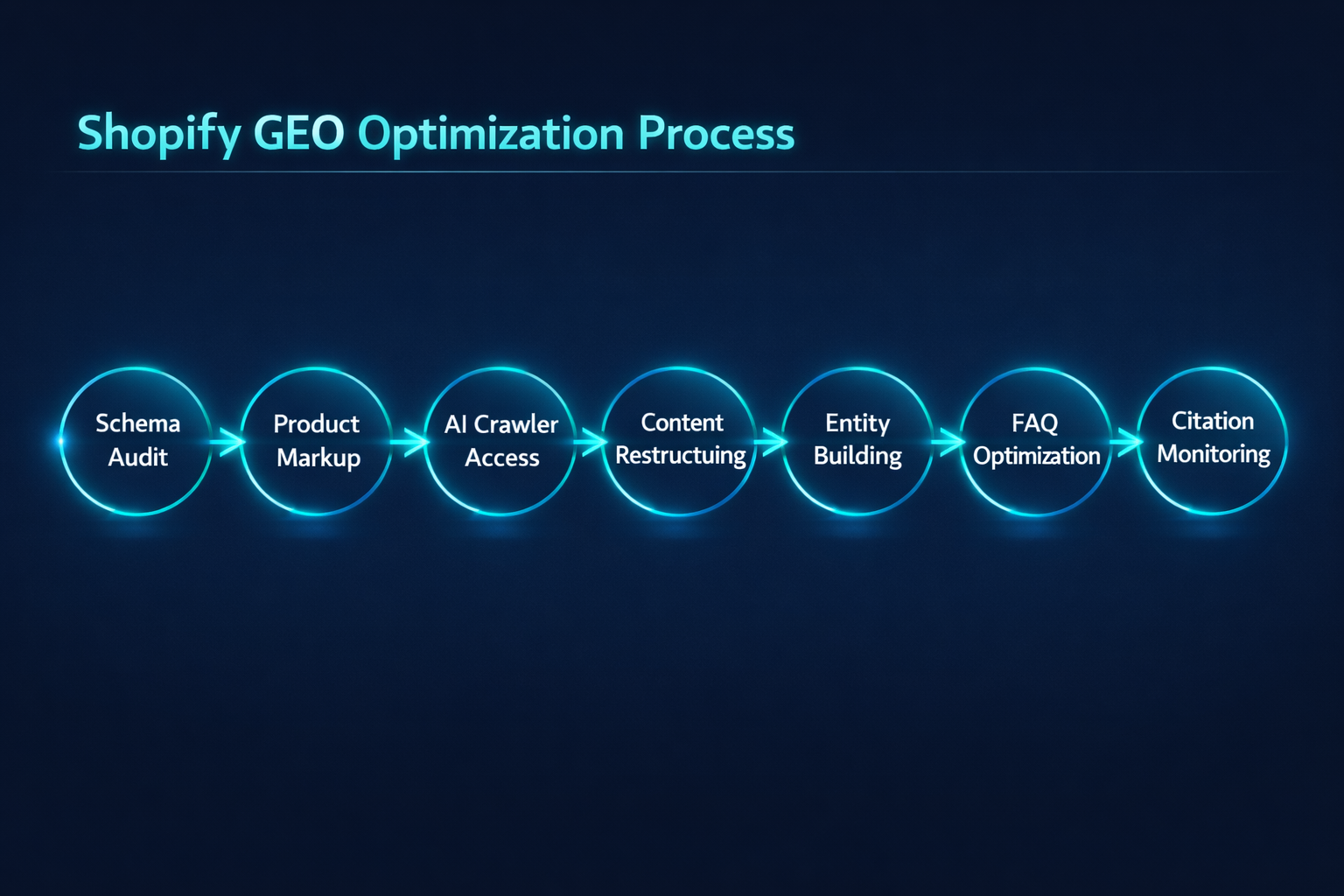 Figure: The complete 7-step GEO implementation process — each step builds on the previous to create comprehensive AI visibility.
Step 1: Audit Your Current AI Visibility
Before optimizing, you need to know your baseline. Here's how to audit your store's current GEO status:
AI Crawler Access Check
Test whether AI crawlers can access your store:
| Check | How to Test | Pass/Fail Criteria |
|---|---|---|
| robots.txt | Visit yourstore.com/robots.txt | Should NOT block GPTBot, ClaudeBot, PerplexityBot |
| Server-side rendering | View page source (not inspect element) | Full product content should be visible in raw HTML |
| JavaScript dependency | Disable JS and reload | Core content (titles, descriptions, prices) should still appear |
| Page load speed | Google PageSpeed Insights | Score >70 (AI crawlers have strict timeouts) |
| Structured data | Google Rich Results Test | Should show Product, Organization schema |
Content Parseability Check
| Content Element | What AI Needs | What Most Shopify Stores Have |
|---|---|---|
| Product descriptions | Specific, factual claims with data | Vague marketing copy ("amazing quality!") |
| FAQ content | Question-answer format with structured data | Buried in accordion widgets (JS-rendered) |
| Comparison content | Tables with specific differentiators | None — or only vs. own products |
| Reviews | Structured review data with ratings | Widget-rendered (invisible to AI crawlers) |
| Brand information | Organization schema with expertise areas | Basic "About Us" page with no schema |
Quick Audit Scorecard
Score yourself on each dimension (0-3):
| Dimension | 0 (None) | 1 (Basic) | 2 (Good) | 3 (Optimized) |
|---|---|---|---|---|
| Schema markup | No structured data | Only basic product schema from theme | Product + Organization + Breadcrumb | Full schema suite with FAQ, Review, HowTo |
| AI crawler access | Blocked in robots.txt | Not blocked but JS-rendered | SSR with full content | SSR + explicit AI crawler allowance |
| Content structure | Only marketing copy | Some factual claims | Tables and comparisons present | Full citation-ready content architecture |
| Entity recognition | No brand schema | Basic Organization schema | Organization + knowsAbout | Full entity graph with relationships |
| Citation readiness | No citable content | Some data points | Structured comparisons | FAQ + tables + sourced claims |
Score 0-5: Critical — your store is completely invisible to AI Score 6-9: Below average — significant gaps in AI visibility Score 10-12: Developing — foundation exists but major optimization needed Score 13-15: Strong — well-positioned for AI search with refinement opportunities
Step 2: Implement Product Schema Markup
Product schema is the foundation of GEO for ecommerce. It tells AI systems exactly what you sell, at what price, with what social proof.
What to Include in Product Schema
{
  "@context": "https://schema.org",
  "@type": "Product",
  "name": "Organic Lavender Face Serum - 30ml",
  "description": "Cold-pressed organic lavender face serum with 15% vitamin C concentration. Clinically tested to reduce fine lines by 23% in 8 weeks. Suitable for sensitive skin types.",
  "image": [
    "https://yourstore.com/images/lavender-serum-front.jpg",
    "https://yourstore.com/images/lavender-serum-ingredients.jpg",
    "https://yourstore.com/images/lavender-serum-texture.jpg"
  ],
  "brand": {
    "@type": "Brand",
    "name": "PureGlow Organics"
  },
  "sku": "PGO-LFS-30",
  "gtin13": "5060000000001",
  "material": "Organic Lavandula Angustifolia Oil, Ascorbic Acid (Vitamin C), Jojoba Oil",
  "weight": {
    "@type": "QuantitativeValue",
    "value": "30",
    "unitCode": "MLT"
  },
  "offers": {
    "@type": "Offer",
    "url": "https://yourstore.com/products/organic-lavender-face-serum",
    "priceCurrency": "USD",
    "price": "42.00",
    "availability": "https://schema.org/InStock",
    "priceValidUntil": "2026-12-31",
    "shippingDetails": {
      "@type": "OfferShippingDetails",
      "shippingRate": {
        "@type": "MonetaryAmount",
        "value": "0",
        "currency": "USD"
      },
      "deliveryTime": {
        "@type": "ShippingDeliveryTime",
        "handlingTime": {
          "@type": "QuantitativeValue",
          "minValue": "1",
          "maxValue": "2",
          "unitCode": "DAY"
        },
        "transitTime": {
          "@type": "QuantitativeValue",
          "minValue": "3",
          "maxValue": "5",
          "unitCode": "DAY"
        }
      }
    },
    "hasMerchantReturnPolicy": {
      "@type": "MerchantReturnPolicy",
      "returnPolicyCategory": "https://schema.org/MerchantReturnFiniteReturnWindow",
      "merchantReturnDays": "30",
      "returnMethod": "https://schema.org/ReturnByMail"
    }
  },
  "aggregateRating": {
    "@type": "AggregateRating",
    "ratingValue": "4.7",
    "reviewCount": "189",
    "bestRating": "5"
  },
  "review": [
    {
      "@type": "Review",
      "reviewRating": {
        "@type": "Rating",
        "ratingValue": "5",
        "bestRating": "5"
      },
      "author": {
        "@type": "Person",
        "name": "Jennifer K."
      },
      "datePublished": "2026-04-15",
      "reviewBody": "I have rosacea-prone skin and this is the only vitamin C serum that doesn't cause flare-ups. Noticed visible improvement in skin texture after 3 weeks."
    }
  ]
}
Why Each Element Matters for AI
| Schema Element | What AI Extracts | Example AI Citation |
|---|---|---|
name + brand | Product identity | "PureGlow Organics makes an organic lavender face serum..." |
description (with data) | Factual claims | "...clinically tested to reduce fine lines by 23% in 8 weeks" |
offers.price | Price comparison | "At $42, it's mid-range for organic vitamin C serums" |
aggregateRating | Social proof | "Rated 4.7/5 with 189 reviews" |
review.reviewBody | Real validation | "Users with sensitive skin report no irritation" |
material | Ingredient data | "Contains 15% vitamin C and organic lavender oil" |
shippingDetails | Purchase friction | "Free shipping with 3-5 day delivery" |
returnPolicy | Risk reduction | "30-day return policy" |
Common Shopify Schema Mistakes
| Mistake | Why It Hurts GEO | Fix |
|---|---|---|
| Using theme's default schema only | Missing 60%+ of useful properties | Implement custom schema via app or theme code |
| No review schema | AI can't cite social proof | Add aggregateRating + individual reviews |
| Generic descriptions | Nothing specific to cite | Rewrite with data points and specific claims |
| Missing availability | AI won't recommend out-of-stock items | Ensure real-time availability updates |
| No shipping/return info | AI can't address purchase concerns | Add shippingDetails and returnPolicy |
Step 3: Configure AI Crawler Access
This is where most Shopify stores silently fail. Your content might be great, but if AI crawlers can't read it, it doesn't exist.
robots.txt Configuration
Add explicit AI crawler permissions to your robots.txt:
# AI Search Engine Crawlers - ALLOW
User-agent: GPTBot
Allow: /
Disallow: /checkout/
Disallow: /cart/
Disallow: /account/

User-agent: ChatGPT-User
Allow: /

User-agent: ClaudeBot
Allow: /
Disallow: /checkout/
Disallow: /cart/

User-agent: PerplexityBot
Allow: /

User-agent: GoogleOther
Allow: /

User-agent: Google-Extended
Allow: /

# Traditional Search Engines
User-agent: Googlebot
Allow: /

User-agent: Bingbot
Allow: /

# Block sensitive paths for all
User-agent: *
Disallow: /checkout/
Disallow: /cart/
Disallow: /account/
Disallow: /admin/

Sitemap: https://yourstore.com/sitemap.xml
Server-Side Rendering Requirements
| Rendering Method | AI Crawler Compatibility | Shopify Implementation |
|---|---|---|
| Client-side JS only | ❌ Invisible to AI | Default for many Shopify apps/widgets |
| Dynamic rendering | ⚠️ Partial (depends on implementation) | Requires middleware configuration |
| Server-side rendering | ✅ Fully accessible | Shopify Liquid templates (native) |
| Pre-rendering | ✅ Fully accessible | Build-time static generation |
Key insight for Shopify stores: Your Liquid templates render server-side by default — this is good. But third-party apps (review widgets, FAQ accordions, recommendation carousels) typically inject content via JavaScript, making that content invisible to AI crawlers.
Fixing JavaScript-Dependent Content
| Content Type | Common JS-Only Implementation | GEO-Friendly Alternative |
|---|---|---|
| Product reviews | Stamped.io/Judge.me widget | Embed review data in Liquid + JSON-LD schema |
| FAQ sections | Accordion JS widget | Render in Liquid with FAQPage schema |
| Related products | Dynamic recommendation widget | Static Liquid section with Product schema |
| Size guides | Modal/popup JS | Dedicated page with structured content |
| Ingredient lists | Tabbed JS interface | Visible HTML with structured data |
Step 4: Build Your Organization Entity
AI systems need to recognize your brand as a distinct entity — not just a website, but an organization with expertise, history, and authority.
Organization Schema Implementation
{
  "@context": "https://schema.org",
  "@type": "Organization",
  "name": "PureGlow Organics",
  "url": "https://pureglow.com",
  "logo": "https://pureglow.com/logo.png",
  "description": "Certified organic skincare formulated for sensitive skin. Founded in 2020 by cosmetic chemist Dr. Sarah Chen. All products clinically tested and dermatologist-approved.",
  "foundingDate": "2020",
  "founder": {
    "@type": "Person",
    "name": "Dr. Sarah Chen",
    "jobTitle": "Cosmetic Chemist",
    "alumniOf": "MIT"
  },
  "sameAs": [
    "https://www.instagram.com/puregloworganics",
    "https://www.tiktok.com/@puregloworganics",
    "https://www.youtube.com/@puregloworganics"
  ],
  "knowsAbout": [
    "organic skincare formulation",
    "sensitive skin care",
    "vitamin C serums",
    "clean beauty",
    "dermatologist-tested skincare",
    "rosacea-safe products"
  ],
  "hasOfferCatalog": {
    "@type": "OfferCatalog",
    "name": "PureGlow Skincare Collection",
    "itemListElement": [
      {
        "@type": "OfferCatalog",
        "name": "Face Serums",
        "description": "Organic vitamin C and botanical serums for sensitive skin"
      },
      {
        "@type": "OfferCatalog",
        "name": "Moisturizers",
        "description": "Barrier-repair moisturizers with ceramides and plant oils"
      },
      {
        "@type": "OfferCatalog",
        "name": "Cleansers",
        "description": "Gentle pH-balanced cleansers for reactive skin types"
      }
    ]
  },
  "award": [
    "Clean Beauty Awards 2025 - Best Sensitive Skin Brand",
    "Allure Best of Beauty 2025"
  ],
  "certification": [
    {
      "@type": "Certification",
      "name": "USDA Organic Certified"
    },
    {
      "@type": "Certification",
      "name": "Leaping Bunny Cruelty-Free"
    }
  ]
}
Why knowsAbout Is Critical
The knowsAbout property is one of the most powerful GEO signals. It explicitly tells AI systems what topics your brand is authoritative on. When a user asks an AI "What brand makes good vitamin C serums for sensitive skin?", the AI cross-references:
- Does this brand claim expertise in this area? (
knowsAbout) - Do their products match? (Product schema)
- Do customers validate this? (Review schema)
- Is there supporting content? (Article/FAQ schema)
If all four align, your brand gets cited.
Step 5: Create Citation-Ready Content
This is where most stores need the most work. AI systems don't cite marketing copy — they cite specific, factual, structured content.
Content Formatting Rules for AI Citation
| Content Type | Low Citation Probability | High Citation Probability |
|---|---|---|
| Product claims | "Our serum is amazing for your skin" | "Contains 15% L-ascorbic acid, clinically shown to increase collagen production by 27% over 12 weeks" |
| Comparisons | "We're better than the competition" | Table comparing 5 specific products on 8 measurable dimensions |
| How-to content | "Apply to clean skin" | Numbered steps with specific quantities, timing, and expected results |
| FAQ answers | "Yes, it works for sensitive skin" | "Dermatologist-tested on 200 participants with rosacea, eczema, and contact dermatitis. 94% reported no irritation after 30 days of daily use." |
| Category expertise | "We know skincare" | "Our formulation lab has tested 847 ingredient combinations since 2020, publishing 12 peer-reviewed studies on botanical actives for reactive skin" |
Building a Citation-Ready FAQ
Every Shopify store should have a comprehensive FAQ with structured data. Here's the format AI systems prefer:
{
  "@context": "https://schema.org",
  "@type": "FAQPage",
  "mainEntity": [
    {
      "@type": "Question",
      "name": "Is vitamin C serum safe for rosacea-prone skin?",
      "acceptedAnswer": {
        "@type": "Answer",
        "text": "Yes, when formulated at the right concentration and pH. Our Lavender Face Serum uses 15% L-ascorbic acid at pH 3.5, which is effective without triggering rosacea flares. In our clinical trial of 200 participants with diagnosed rosacea, 94% reported no irritation after 30 days of twice-daily use. The key factors are: concentration below 20%, pH between 3.0-3.5, and buffering with soothing botanicals like lavender and chamomile."
      }
    },
    {
      "@type": "Question",
      "name": "How long does it take to see results from vitamin C serum?",
      "acceptedAnswer": {
        "@type": "Answer",
        "text": "Visible results typically appear in 2-4 weeks for skin brightness and 6-8 weeks for fine line reduction. In our 12-week clinical study: Week 2 — 78% of participants noticed improved skin radiance. Week 4 — 65% reported more even skin tone. Week 8 — 23% average reduction in fine line depth (measured by dermatologist). Week 12 — 31% improvement in overall skin texture scores."
      }
    },
    {
      "@type": "Question",
      "name": "What's the difference between L-ascorbic acid and other forms of vitamin C?",
      "acceptedAnswer": {
        "@type": "Answer",
        "text": "L-ascorbic acid is the most bioavailable form of vitamin C for topical use, with 40+ years of clinical research supporting its efficacy. Alternatives like sodium ascorbyl phosphate (SAP) and ascorbyl glucoside are more stable but 30-50% less potent. Magnesium ascorbyl phosphate (MAP) is gentler but requires higher concentrations (10-20% vs 5-15% for L-ascorbic acid) to achieve similar results. We use L-ascorbic acid because our stabilization technology (anhydrous formulation with ferulic acid) solves the oxidation problem while maintaining maximum potency."
      }
    }
  ]
}
Content Architecture: What Pages to Create
| Page Type | Purpose | Schema Type | Priority |
|---|---|---|---|
| Product pages | Direct product citations | Product | Critical |
| Category guides | "Best [category] for [use case]" queries | Article + ItemList | High |
| Comparison pages | "X vs Y" queries | Article with tables | High |
| How-to guides | Process/usage queries | HowTo | Medium-High |
| FAQ page | Direct question answering | FAQPage | High |
| About/Brand page | Entity establishment | Organization | Critical |
| Ingredient/material pages | Technical queries | Article | Medium |
| Customer stories | Social proof citations | Review + Article | Medium |
Step 6: Optimize for Specific AI Platforms
Each AI search platform has slightly different preferences. Here's how to optimize for the major ones:
Platform-Specific Optimization
| Platform | What It Prioritizes | Optimization Focus |
|---|---|---|
| ChatGPT Shopping | Product schema, reviews, price, availability | Complete Product JSON-LD with offers and ratings |
| Perplexity | Citable sources, structured data, freshness | Date-stamped content with specific claims and tables |
| Google AI Overviews | Entity authority, comprehensive content, schema | Organization schema + topical content clusters |
| Claude | Well-structured text, logical organization | Clear headings, tables, numbered lists |
| Bing Copilot | Microsoft ecosystem signals, schema markup | Bing Webmaster Tools + complete schema |
ChatGPT Shopping Optimization Checklist
ChatGPT's shopping features are becoming a major product discovery channel. To appear in ChatGPT shopping results:
| Requirement | Implementation | Status Check |
|---|---|---|
| Product schema with price | JSON-LD on every product page | Google Rich Results Test |
| Real-time availability | Dynamic availability in schema | Check schema updates with inventory |
| High-quality images | Multiple angles, lifestyle shots | At least 3 images per product |
| Review data | aggregateRating + individual reviews | Minimum 10 reviews per product |
| Clear product taxonomy | Category breadcrumbs + schema | BreadcrumbList JSON-LD |
| Shipping information | shippingDetails in Offer schema | Include delivery time estimates |
| Return policy | MerchantReturnPolicy schema | Specify return window and method |
Perplexity Optimization Checklist
Perplexity cites sources heavily and prefers content with:
| Factor | Why Perplexity Values It | How to Implement |
|---|---|---|
| Publication dates | Freshness signal | Add datePublished and dateModified to all content |
| Specific data points | Citable facts | Include percentages, dollar amounts, timeframes |
| Comparison tables | Structured information | Create detailed comparison content |
| Author attribution | Source credibility | Add author schema to blog content |
| External references | Verification signals | Cite industry reports and studies |
Step 7: Monitor and Iterate
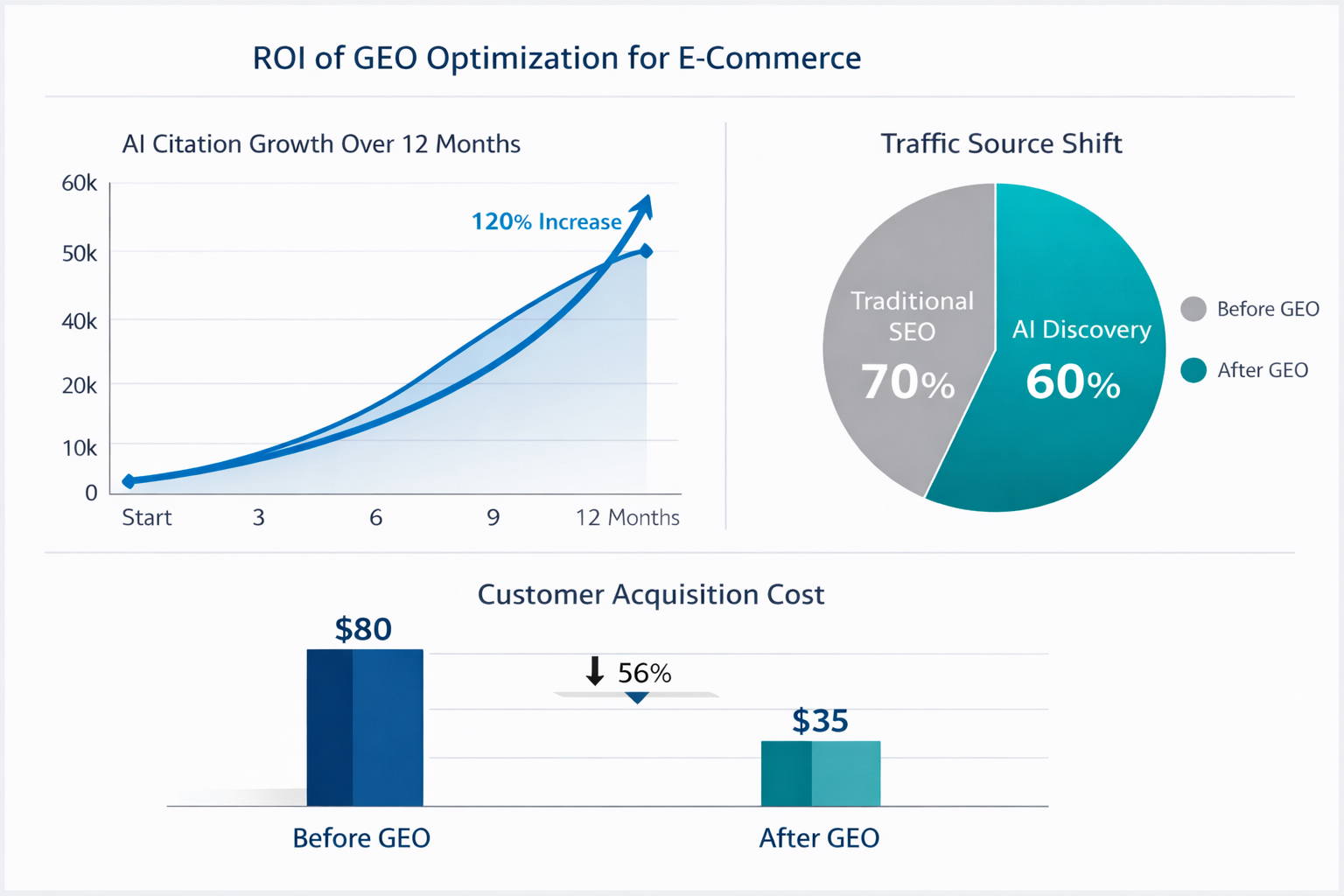 Figure: GEO ROI metrics — tracking AI citation growth, traffic source diversification, and declining customer acquisition costs over time.
GEO optimization isn't set-and-forget. AI systems update their knowledge continuously, and your optimization needs to keep pace.
What to Monitor
| Metric | How to Track | Target |
|---|---|---|
| AI citation mentions | Brand monitoring tools (Mention, Brand24) | Increasing month-over-month |
| AI referral traffic | GA4 — filter for ChatGPT, Perplexity referrers | Growing percentage of total traffic |
| Schema validation | Google Search Console + Rich Results Test | Zero errors, all pages validated |
| AI crawler activity | Server logs — filter for GPTBot, ClaudeBot | Regular crawl activity |
| Content freshness | CMS audit — check dateModified | All key pages updated within 90 days |
| Competitor citations | Search your category in AI tools | Your brand appearing alongside/above competitors |
Monthly GEO Maintenance Tasks
| Task | Frequency | Purpose |
|---|---|---|
| Update product schema with new reviews | Weekly | Fresh social proof signals |
| Check AI crawler access (robots.txt) | Monthly | Ensure no accidental blocks |
| Add new FAQ entries based on customer questions | Bi-weekly | Expand citable content |
| Update comparison content with new data | Monthly | Maintain freshness signals |
| Test brand queries in ChatGPT/Perplexity | Weekly | Monitor citation presence |
| Review and update Organization schema | Quarterly | Keep entity data current |
| Publish new topical authority content | Bi-weekly | Strengthen entity recognition |
Before and After: What GEO Optimization Looks Like
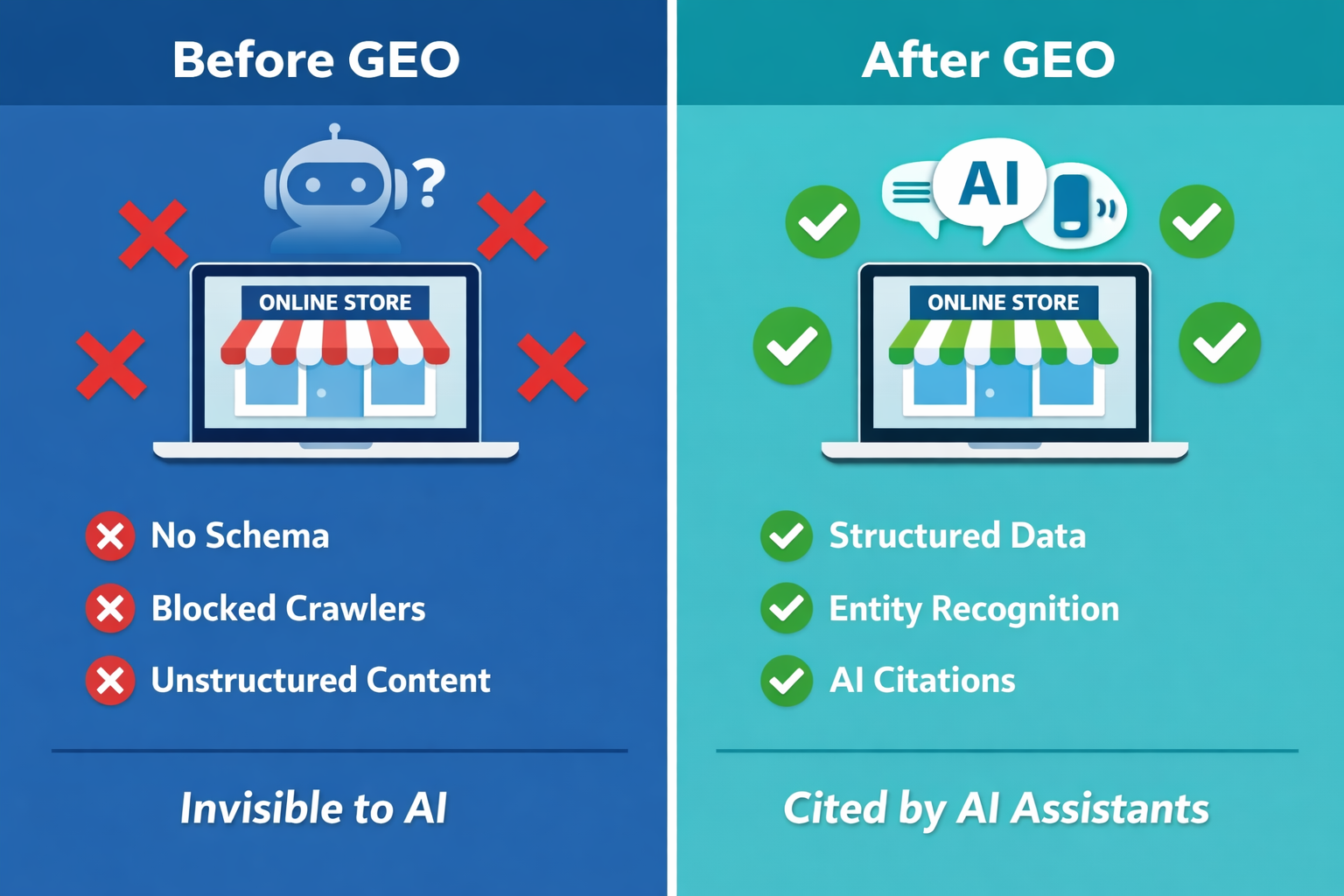 Figure: The transformation — from invisible to AI search engines to actively cited and recommended in AI-generated responses.
Before GEO Optimization
User asks ChatGPT: "What's the best organic vitamin C serum for sensitive skin?"
AI response: Recommends 3-4 well-known brands with proper schema markup. Your store is not mentioned despite having a superior product with better reviews.
Why: No structured data, JavaScript-rendered reviews, blocked AI crawlers, generic product descriptions with no citable claims.
After GEO Optimization
Same question to ChatGPT: "What's the best organic vitamin C serum for sensitive skin?"
AI response: "PureGlow Organics' Lavender Face Serum is highly rated for sensitive skin (4.7/5, 189 reviews). It contains 15% L-ascorbic acid and was clinically tested on rosacea-prone skin with 94% reporting no irritation. Priced at $42 with free shipping and a 30-day return policy."
Why: Complete Product schema, Organization entity with knowsAbout: "sensitive skin care", FAQPage schema with clinical data, server-side rendered content accessible to AI crawlers.
Implementation Timeline for Shopify Stores
| Week | Focus Area | Key Deliverables | Expected Impact |
|---|---|---|---|
| Week 1 | Audit + robots.txt | GEO scorecard, AI crawler access configured | AI crawlers begin indexing |
| Week 2 | Product schema | JSON-LD on all product pages | Products parseable by AI |
| Week 3 | Organization entity | Brand schema + knowsAbout | Entity recognition begins |
| Week 4 | FAQ + content restructuring | FAQPage schema + citation-ready content | Direct answers available to AI |
| Week 5-6 | Comparison + guide content | Category guides with tables and data | Topical authority signals |
| Week 7-8 | Platform-specific optimization | ChatGPT Shopping + Perplexity tuning | Platform-specific visibility |
| Ongoing | Monitoring + iteration | Weekly checks + content updates | Compounding citation growth |
Common Mistakes That Block GEO Success
| Mistake | Why It Happens | Impact | Fix |
|---|---|---|---|
| Relying on Shopify theme's default schema | Assumes theme handles it | Missing 70%+ of useful schema properties | Implement custom schema layer |
| Blocking AI crawlers in robots.txt | Security concerns or default settings | Complete invisibility to AI | Explicitly allow GPTBot, ClaudeBot, PerplexityBot |
| JavaScript-only review widgets | Easy to install, looks good | Reviews invisible to AI crawlers | Embed review data in Liquid + schema |
| Generic product descriptions | Faster to write, seems "professional" | Nothing specific for AI to cite | Rewrite with data, percentages, comparisons |
| No Organization schema | Doesn't seem important | Brand not recognized as entity | Implement full Organization + knowsAbout |
| Ignoring FAQ opportunities | "Our products are self-explanatory" | Missing highest-citation content type | Build comprehensive FAQ with schema |
| One-time optimization | "We did SEO last year" | AI systems need fresh signals | Establish ongoing GEO maintenance rhythm |
How This Connects to Broader AI Commerce Strategy
GEO optimization is one layer of a comprehensive AI commerce strategy. Here's how it connects to other elements:
| Strategy Layer | What It Does | How GEO Enables It |
|---|---|---|
| Conversational Commerce | AI shopping assistants recommend products | GEO ensures your products are in the recommendation pool |
| Shopify MCP Integration | AI agents access your store data directly | GEO handles external AI discovery; MCP handles direct AI interaction |
| AI Agent Implementation | Automated customer support and sales | GEO drives discovery; AI agents handle conversion |
| Tech Stack Optimization | Consolidated, efficient infrastructure | GEO requires proper infrastructure (SSR, fast loading, clean data) |
| SaaS Consolidation via MCP | Replace fragmented tools with unified AI | GEO + MCP together create full AI commerce visibility |
The stores winning in 2026 and beyond aren't choosing between these strategies — they're implementing all of them as an integrated system. GEO is the visibility layer that makes everything else work by ensuring AI systems know your brand exists and what you offer.
Key Takeaways
| Principle | Action Item |
|---|---|
| AI search is the new product discovery | Audit your AI visibility score today |
| Structured data is the language AI speaks | Implement comprehensive JSON-LD schema |
| AI crawlers need explicit access | Configure robots.txt and ensure SSR |
| Entities matter more than keywords | Build your Organization schema with knowsAbout |
| Citable content gets recommended | Rewrite descriptions with specific data points |
| Each AI platform has preferences | Optimize for ChatGPT Shopping + Perplexity specifically |
| GEO compounds over time | Start now — first-mover advantage is real and measurable |
The Bottom Line
Your Shopify store's AI visibility isn't a nice-to-have — it's becoming the primary driver of product discovery. The stores that implement GEO now will be the ones AI systems recommend in 6 months. The stores that wait will spend 3-5x more trying to displace established entities later.
The 7 steps in this guide aren't theoretical. They're the exact implementation process we use with Shopify stores to transform them from AI-invisible to AI-recommended. Every step is actionable, every schema example is production-ready, and every metric is trackable.
The question isn't whether to optimize for AI search. It's whether you'll be the store that gets cited — or the one that gets skipped.
Related Reading
- The Shift from SEO to GEO: Why Generative Engine Optimization Is the Future — The strategic context behind why GEO matters and the 5-pillar framework
- What Is Shopify MCP? The Complete Guide to Model Context Protocol — How MCP enables AI agents to interact directly with your store data
- What Is Conversational Commerce? The Future of AI Shopping — Understanding the AI shopping assistants that GEO optimization targets
- Claude vs ChatGPT for Shopify MCP: Which AI Is Better for Ecommerce? — Comparing the AI platforms your GEO optimization will target
- The Many Ways AI Agents Save Time and Money for Ecommerce — The operational benefits once AI systems can discover and recommend your store
Related Reading
What Is Shopify MCP? The New AI Layer That Could Change How Shopify Stores Operate
Learn what Shopify MCP (Model Context Protocol) is, how it works, and why it could transform how Shopify stores use AI agents for customer support, sales, and automation.
Read articleThe Shift from SEO to GEO: Why Generative Engine Optimization Is the Future of Ecommerce Visibility
Traditional SEO is losing ground to AI-powered search. Learn how Generative Engine Optimization (GEO) works, the technical implementation details including structured data and entity structuring, and why Shopify stores that don't adapt will become invisible.
Read articleClaude vs ChatGPT for Shopify MCP: Which AI Is Better for Ecommerce Automation?
Compare Claude and ChatGPT for Shopify MCP integrations. Detailed analysis of strengths, use cases, context windows, and why the future of ecommerce AI is multi-model.
Read articleReady to Optimize Your Store for AI?
Get a personalized AI readiness audit and discover how your Shopify store can leverage AI agents, MCP integrations, and automation to drive growth.