The 15 Best AI Agents for Automating Business Processes
The Complete Buyer's Guide for Modern Businesses
Artificial intelligence has moved far beyond simple chatbots.
Today's AI agents can automate customer support, manage workflows, analyze business data, coordinate software, generate reports, trigger actions, and dramatically reduce repetitive work across nearly every department.
For business owners, that's exciting—but also overwhelming.
Search for "AI agent" today and you'll find hundreds of tools claiming to automate everything from marketing to operations. Some are excellent. Others solve very specific problems. Many overlap in functionality, making it difficult to know which tools are actually worth implementing.
The reality is this:
The best AI agent isn't necessarily the one with the most features—it's the one that fits your business processes.
In this guide, we'll compare the leading AI agents available today, explain what each one does best, and help you determine which solution is right for your business.
Whether you run a Shopify store, an ecommerce brand, a growing startup, or an established organization, this guide will help you build an AI strategy that delivers real business value.
What You'll Learn
- ✔ What AI agents actually are
- ✔ How AI agents differ from traditional automation
- ✔ The best AI agents by business function
- ✔ Which platforms are easiest to implement
- ✔ Which AI agents work best with Shopify
- ✔ Common implementation mistakes
- ✔ How to choose the right solution
- ✔ Why implementation matters more than software
💡 ShopifyAgentAI Insight: Businesses often ask, "What's the best AI agent?" The better question is: "Which AI agent best fits the way my business already operates?" Successful AI implementation starts with understanding workflows—not shopping for software.
What Is an AI Agent?
An AI agent is software capable of understanding a goal, reasoning through available information, making decisions, and completing tasks with minimal human involvement.
Unlike traditional automation—which follows predefined rules—modern AI agents can adapt to changing situations, understand natural language, and interact with multiple business systems.
Think of an AI agent as a digital team member.
Instead of simply executing one workflow, it can:
- Analyze information
- Make recommendations
- Retrieve data
- Coordinate multiple tools
- Generate reports
- Trigger automations
- Communicate with users
- Continue improving over time
This makes AI agents significantly more capable than traditional workflow automation.
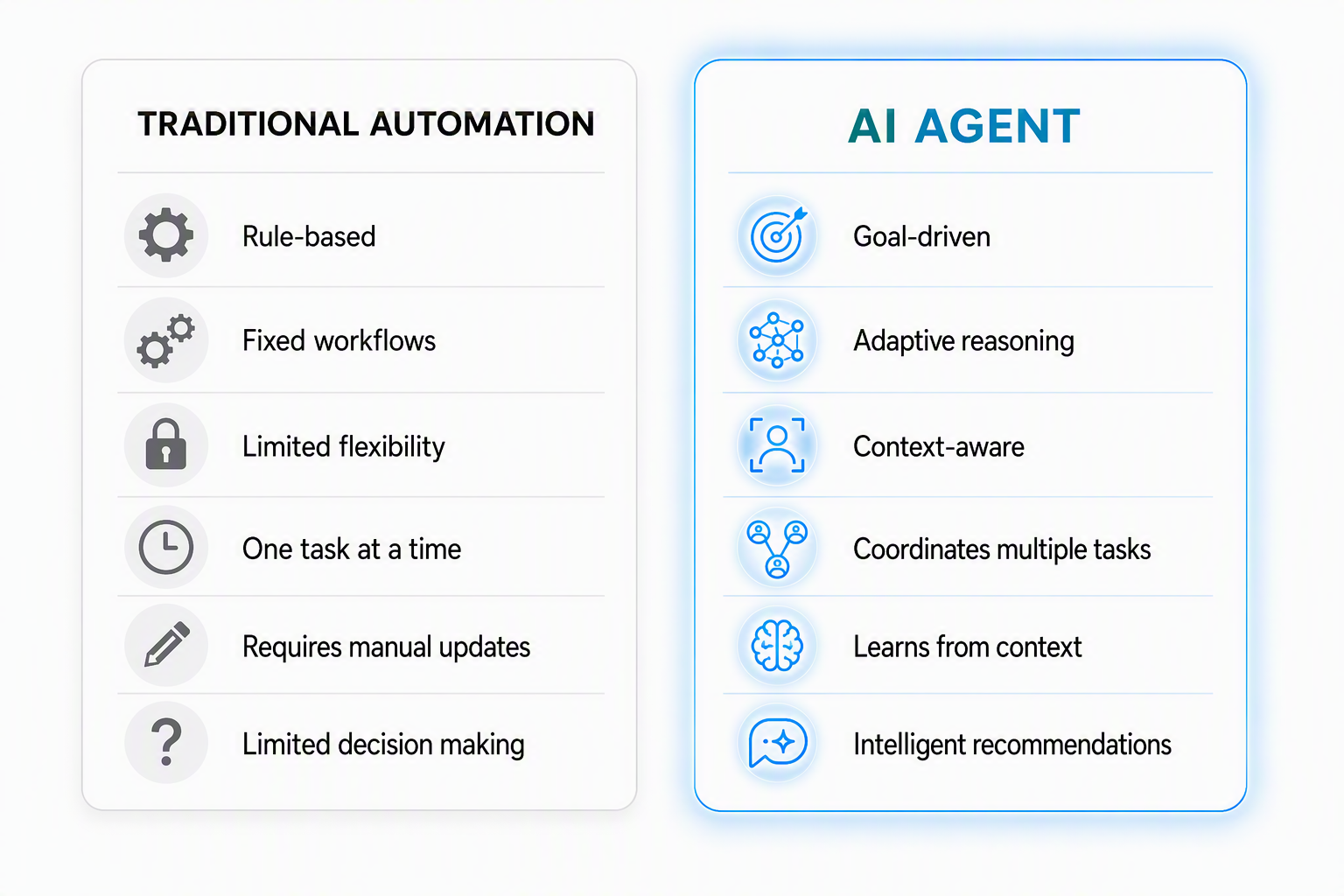
AI Agent vs Traditional Automation
| Traditional Automation | AI Agent |
|---|---|
| Rule-based | Goal-driven |
| Fixed workflows | Adaptive reasoning |
| Limited flexibility | Context-aware |
| One task at a time | Coordinates multiple tasks |
| Requires manual updates | Learns from context |
| Limited decision making | Intelligent recommendations |
Traditional automation is still valuable.
AI agents simply expand what's possible.
How We Evaluated Each AI Agent
Rather than ranking tools based on popularity, we evaluated them using the criteria that matter most to businesses implementing AI today.
Each platform was considered based on:
- Ease of implementation
- Business process automation capabilities
- Integration ecosystem
- AI reasoning ability
- Workflow flexibility
- Scalability
- Security
- Business use cases
- Overall value
No single platform is the best at everything.
That's why we've highlighted where each solution performs best.
The Best AI Agents for Automating Business Processes
1. Claude
Best For: Business reasoning, documentation, workflow planning, knowledge work
Claude has become one of the strongest AI assistants for businesses that rely heavily on documentation, research, writing, planning, and thoughtful decision-making.
Its strength lies in understanding large amounts of context and producing highly structured outputs.
Pros
- ✔ Excellent reasoning
- ✔ Long-context conversations
- ✔ Strong writing quality
- ✔ Great documentation support
- ✔ Reliable business analysis
Cons
- Doesn't automate workflows by itself
- Requires integrations for advanced automation
Best For
- SOP creation
- Documentation
- Internal knowledge bases
- Business planning
- Technical writing
For a deeper comparison of Claude in an ecommerce context, see Claude vs ChatGPT for Shopify MCP.
2. ChatGPT
Best For: Content creation, brainstorming, coding assistance, general business productivity
ChatGPT remains one of the most versatile AI assistants available.
Businesses commonly use it for:
- Marketing
- Product descriptions
- Customer communication
- Coding
- Brainstorming
- Research
- Content creation
Its flexibility makes it an excellent starting point for organizations beginning their AI journey.
Pros
- ✔ Easy to use
- ✔ Excellent ecosystem
- ✔ Strong coding support
- ✔ Broad business applications
Cons
- Requires workflow tools for advanced automation
Best For
- Marketing teams
- Content creators
- Developers
- Small businesses
- General productivity
3. Microsoft Copilot
Best For: Microsoft organizations
Businesses already using Microsoft 365 often benefit from Copilot because it integrates directly into Outlook, Excel, Teams, Word, and other Microsoft applications.
It's particularly valuable for organizations with established Microsoft workflows.
Pros
- ✔ Deep Microsoft integration
- ✔ Enterprise security
- ✔ Productivity enhancements
Cons
- Best suited for Microsoft environments
4. Google Gemini
Best For: Google Workspace organizations
Gemini integrates naturally with Gmail, Docs, Sheets, Meet, and Drive, making it a strong option for organizations already invested in Google's ecosystem.
5. n8n
Best For: Advanced workflow automation
Unlike AI chat assistants, n8n focuses on connecting business systems through highly customizable workflows.
It allows organizations to build sophisticated automations between CRMs, ecommerce platforms, communication tools, analytics, APIs, and AI models.
Pros
- ✔ Extremely flexible
- ✔ Self-hosting available
- ✔ Excellent AI integrations
- ✔ Strong developer community
Cons
- Steeper learning curve
Best For
- Growing businesses
- Custom AI workflows
- Advanced automation
6. Make
Best For: No-code business automation
Make provides one of the most intuitive visual workflow builders available.
Businesses can automate marketing, sales, ecommerce, customer support, reporting, and internal operations with minimal coding.
For many organizations, it strikes an excellent balance between power and ease of use.
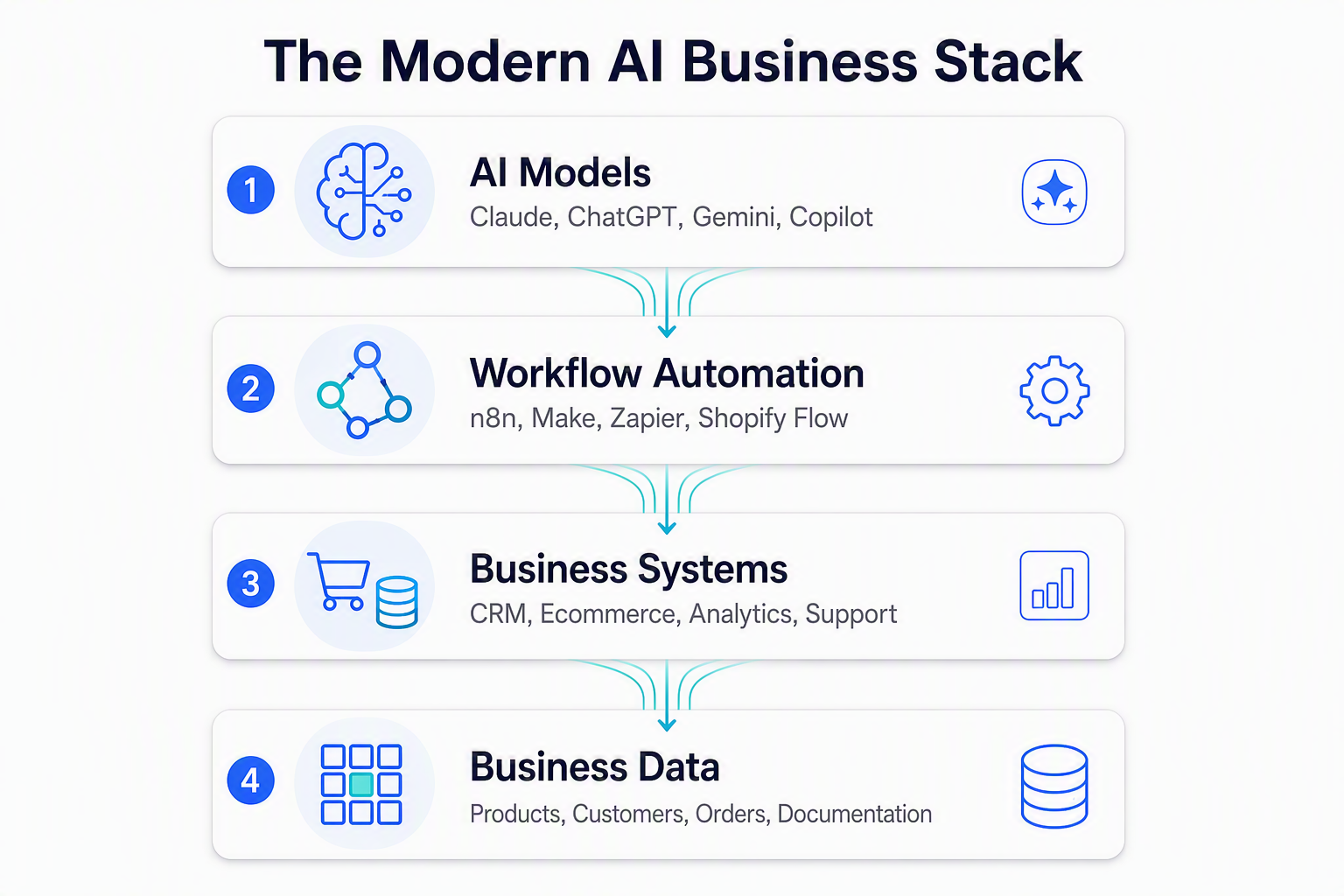
💡 ShopifyAgentAI Insight: Choosing the right AI platform is only half the equation. The real competitive advantage comes from designing workflows that connect your existing software into one intelligent business system.
Quick Comparison
| Platform | Best For | Difficulty | Custom Workflows |
|---|---|---|---|
| Claude | Reasoning | Beginner | Moderate |
| ChatGPT | General AI | Beginner | Moderate |
| Microsoft Copilot | Microsoft businesses | Beginner | Moderate |
| Gemini | Google Workspace | Beginner | Moderate |
| n8n | Advanced automation | Advanced | Excellent |
| Make | No-code automation | Intermediate | Excellent |
Which AI Agent Is Right for You?
The answer depends less on the AI model and more on the problem you're trying to solve.
| If You Want To... | Recommended Solution |
|---|---|
| Create better content | Claude or ChatGPT |
| Automate repetitive workflows | n8n or Make |
| Improve Microsoft productivity | Microsoft Copilot |
| Streamline Google Workspace | Gemini |
| Build custom business automations | AI + workflow platform |
| Implement an end-to-end AI strategy | ShopifyAgentAI |
Notice that the final recommendation isn't another AI model.
It's the implementation partner that helps businesses connect these technologies into practical, measurable solutions.
7. Zapier
Best For: Businesses looking for simple, no-code automation between thousands of applications.
Zapier has long been one of the most popular automation platforms because it allows businesses to connect thousands of cloud applications without writing code.
While it isn't an AI agent itself, Zapier now incorporates AI features that help users build workflows faster and automate increasingly complex business processes.
Best Uses
- Lead routing
- CRM automation
- Email notifications
- Order updates
- Marketing workflows
- Customer onboarding
Pros
- ✔ Massive integration library
- ✔ Beginner friendly
- ✔ Fast setup
- ✔ Excellent documentation
Cons
- Complex workflows can become expensive
- Less flexible than developer-focused platforms
8. Shopify Flow
Best For: Native Shopify automation.
If your business runs on Shopify, Shopify Flow is one of the most valuable automation tools available.
It allows merchants to automate repetitive ecommerce tasks without relying on multiple third-party apps.
Common workflows include:
- Tagging customers
- Fraud detection
- Inventory alerts
- Order notifications
- Loyalty program triggers
- Internal team notifications
Combined with AI, Shopify Flow becomes even more powerful.
Rather than replacing Shopify, AI helps determine when and why workflows should execute.
9. AI Customer Support Platforms
Best For: Reducing repetitive support requests while improving response times.
Modern AI support agents can:
- Answer FAQs
- Recommend products
- Track orders
- Route tickets
- Summarize conversations
- Escalate complex issues
Popular platforms include:
- Intercom
- Zendesk AI
- Gorgias AI
- Tidio
Rather than replacing human support teams, these platforms handle repetitive conversations so staff can focus on higher-value customer interactions.
10. CRM AI
Best For: Sales, customer lifecycle management, and relationship building.
Modern CRM platforms increasingly include AI capabilities that help organizations:
- Prioritize leads
- Summarize customer interactions
- Predict opportunities
- Generate follow-up emails
- Recommend next actions
Whether you use Salesforce, HubSpot, Zoho CRM, Microsoft Dynamics, Pipedrive, or another CRM, AI helps transform customer data into actionable insights.
11. AI Analytics Platforms
Best For: Turning business data into actionable recommendations.
Dashboards alone don't create better decisions.
Modern AI analytics platforms help answer questions like:
- Why did revenue change?
- Which products are underperforming?
- What marketing campaigns produced the best ROI?
- Which customers are most likely to return?
Instead of reviewing spreadsheets, business owners receive meaningful insights they can act on immediately.
12. AI Marketing Platforms
Best For: Accelerating campaign production.
Marketing teams increasingly rely on AI for:
- Email campaigns
- Social media
- Blog content
- Landing pages
- Product descriptions
- Advertising copy
- Creative brainstorming
The best marketing teams don't let AI replace creativity—they use it to eliminate repetitive production work.
13. AI Knowledge Assistants
Best For: Internal documentation and employee productivity.
As businesses grow, institutional knowledge often becomes scattered across documents, emails, and messaging platforms.
AI knowledge assistants help employees quickly find:
- SOPs
- Product documentation
- HR policies
- Technical documentation
- Training materials
Reducing search time often creates substantial productivity improvements.
14. AI Operations Agents
Best For: Coordinating business processes.
Operations-focused AI agents can help automate:
- Inventory management
- Purchasing
- Vendor communication
- Reporting
- Task assignment
- Scheduling
- Internal approvals
Rather than focusing on one department, these agents improve operational efficiency across the organization.
15. ShopifyAgentAI
Best for End-to-End Shopify AI Implementation
Most businesses don't struggle because they lack AI tools.
They struggle because those tools aren't connected into a system that supports how their business actually operates.
That's where ShopifyAgentAI is different.
Rather than offering another standalone AI application, ShopifyAgentAI helps merchants design, implement, and optimize complete AI ecosystems built around their business goals.
Our focus isn't simply recommending software.
It's helping businesses connect the right technologies into intelligent workflows that save time, improve operations, and prepare stores for the future of AI-powered commerce.
Services include
- AI strategy consulting
- Business process automation
- Shopify AI implementation
- AI workflow design
- CRM integration
- Marketing automation
- Shopify Flow optimization
- Shopify MCP implementation
- AI shopping optimization
- SEO, GEO & AEO strategy
- Structured data optimization
- AI readiness assessments
Whether you're implementing your first automation or designing an enterprise AI roadmap, our goal is to help you build an AI ecosystem—not just install another app.
💡 ShopifyAgentAI Insight: Software alone doesn't create competitive advantage. Well-designed workflows do. The businesses seeing the greatest ROI from AI aren't necessarily using more tools—they're using their existing tools more intelligently.
Which Business Processes Should You Automate First?
One of the biggest mistakes businesses make is trying to automate everything at once.
Instead, start with processes that are:
- Repetitive
- Time-consuming
- Rule-based
- High-volume
- Low-risk
These typically produce the fastest return on investment.
| Business Process | AI Opportunity | Implementation Difficulty |
|---|---|---|
| Customer Support | High | Easy |
| Product Content | High | Easy |
| CRM Updates | High | Medium |
| Email Marketing | High | Medium |
| Reporting | High | Medium |
| Lead Routing | High | Medium |
| Inventory Monitoring | Medium | Medium |
| Order Processing | Medium | Medium |
| Financial Reporting | Medium | Advanced |
| Purchasing | Medium | Advanced |
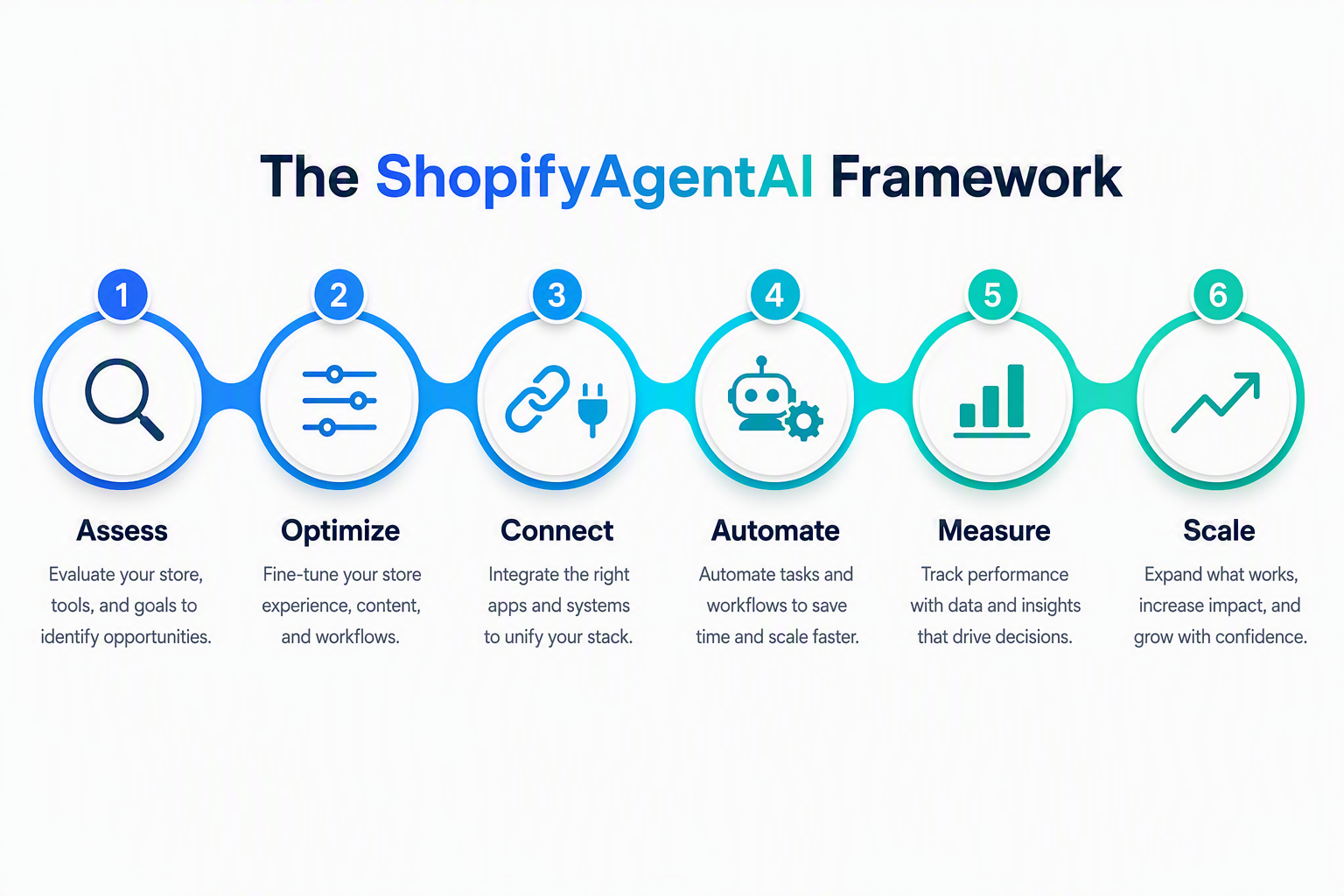
The ShopifyAgentAI Framework
At ShopifyAgentAI, we recommend implementing AI in stages rather than attempting a complete transformation overnight.
Step 1 — Assess
Review existing software, workflows, and manual processes.
Step 2 — Optimize
Improve current business processes before introducing automation.
Step 3 — Connect
Integrate your ecommerce platform, CRM, analytics, marketing tools, communication platforms, and operational systems.
Step 4 — Automate
Use AI agents and workflows to eliminate repetitive work.
Step 5 — Measure
Track time savings, customer experience improvements, and operational performance.
Step 6 — Scale
Expand successful automations into additional departments as your business grows.
The Biggest Mistake Businesses Make
Many organizations believe AI implementation begins with choosing software.
In reality...
It begins with understanding your business.
Every organization has unique workflows. Unique customers. Unique technology. Unique bottlenecks.
The best AI implementation isn't the one with the most features.
It's the one that solves the right problems.
That's why successful AI adoption almost always starts with understanding business processes before selecting technology.
⚠️ Common Mistake: Buying multiple AI subscriptions before mapping business workflows often leads to duplicate functionality, disconnected systems, and unnecessary software costs. Start with the workflow. Then choose the AI tools that support it.
Common Mistakes When Implementing AI Agents
Choosing the right AI agent is only the beginning.
Successful implementation depends on understanding your business processes, identifying automation opportunities, and connecting the right systems together.
Here are the mistakes we see most often.
Mistake #1: Trying to Automate Everything at Once
AI is incredibly powerful, but successful implementations happen in phases.
Rather than automating every department immediately, start with high-impact workflows that deliver measurable time savings.
Quick wins create momentum and make it easier to expand automation across the business.
Mistake #2: Buying Software Before Mapping Workflows
Businesses often purchase multiple AI subscriptions before understanding how those tools will work together.
The result is usually:
- Duplicate functionality
- Disconnected systems
- Higher software costs
- More complexity
- Lower adoption
Technology should support your workflow—not define it.
Mistake #3: Ignoring Existing Software
Many organizations already own powerful software.
The challenge isn't replacing it.
The challenge is connecting it.
Modern AI agents often provide the greatest value when integrated with your existing CRM, ecommerce platform, analytics tools, communication platforms, and operational systems.
Mistake #4: Overlooking Data Quality
AI performs best when it has access to clean, organized information.
Poor product data, incomplete customer records, outdated documentation, and inconsistent naming conventions all reduce the quality of AI outputs.
Before expanding automation, make sure your business data is reliable.
Mistake #5: Measuring Activity Instead of Results
The goal isn't building the largest automation library.
The goal is improving business outcomes.
Measure success through:
- Hours saved
- Faster response times
- Increased productivity
- Reduced operational costs
- Improved customer satisfaction
- Higher revenue per employee
Those metrics matter far more than the number of workflows you've created.
💡 ShopifyAgentAI Insight: The best AI projects don't start with software. They start with one question: "What repetitive work is preventing our team from focusing on growth?"
The Future of AI Agents in Business
AI agents are evolving rapidly.
Today's systems can already automate documentation, customer support, workflow coordination, reporting, and marketing.
Over the next several years, businesses can expect even greater capabilities.
Multi-Agent Collaboration
Instead of relying on a single AI assistant, organizations will increasingly deploy multiple specialized AI agents working together.
For example:
Marketing Agent → Sales Agent → Customer Support Agent → Operations Agent → Analytics Agent
Each agent performs specialized tasks while sharing information with the rest of the business.
Autonomous Workflow Management
Future AI agents will coordinate increasingly complex processes while keeping humans in control of approvals and strategic decisions.
Examples include:
- Marketing campaign execution
- Inventory forecasting
- Vendor communication
- Internal reporting
- Customer lifecycle management
AI-Powered Business Intelligence
Business owners won't need to search dashboards for answers.
Instead, they'll ask:
- "Why did sales decline this month?"
- "Which customers are most likely to buy again?"
- "Where should I invest my marketing budget?"
AI will provide recommendations alongside supporting data.
AI Shopping & Commerce
As AI assistants become part of the buying journey, businesses will need to optimize not only for search engines but also for AI-powered discovery.
Preparing today means investing in:
- Structured data
- Product knowledge
- Helpful content
- Workflow automation
- AI-ready business systems
Learn more about this shift in How AI Shopping Agents Discover Shopify Products.
Frequently Asked Questions
What is an AI agent?
An AI agent is software that can understand goals, analyze information, make decisions, and complete tasks with minimal human involvement. Unlike traditional automation, AI agents adapt to context and can coordinate multiple business systems.
What is the difference between AI agents and workflow automation?
Workflow automation follows predefined rules. AI agents combine reasoning, decision-making, and automation to complete more complex business processes.
Which AI agent is best for small businesses?
The best solution depends on your goals. Many small businesses begin with ChatGPT or Claude for productivity and pair them with automation platforms like Shopify Flow, Make, or Zapier as they grow. See our dedicated guide: Best AI Agents for Small Businesses.
Which AI agent is best for ecommerce?
Ecommerce businesses typically benefit from combining AI assistants with automation platforms, CRM integrations, analytics, and ecommerce-specific workflows. A connected AI ecosystem usually delivers better results than relying on a single tool. Compare options in The 12 Best Shopify AI Agents.
Can AI automate customer support?
Yes. AI can answer common questions, summarize conversations, recommend products, route support tickets, and escalate more complex issues to human agents.
Can AI automate marketing?
Absolutely. AI helps create email campaigns, product descriptions, landing pages, blog articles, social media content, advertising copy, and performance reports.
Can AI automate CRM workflows?
Modern AI systems can automate lead routing, customer summaries, follow-up recommendations, contact enrichment, and lifecycle management across most CRM platforms.
Do I need coding experience to use AI agents?
Not necessarily. Many platforms provide no-code or low-code interfaces. More advanced implementations involving custom workflows, integrations, or AI agents may benefit from technical expertise. See Can You Set Up Shopify MCP Yourself?.
Are AI agents replacing employees?
No. Most organizations use AI to automate repetitive work while allowing employees to focus on customer relationships, creativity, problem solving, and strategic decision-making.
How much do AI agents cost?
Costs vary widely. Some AI assistants charge monthly subscriptions, while enterprise implementations depend on workflow complexity, integrations, and business requirements.
What business processes should I automate first?
Most organizations begin with customer support, reporting, marketing, CRM updates, documentation, and email automation. These areas often produce the fastest return on investment.
How long does AI implementation take?
Simple automations may be implemented in days. Larger business-wide AI initiatives involving multiple systems typically require phased implementation over several weeks or months.
Can AI reduce software costs?
In many cases, yes. Connecting existing software more effectively often reduces duplicate functionality and eliminates unnecessary manual work. See How Shopify MCP Could Replace Multiple SaaS Tools.
How do I know which AI agent is right for my business?
The best solution depends on your existing software, workflows, business goals, and operational challenges. An AI assessment can help identify the highest-impact opportunities before investing in new tools.
Why Implementation Matters More Than Software
Businesses often spend weeks comparing AI platforms.
Ironically, that's usually the easiest part of the process.
The difficult part is designing workflows that actually improve how your business operates.
The same AI tool can produce dramatically different results depending on:
- Workflow design
- Integration quality
- Business processes
- Data organization
- Team adoption
- Ongoing optimization
That's why implementation is often the biggest factor separating successful AI projects from disappointing ones.
Ready to Automate Your Business?
Whether you're exploring AI for the first time or looking to connect existing software into a more intelligent business system, success starts with understanding your workflows—not simply purchasing another subscription.
At ShopifyAgentAI, we help businesses design practical AI ecosystems that reduce repetitive work, improve operations, and prepare organizations for the future of AI-powered commerce.
Our implementation approach focuses on measurable business outcomes rather than technology for technology's sake.
Get Your Free AI Business Automation Audit
Not sure where to start?
Our complimentary AI Business Automation Audit helps identify the highest-impact opportunities for your organization.
We'll review:
- ✔ Current software stack
- ✔ Manual business processes
- ✔ Automation opportunities
- ✔ CRM integration potential
- ✔ AI workflow recommendations
- ✔ AI shopping readiness
- ✔ SEO, GEO & AEO opportunities
- ✔ Estimated time savings
- ✔ Opportunities to reduce software costs
Instead of generic advice, you'll receive practical recommendations tailored to your business.
Continue Learning
Explore more resources from ShopifyAgentAI:
- The Ultimate Shopify AI Toolkit
- What Is Shopify MCP?
- Shopify MCP Installation Guide
- Shopify MCP Connectors Explained
- Best Shopify AI Agents
- Hire an AI Agent Service for Shopify Automation
- How AI Shopping Agents Discover Shopify Products
- SEO vs. AEO vs. GEO
Each guide is designed to help businesses understand not only what AI tools exist, but how to implement them effectively.
Final Thoughts
Artificial intelligence is quickly becoming part of the foundation of modern business operations.
The organizations that gain the greatest advantage won't necessarily be those using the most AI tools.
They'll be the ones implementing AI thoughtfully, connecting existing systems intelligently, and focusing on workflows that create measurable value.
Choosing the right AI agent is important.
Building the right AI strategy is even more important.
Whether you're optimizing customer support, automating operations, improving marketing, or preparing for AI-powered commerce, success comes from designing an ecosystem where your technology works together—not from adding more disconnected software.
At ShopifyAgentAI, that's exactly what we help businesses build.
Frequently Asked Questions
Quick answers to common questions about this topic.
An AI agent is software that can understand goals, analyze information, make decisions, and complete tasks with minimal human involvement. Unlike traditional automation, AI agents adapt to context and can coordinate multiple business systems.
Workflow automation follows predefined rules. AI agents combine reasoning, decision-making, and automation to complete more complex business processes.
The best solution depends on your goals. Many small businesses begin with ChatGPT or Claude for productivity and pair them with automation platforms like Shopify Flow, Make, or Zapier as they grow. See our dedicated guide: [Best AI Agents for Small Businesses](/blog/best-ai-agents-small-business-2026/).
Ecommerce businesses typically benefit from combining AI assistants with automation platforms, CRM integrations, analytics, and ecommerce-specific workflows. A connected AI ecosystem usually delivers better results than relying on a single tool. Compare options in [The 12 Best Shopify AI Agents](/blog/best-shopify-ai-agents-2026/).
Yes. AI can answer common questions, summarize conversations, recommend products, route support tickets, and escalate more complex issues to human agents.
Absolutely. AI helps create email campaigns, product descriptions, landing pages, blog articles, social media content, advertising copy, and performance reports.
Modern AI systems can automate lead routing, customer summaries, follow-up recommendations, contact enrichment, and lifecycle management across most CRM platforms.
Not necessarily. Many platforms provide no-code or low-code interfaces. More advanced implementations involving custom workflows, integrations, or AI agents may benefit from technical expertise. See [Can You Set Up Shopify MCP Yourself?](/blog/can-you-set-up-shopify-mcp-yourself-diy-guide/).
No. Most organizations use AI to automate repetitive work while allowing employees to focus on customer relationships, creativity, problem solving, and strategic decision-making.
Costs vary widely. Some AI assistants charge monthly subscriptions, while enterprise implementations depend on workflow complexity, integrations, and business requirements.
Most organizations begin with customer support, reporting, marketing, CRM updates, documentation, and email automation. These areas often produce the fastest return on investment.
Simple automations may be implemented in days. Larger business-wide AI initiatives involving multiple systems typically require phased implementation over several weeks or months.
In many cases, yes. Connecting existing software more effectively often reduces duplicate functionality and eliminates unnecessary manual work. See [How Shopify MCP Could Replace Multiple SaaS Tools](/blog/shopify-mcp-replace-ecommerce-saas-tools/).
The best solution depends on your existing software, workflows, business goals, and operational challenges. An AI assessment can help identify the highest-impact opportunities before investing in new tools.
Related Reading
What Is Shopify MCP? The New AI Layer That Could Change How Shopify Stores Operate
Learn what Shopify MCP (Model Context Protocol) is, how it works, and why it could transform how Shopify stores use AI agents for customer support, sales, and automation.
Read articleThe Shift from SEO to GEO: Why Generative Engine Optimization Is the Future of Ecommerce Visibility
Traditional SEO is losing ground to AI-powered search. Learn how Generative Engine Optimization (GEO) works, the technical implementation details including structured data and entity structuring, and why Shopify stores that don't adapt will become invisible.
Read articleClaude vs ChatGPT for Shopify MCP: Which AI Is Better for Ecommerce Automation?
Compare Claude and ChatGPT for Shopify MCP integrations. Detailed analysis of strengths, use cases, context windows, and why the future of ecommerce AI is multi-model.
Read articleReady to Automate Your Shopify Store?
Get a personalized AI automation audit and discover how your Shopify store can leverage AI agents, MCP integrations, and intelligent workflows to save time, reduce costs, and drive growth.
- Automation opportunities identified
- SaaS consolidation analysis
- AI workflow recommendations
- No obligation, no pressure