Best AI Agents for Small Businesses in 2026 (Compared by Use Case)
Artificial intelligence has evolved far beyond simple chatbots. Today's AI agents can handle customer support, create marketing campaigns, analyze business data, automate repetitive tasks, and even manage parts of your ecommerce operations with minimal human intervention.
For small businesses, this shift is especially significant. Instead of hiring multiple specialists or paying for a growing stack of software subscriptions, AI agents can act as virtual team members that work around the clock.
The challenge isn't deciding whether to use AI anymore—it's choosing the right AI agent for your business.
In this guide, we'll compare the best AI agents for small businesses, explain what they do best, and help you determine which solution fits your goals.
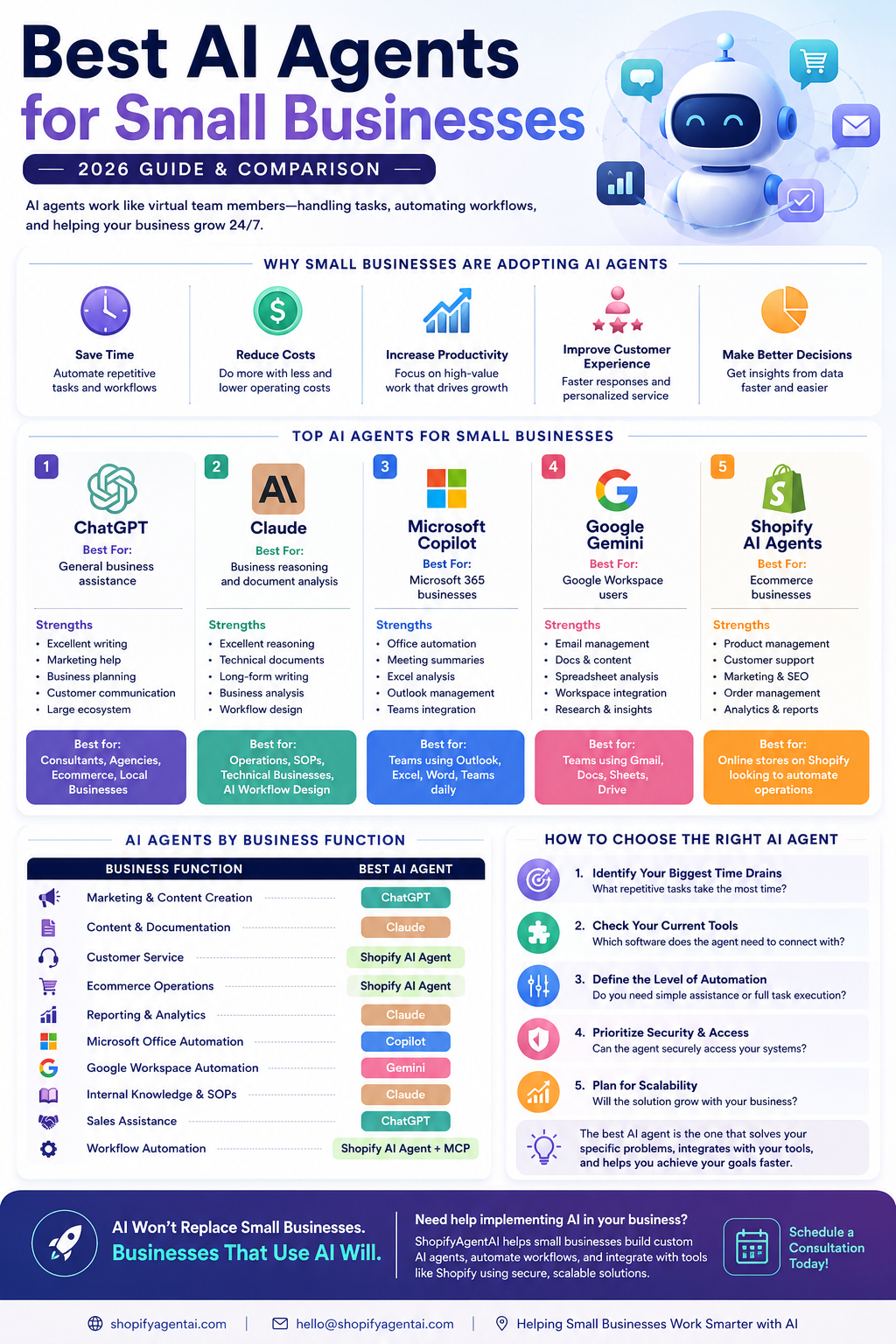
What Is an AI Agent?
Unlike traditional AI tools that simply respond to prompts, an AI agent can complete tasks, access external systems, make decisions, and perform multi-step workflows.
Think of an AI agent as an employee that can:
- Research information
- Access software
- Complete repetitive work
- Analyze business data
- Learn from context
- Execute tasks across multiple platforms
For example, instead of asking AI to "write an email," an AI agent could:
- Analyze yesterday's sales
- Identify best-selling products
- Write a promotional email
- Schedule the campaign
- Generate social media posts
- Produce a performance report
—all from a single instruction.
Why Small Businesses Are Adopting AI Agents
Small businesses often operate with limited budgets and lean teams. AI agents allow owners to automate time-consuming work without hiring additional employees.
Common benefits include:
| Benefit | Impact |
|---|---|
| Faster customer support | 24/7 availability, instant responses |
| Reduced operational costs | Replace multiple SaaS subscriptions |
| Increased productivity | Automate repetitive tasks |
| Better marketing consistency | Scheduled content, automated campaigns |
| Faster reporting | Real-time dashboards and insights |
| Improved customer experiences | Personalized interactions at scale |
| More time for strategic growth | Focus on high-value decisions |
Many businesses discover that AI agents quickly become one of the highest ROI technology investments they make.
🚀 Ready to see what AI can do for your business? Get a free AI readiness audit and discover which tasks you can automate first.
The Best AI Agents for Small Businesses
1. ChatGPT
Best For: General business assistance
ChatGPT excels at content creation, brainstorming, documentation, planning, customer communication, and everyday business tasks.
| Category | Details |
|---|---|
| Strengths | Excellent writing, marketing assistance, business planning, customer communication, large ecosystem |
| Limitations | Requires integrations to perform actions inside business software |
| Best for | Consultants, agencies, ecommerce, local businesses, marketing teams |
2. Claude
Best For: Business reasoning and document analysis
Claude is particularly strong at understanding complex information, creating long-form content, analyzing reports, and helping businesses build workflows.
| Category | Details |
|---|---|
| Strengths | Excellent reasoning, technical documentation, long-form writing, business analysis, software planning |
| Best for | Operations, SOP creation, AI workflow design, technical businesses |
3. Microsoft Copilot
Best For: Microsoft 365 businesses
Companies heavily invested in Outlook, Excel, Teams, and Word benefit from seamless AI integration throughout Microsoft's ecosystem.
| Category | Details |
|---|---|
| Strengths | Native Microsoft integration, familiar interface, enterprise security |
| Best for | Office automation, internal documentation, meeting summaries, Excel analysis |
4. Google Gemini
Best For: Google Workspace users
Gemini integrates naturally with Gmail, Docs, Sheets, and Drive.
| Category | Details |
|---|---|
| Strengths | Deep Google integration, multimodal capabilities, real-time search |
| Best for | Email management, document creation, spreadsheet analysis, workspace productivity |
5. Shopify AI Agents
Best For: Ecommerce businesses
Rather than acting as general assistants, Shopify AI agents specialize in ecommerce operations. They can help with:
- Product management
- Inventory
- Customer service
- Marketing
- SEO
- Analytics
- Order management
- Merchandising
When combined with Shopify's Model Context Protocol (MCP), AI agents can securely interact with your store using natural language instead of relying on dozens of disconnected automations.
For growing ecommerce brands, this approach often replaces multiple software subscriptions while creating a more scalable automation strategy.
💡 Want to learn more about Shopify MCP? Read our complete guide: What Is Shopify MCP and Why Does It Matter?
AI Agents by Business Function
| Business Need | Recommended AI Agent | Why |
|---|---|---|
| Marketing | ChatGPT | Versatile content creation and campaign ideation |
| Content Creation | Claude | Superior long-form writing and reasoning |
| Customer Service | Shopify AI Agent | Native ecommerce context and order access |
| Ecommerce Operations | Shopify AI Agent | Direct store integration via MCP |
| Reporting | Claude | Complex data analysis and synthesis |
| Microsoft Office | Copilot | Seamless 365 ecosystem integration |
| Google Workspace | Gemini | Native Gmail, Docs, Sheets integration |
| Internal Knowledge | Claude | Document analysis and SOP creation |
| Sales Assistance | ChatGPT | Lead communication and outreach |
| Workflow Automation | Shopify AI Agent + MCP | Unified multi-system orchestration |
Should You Use One AI Agent or Multiple?
Many businesses start by experimenting with several AI tools. Over time, however, they often discover that managing multiple disconnected systems creates unnecessary complexity.
A better long-term approach is to build an AI ecosystem where specialized agents work together.
Example Multi-Agent Ecosystem:
| Agent Role | Responsibility |
|---|---|
| Marketing Agent | Creates blogs, emails, and social content |
| Sales Agent | Analyzes leads and customer behavior |
| Support Agent | Handles customer inquiries and order lookups |
| Operations Agent | Monitors inventory and fulfillment |
| Executive Agent | Creates dashboards and business reports |
Instead of replacing employees, these agents augment your team by handling repetitive work, allowing people to focus on strategy and customer relationships.
🔧 Curious how a multi-agent system works in practice? See how businesses are replacing multiple SaaS tools with unified AI workflows.
How to Choose the Right AI Agent
Before selecting an AI platform, ask yourself:
- What repetitive tasks consume the most time?
- Which software needs to connect?
- How much automation do you want?
- Do you need industry-specific capabilities?
- Can the AI securely access your business systems?
- Will it scale as your business grows?
Choosing an AI agent isn't just about features—it's about creating a foundation that supports your future operations.
Why Integration Matters More Than Features
Many businesses purchase multiple AI subscriptions only to discover that none of them communicate with one another.
The real value comes from integration.
Modern technologies such as the Model Context Protocol (MCP) allow AI agents to securely connect with platforms like Shopify, creating unified workflows instead of isolated automations.
This reduces software costs, simplifies operations, and gives businesses greater flexibility as AI capabilities continue to evolve.
Integration vs. Isolation
| Approach | Result |
|---|---|
| Multiple disconnected AI tools | Data silos, manual handoffs, higher costs |
| Integrated AI ecosystem (MCP) | Unified workflows, automated handoffs, lower costs |
Frequently Asked Questions
What is the best AI agent for small businesses?
The best AI agent depends on your goals. ChatGPT and Claude are excellent general-purpose assistants, while Shopify AI agents are ideal for ecommerce businesses looking to automate store operations.
Are AI agents different from chatbots?
Yes. Chatbots primarily answer questions, while AI agents can complete tasks, interact with software, and execute multi-step workflows. Learn more about how AI agents work.
Can AI agents replace employees?
AI agents are best viewed as productivity tools. They automate repetitive work, allowing employees to focus on higher-value tasks rather than replacing human expertise.
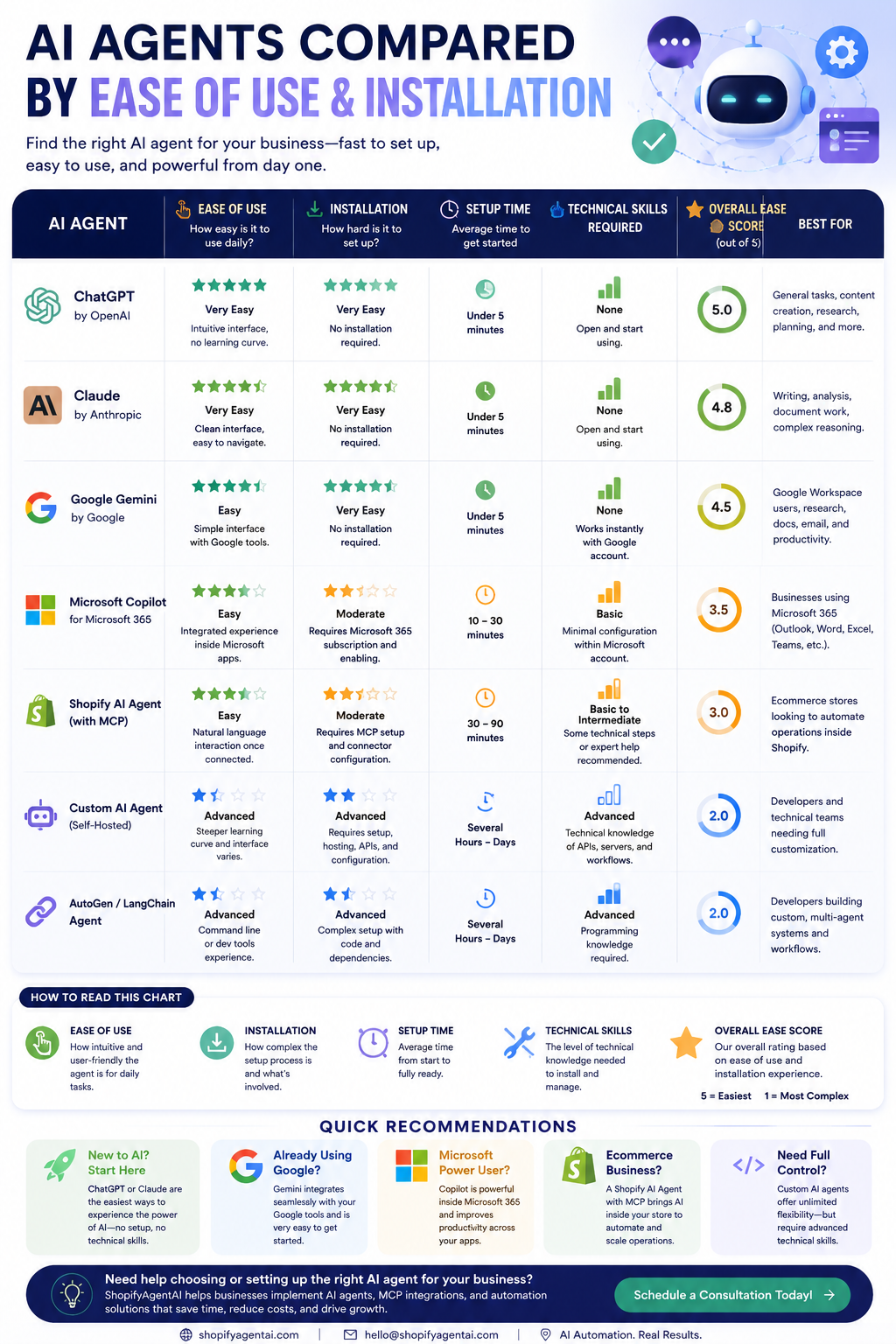
Do AI agents require coding?
Not always. Many AI platforms offer no-code or low-code integrations, while advanced implementations—such as custom Shopify AI agents using MCP—may require technical setup. See our DIY setup guide for more details.
How much do AI agents cost for small businesses?
Costs vary widely. ChatGPT and Claude offer plans starting at $20/month, while specialized ecommerce AI solutions range from $50–$500/month depending on capabilities. The ROI typically far exceeds the investment—learn more in our cost savings analysis.
Ready to Build an AI Agent for Your Business?
Choosing the right AI platform is only the first step. The biggest gains come from implementing AI in a way that connects your existing tools, reduces manual work, and scales with your business.
At ShopifyAgentAI, we help businesses design and implement practical AI solutions—from Shopify AI agents and MCP integrations to workflow automation, AI readiness audits, and custom ecommerce strategies.
Whether you're exploring AI for the first time or looking to replace a patchwork of disconnected apps with a unified AI ecosystem, we can help you build a solution tailored to your business goals.
🎯 Get started today. Schedule a free consultation to learn how AI agents can save time, lower operating costs, and help your business grow.
Related Reading
- The 12 Best Shopify AI Agents in 2026 (Compared by Use Case) — Deep dive into Shopify-specific AI agents
- How Much Can Small E-Commerce Companies Save With AI Automation? — ROI data and cost comparisons
- How Shopify MCP Could Replace Multiple SaaS Tools — Consolidating your tech stack
- Hire an AI Agent Service for Shopify Automation — When to DIY vs. hire experts
- How to Add an AI Agent to Your Shopify Store — Step-by-step implementation guide
Frequently Asked Questions
Quick answers to common questions about this topic.
The best AI agent depends on your goals. ChatGPT and Claude are excellent general-purpose assistants, while [Shopify AI agents](/blog/best-shopify-ai-agents-2026/) are ideal for ecommerce businesses looking to automate store operations.
Yes. Chatbots primarily answer questions, while AI agents can complete tasks, interact with software, and execute multi-step workflows. Learn more about [how AI agents work](/blog/ai-agents-shopify-implementation-guide/).
AI agents are best viewed as productivity tools. They automate repetitive work, allowing employees to focus on higher-value tasks rather than replacing human expertise.
Not always. Many AI platforms offer no-code or low-code integrations, while advanced implementations—such as custom Shopify AI agents using MCP—may require technical setup. See our [DIY setup guide](/blog/can-you-set-up-shopify-mcp-yourself-diy-guide/) for more details.
Costs vary widely. ChatGPT and Claude offer plans starting at $20/month, while specialized ecommerce AI solutions range from $50–$500/month depending on capabilities. The ROI typically far exceeds the investment—learn more in our [cost savings analysis](/blog/ecommerce-tech-stack-cost-savings-ai-automation/).
Related Reading
What Is Shopify MCP? The New AI Layer That Could Change How Shopify Stores Operate
Learn what Shopify MCP (Model Context Protocol) is, how it works, and why it could transform how Shopify stores use AI agents for customer support, sales, and automation.
Read articleThe Shift from SEO to GEO: Why Generative Engine Optimization Is the Future of Ecommerce Visibility
Traditional SEO is losing ground to AI-powered search. Learn how Generative Engine Optimization (GEO) works, the technical implementation details including structured data and entity structuring, and why Shopify stores that don't adapt will become invisible.
Read articleClaude vs ChatGPT for Shopify MCP: Which AI Is Better for Ecommerce Automation?
Compare Claude and ChatGPT for Shopify MCP integrations. Detailed analysis of strengths, use cases, context windows, and why the future of ecommerce AI is multi-model.
Read articleReady to Automate Your Shopify Store?
Get a personalized AI automation audit and discover how your Shopify store can leverage AI agents, MCP integrations, and intelligent workflows to save time, reduce costs, and drive growth.
- Automation opportunities identified
- SaaS consolidation analysis
- AI workflow recommendations
- No obligation, no pressure