How Much Can Small E-Commerce Companies Save With the Right Tech Stack and AI Automation?
The Hidden Cost Crisis in Small Ecommerce
Most small and mid-size ecommerce companies are bleeding money on their tech stack without realizing it.
Between disconnected SaaS subscriptions, manual customer support, fragmented marketing tools, and integration maintenance — the average small ecommerce business spends $8,000 to $12,000 per month on operational technology that could be consolidated, automated, or eliminated entirely.
The problem isn't that these businesses lack tools. It's that they have too many — and none of them talk to each other.
According to industry research, the average small ecommerce business uses 12–18 different SaaS tools, with significant overlap in functionality and zero unified data flow between them.
This article breaks down exactly where the money goes, what a poor tech stack actually costs, and how much companies can realistically save by switching to an optimized AI-powered architecture.
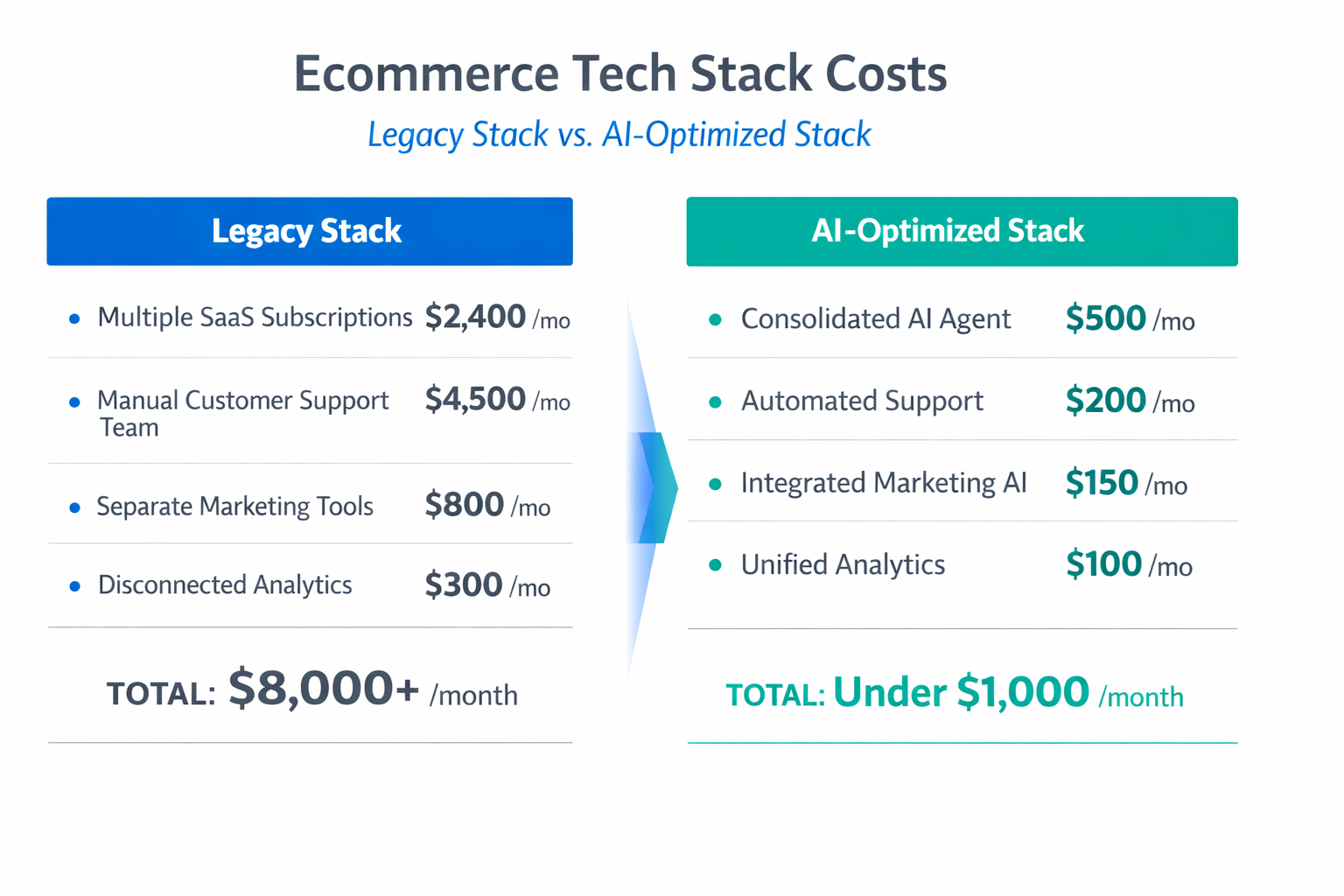 Figure: Side-by-side cost comparison — a legacy ecommerce tech stack averaging $8,000+/month versus an AI-optimized stack under $1,000/month with consolidated functionality.
What a Poor Tech Stack Actually Costs
The Visible Costs
Most ecommerce operators know about their monthly SaaS bills. But few have totaled them up across every category:
| Category | Typical Monthly Cost | Annual Cost |
|---|---|---|
| Multiple support tools (Zendesk, Intercom, etc.) | $300–$800 | $3,600–$9,600 |
| Email marketing platform | $150–$500 | $1,800–$6,000 |
| SMS marketing tool | $100–$400 | $1,200–$4,800 |
| Review/UGC platform | $100–$300 | $1,200–$3,600 |
| Search & merchandising app | $200–$600 | $2,400–$7,200 |
| Analytics & reporting tools | $100–$400 | $1,200–$4,800 |
| Quiz/recommendation apps | $50–$200 | $600–$2,400 |
| Workflow automation (Zapier, etc.) | $100–$300 | $1,200–$3,600 |
| Customer support staff (1–3 agents) | $3,000–$9,000 | $36,000–$108,000 |
| Total | $4,100–$12,500 | $49,200–$150,000 |
For a small ecommerce company doing $500K–$2M in annual revenue, that's 10–30% of gross revenue going to operational technology and support labor.
The Hidden Costs
Beyond the subscription fees, a fragmented tech stack creates compounding hidden costs:
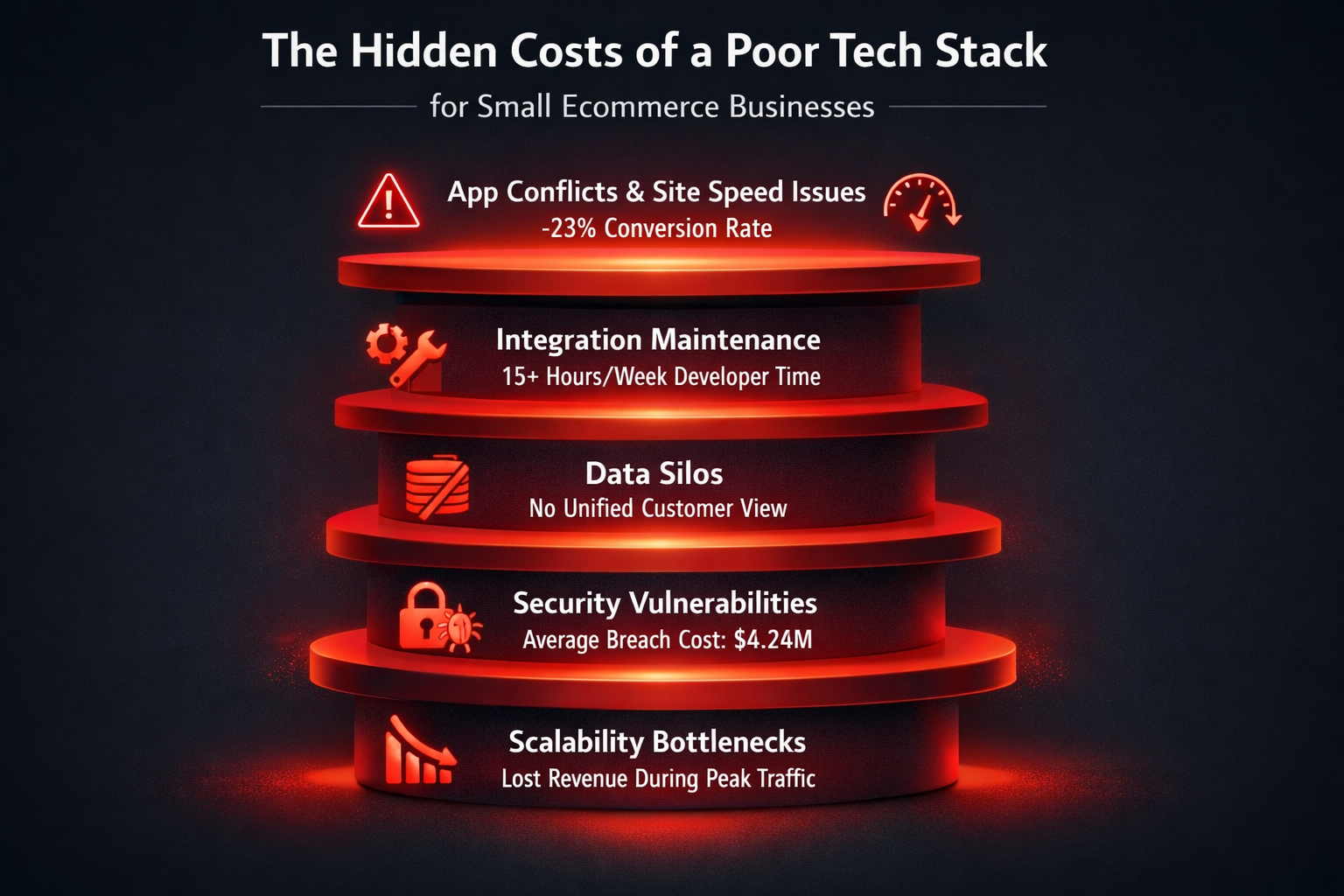 Figure: The hidden costs of a poor tech stack extend far beyond monthly subscription fees — they compound into lost revenue, wasted time, and missed growth opportunities.
1. Site Speed Degradation
Every additional app script on your storefront adds load time. Research shows that each additional second of page load time reduces conversions by 7–10%. A store running 15+ apps can easily add 2–4 seconds of load time, translating to a 15–30% reduction in conversion rate.
For a store doing $100K/month, that's $15,000–$30,000 in lost monthly revenue from site speed alone.
2. Integration Maintenance
Disconnected tools require constant maintenance. When one app updates, integrations break. The average small ecommerce team spends 10–15 hours per week managing app conflicts, data syncing issues, and broken workflows.
At $50–$100/hour for developer or agency time, that's $2,000–$6,000/month in maintenance costs.
3. Data Silos
When your email tool doesn't talk to your support tool, which doesn't talk to your analytics platform, you lose the ability to:
- Personalize customer experiences
- Identify at-risk customers
- Optimize marketing spend
- Make data-driven decisions
The opportunity cost of fragmented data is estimated at $10,000–$30,000/year for small ecommerce businesses in missed personalization revenue.
4. Scalability Bottlenecks
During peak traffic events (Black Friday, product launches, viral moments), fragmented tech stacks often break. Apps conflict, servers slow down, and checkout flows fail.
The average ecommerce business loses 12–18% of potential peak-period revenue due to tech stack limitations during high-traffic events.
The AI-Optimized Alternative
An AI-powered tech stack consolidates multiple tools into fewer, smarter systems that communicate natively.
Here's what the modern alternative looks like:
| Legacy Approach | AI-Optimized Approach | Monthly Savings |
|---|---|---|
| 3 support agents ($9,000/mo) | AI support agent + 1 human ($3,500/mo) | $5,500 |
| Separate email + SMS tools ($650/mo) | Unified AI marketing system ($200/mo) | $450 |
| Quiz app + search app + recs ($450/mo) | AI shopping assistant via MCP ($150/mo) | $300 |
| Zapier + custom workflows ($300/mo) | Native AI workflow automation ($100/mo) | $200 |
| Analytics + reporting stack ($400/mo) | Unified AI analytics ($100/mo) | $300 |
| FAQ system + knowledge base ($200/mo) | AI agent with store knowledge ($50/mo) | $150 |
| Total Legacy: ~$11,000/mo | Total AI-Optimized: ~$4,100/mo | $6,900/mo saved |
That's $82,800 per year in direct savings — before accounting for the revenue gains from better customer experiences, faster support, and higher conversion rates.
Real Numbers: Annual Savings Breakdown
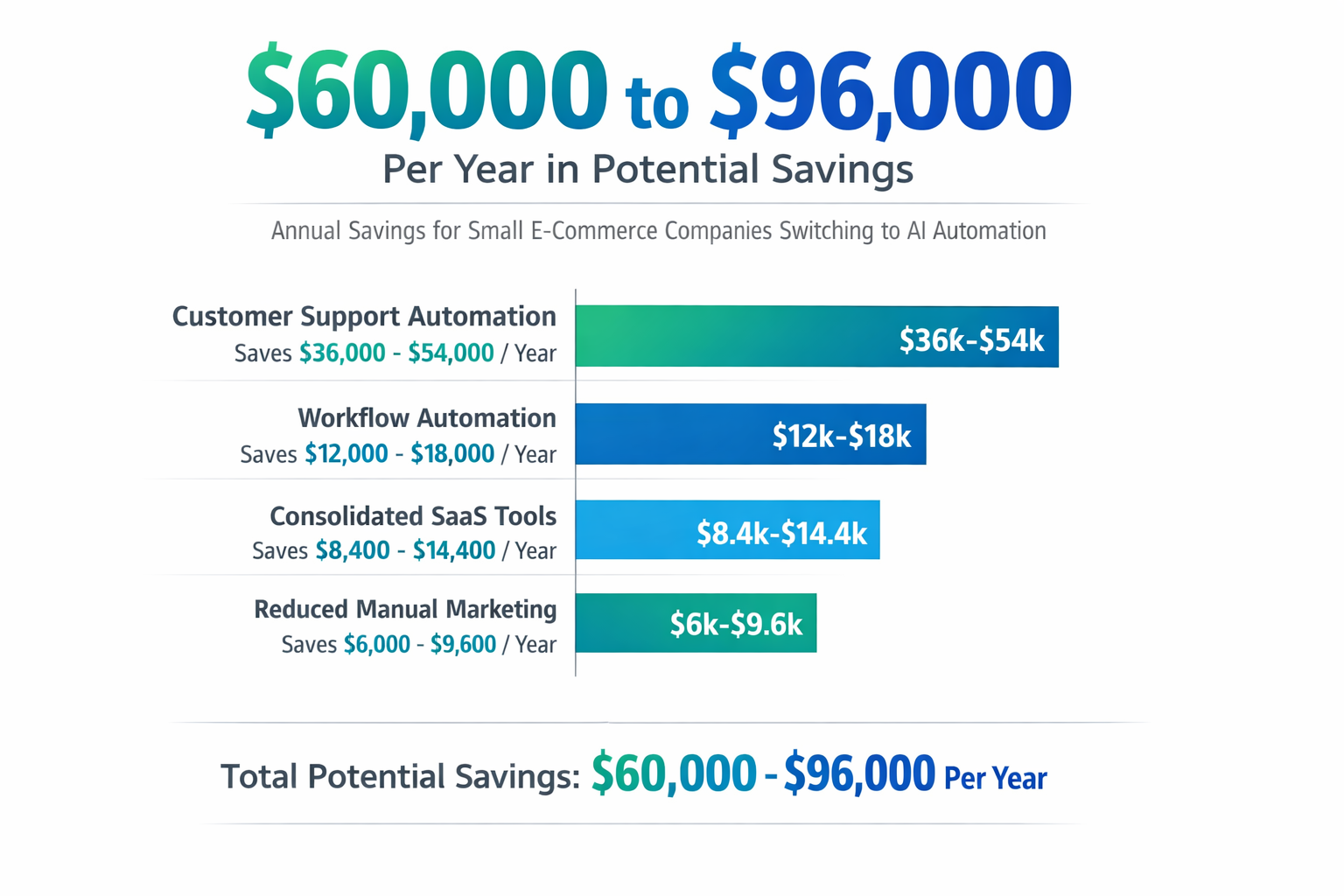 Figure: Small ecommerce companies can realistically save $60,000–$96,000 per year by implementing AI automation across support, workflows, SaaS consolidation, and marketing.
Customer Support Automation: $36,000–$54,000/year
The biggest single savings category. An AI agent trained on your store's products, policies, and customer data can handle 60–80% of support tickets without human intervention.
- Average cost per human-handled ticket: $8–$15
- Average cost per AI-handled ticket: $0.10–$0.50
- At 500 tickets/month, that's $4,000–$7,500/month in savings
Workflow Automation: $12,000–$18,000/year
AI-powered workflow automation eliminates manual tasks like:
- Order routing and fulfillment triggers
- Customer segmentation updates
- Inventory alerts and reorder notifications
- Review request timing
- Abandoned cart sequences
These tasks typically consume 15–25 hours/week of staff time at small companies.
SaaS Consolidation: $8,400–$14,400/year
Replacing 5–8 separate tools with 1–2 AI-powered systems that handle multiple functions:
- Search + recommendations + quizzes → AI shopping assistant
- FAQ + knowledge base + basic support → AI support agent
- Multiple analytics dashboards → Unified AI reporting
Marketing Efficiency: $6,000–$9,600/year
AI-driven marketing reduces waste by:
- Optimizing send times automatically
- Personalizing content at scale without manual segmentation
- Reducing A/B testing cycles from weeks to hours
- Eliminating underperforming campaigns faster
The AI Agent Advantage
The single highest-impact investment for most small ecommerce companies is implementing an AI agent connected to their store data.
Unlike traditional chatbots that follow scripted flows, a properly implemented AI agent powered by Shopify MCP:
- Accesses live product, order, and customer data
- Reasons through complex customer requests
- Handles support, sales, and discovery simultaneously
- Learns from interactions to improve over time
- Operates 24/7 without breaks or training costs
- Scales instantly during peak periods
ROI Timeline for AI Agent Implementation
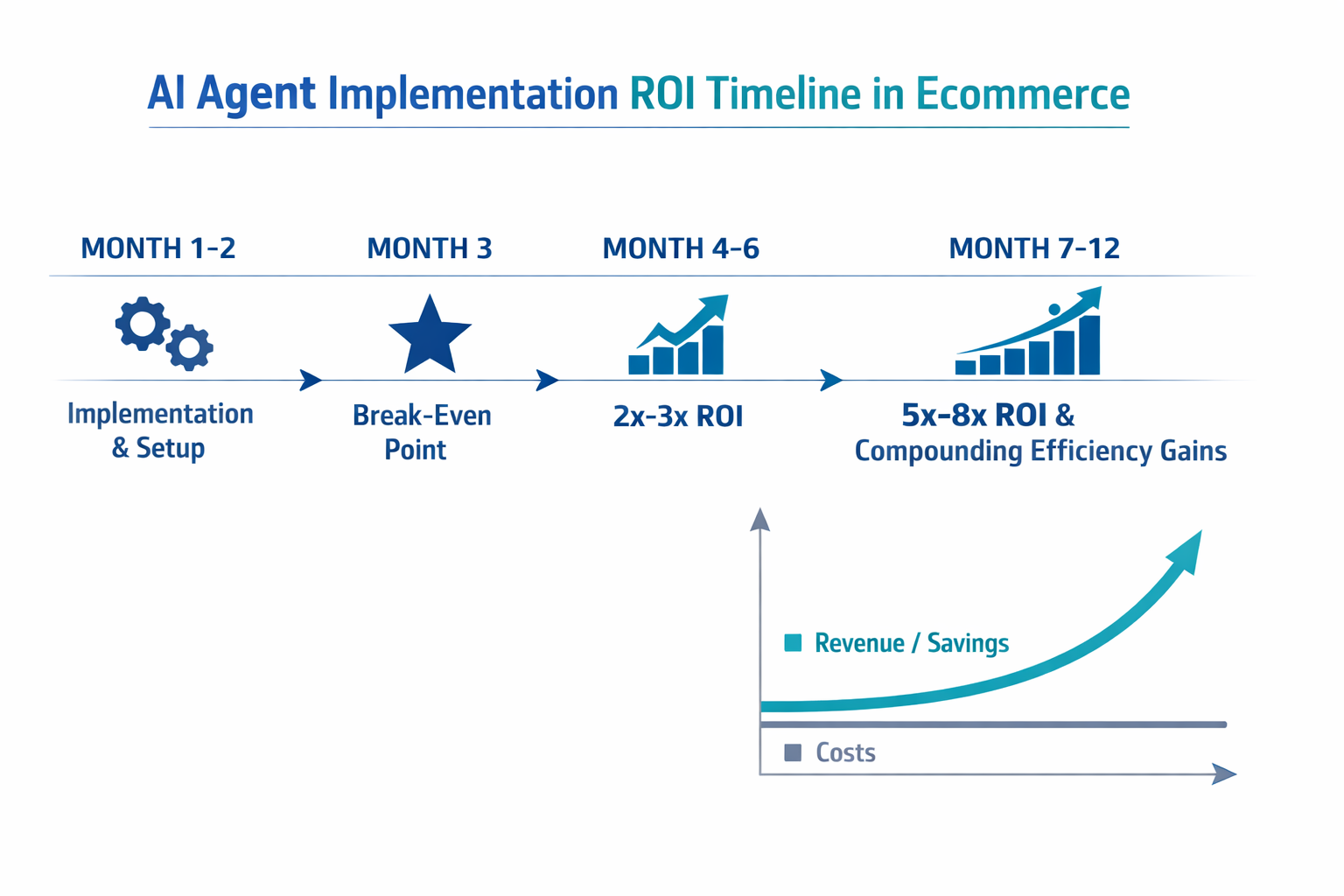 Figure: Most ecommerce AI agent implementations reach break-even within 3 months and deliver 5x–8x ROI within the first year through compounding efficiency gains.
Month 1–2: Implementation and configuration Month 3: Break-even point (savings exceed implementation cost) Month 4–6: 2x–3x ROI as the system handles increasing ticket volume Month 7–12: 5x–8x ROI with compounding efficiency gains and reduced scaling costs
For a typical implementation costing $5,000–$15,000 upfront, the first-year net savings range from $40,000–$80,000 after accounting for the implementation investment.
What "The Right Tech Stack" Actually Looks Like
For small ecommerce companies ($500K–$5M revenue), the optimal AI-powered tech stack in 2026 typically includes:
Core Infrastructure
- Shopify (or equivalent platform) — storefront and commerce engine
- One AI agent system — handles support, sales assistance, and product discovery
- One unified marketing platform — email, SMS, and automation in one tool
- One analytics system — connected to all data sources
AI Layer
- MCP integration — connects AI agents to live store data
- Workflow automation — handles repetitive operational tasks
- Content generation — product descriptions, email copy, social content
What Gets Eliminated
A single MCP-powered agent can replace multiple SaaS tools:
- Separate quiz/recommendation apps
- Standalone FAQ/knowledge base tools
- Multiple disconnected support channels
- Manual workflow tools (Zapier, etc.)
- Redundant analytics platforms
- Scripted chatbot subscriptions
Common Objections (And Why They Don't Hold Up)
"AI implementation is too expensive for small businesses"
Reality: A basic AI agent implementation costs $5,000–$15,000 one-time, with $200–$500/month ongoing. Compare that to $8,000–$12,000/month in legacy stack costs. The math works within 60–90 days.
"We don't have the technical expertise"
Reality: Modern AI implementation services handle the entire technical scope. You don't need to understand APIs, prompts, or server configuration. You need a partner who does.
"Our current stack works fine"
Reality: "Working" and "optimal" are different things. A stack that functions but costs 3–5x more than necessary while delivering worse customer experiences isn't actually working — it's just familiar.
"AI will replace our team"
Reality: AI handles the repetitive 60–80% of tasks so your team can focus on the high-value 20–40% that actually requires human judgment, creativity, and relationship building. Most companies that implement AI grow their teams because they can afford to invest in higher-value roles.
How to Calculate Your Potential Savings
Here's a simple framework to estimate your own savings potential:
Step 1: Total your monthly SaaS subscriptions across all categories Step 2: Add your customer support labor costs (staff + management time) Step 3: Estimate weekly hours spent on manual workflows × hourly rate Step 4: Estimate lost revenue from site speed issues (use Google PageSpeed + conversion data) Step 5: Add integration maintenance costs (developer/agency hours)
Your total = Current operational cost
Step 6: Subtract the cost of an AI-optimized stack (~$1,000–$2,000/month for most small businesses)
The difference = Your annual savings potential
For most small ecommerce companies, this calculation reveals $50,000–$100,000+ in annual savings — money that can be reinvested into growth, inventory, marketing, or profit.
The Bottom Line
Small ecommerce companies are overspending on technology by 40–70% compared to what's possible with modern AI-powered architectures.
The companies that recognize this and act on it gain:
- Lower operational costs — $60,000–$96,000/year in direct savings
- Better customer experiences — faster, smarter, 24/7 support and shopping assistance
- Higher conversion rates — faster sites, better product discovery, personalized experiences
- More scalable operations — systems that grow without proportional cost increases
- Competitive advantage — while competitors stack more apps, you operate leaner and smarter
The technology exists today. The implementation expertise exists today. The only question is whether you'll optimize now or continue overpaying for a fragmented stack that's holding your business back.
Related Reading
Learn more about the AI technologies driving these cost savings:
- What Is Shopify MCP? — The protocol that connects AI agents to your store data, enabling the consolidation described above.
- AI Agents for Shopify: Implementation Guide — What AI agents actually do when connected to your store — and how implementation works.
- How Shopify MCP Could Replace Multiple SaaS Tools — A tool-by-tool breakdown of how one AI system replaces quiz apps, chat, recommendations, and more.
- Shopify MCP Integration Explained — The technical foundation that makes AI-powered cost reduction possible.
- What Is Conversational Commerce? — How AI shopping assistants create better customer experiences at lower cost.
- The Shift from SEO to GEO — How generative engine optimization changes the visibility equation for cost-conscious merchants.
← Back to Blog · ← Back to Home
Ready to See What You Could Save?
At Shopify Agent AI, we help small and mid-size ecommerce companies audit their current tech stack, identify savings opportunities, and implement AI-powered systems that reduce costs while improving performance.
Our free AI Readiness Audit shows you exactly where you're overspending and what an optimized stack would look like for your specific business.
Book a Discovery Call to get your personalized savings analysis.
Related Reading
What Is Shopify MCP? The New AI Layer That Could Change How Shopify Stores Operate
Learn what Shopify MCP (Model Context Protocol) is, how it works, and why it could transform how Shopify stores use AI agents for customer support, sales, and automation.
Read articleThe Shift from SEO to GEO: Why Generative Engine Optimization Is the Future of Ecommerce Visibility
Traditional SEO is losing ground to AI-powered search. Learn how Generative Engine Optimization (GEO) works, the technical implementation details including structured data and entity structuring, and why Shopify stores that don't adapt will become invisible.
Read articleClaude vs ChatGPT for Shopify MCP: Which AI Is Better for Ecommerce Automation?
Compare Claude and ChatGPT for Shopify MCP integrations. Detailed analysis of strengths, use cases, context windows, and why the future of ecommerce AI is multi-model.
Read articleReady to Automate Your Shopify Store?
Get a personalized AI automation audit and discover how your Shopify store can leverage AI agents, MCP integrations, and intelligent workflows to save time, reduce costs, and drive growth.
- Automation opportunities identified
- SaaS consolidation analysis
- AI workflow recommendations
- No obligation, no pressure