What Is Shopify MCP?
The New AI Layer That Could Change How Shopify Stores Operate
Artificial intelligence is quickly becoming part of everyday ecommerce operations — from customer support and product recommendations to inventory management and personalized shopping experiences. But one of the biggest recent developments for Shopify merchants is something called Shopify MCP.
If you've been seeing terms like AI agents, Shopify MCP servers, or AI-powered Shopify automation floating around online, here's what you actually need to know.
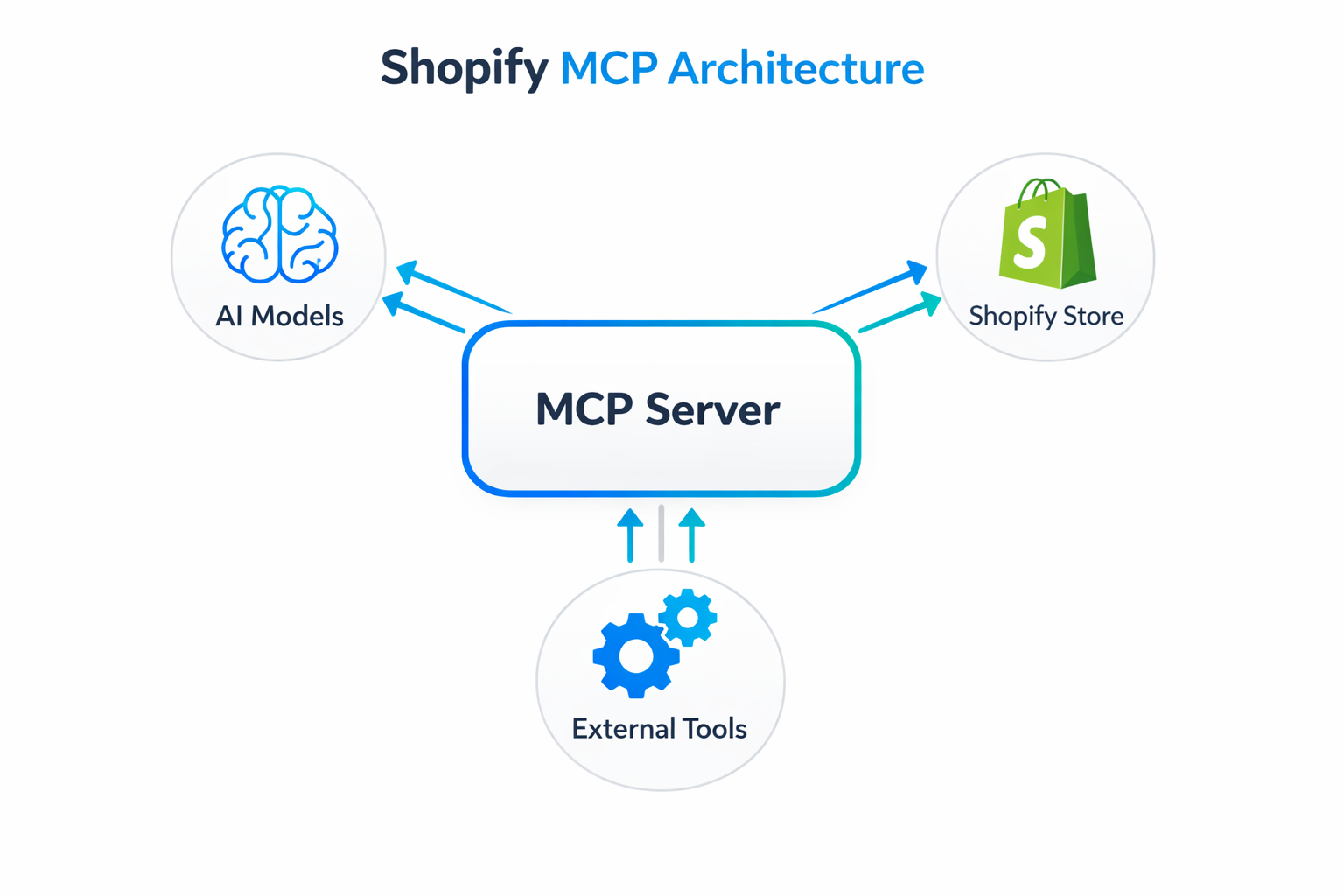 Figure: Shopify MCP architecture — the Model Context Protocol acts as a bridge between AI models, your Shopify store, and external tools.
What Does MCP Stand For?
MCP stands for Model Context Protocol.
It's an open protocol designed to let AI systems securely connect to external tools, platforms, and data sources — including Shopify stores.
In simpler terms:
Shopify MCP gives AI assistants a structured way to interact with your Shopify store in real time.
Instead of an AI chatbot only answering pre-written FAQs, an MCP-enabled AI agent can potentially:
- Access live product data
- Check inventory
- Create carts
- Recommend products intelligently
- Look up orders
- Help with customer support
- Trigger workflows
- Interact with apps and backend systems
Think of it as turning your Shopify store into something AI can actually work with, not just talk about.
Why Shopify MCP Matters
Traditional ecommerce automation has usually required:
- Expensive SaaS subscriptions
- Multiple disconnected apps
- Custom APIs
- Zapier workflows
- Manual coding
- Complex integrations
Shopify MCP changes the conversation by creating a more standardized bridge between AI and Shopify.
That means businesses may soon be able to deploy advanced AI shopping assistants without building everything from scratch.
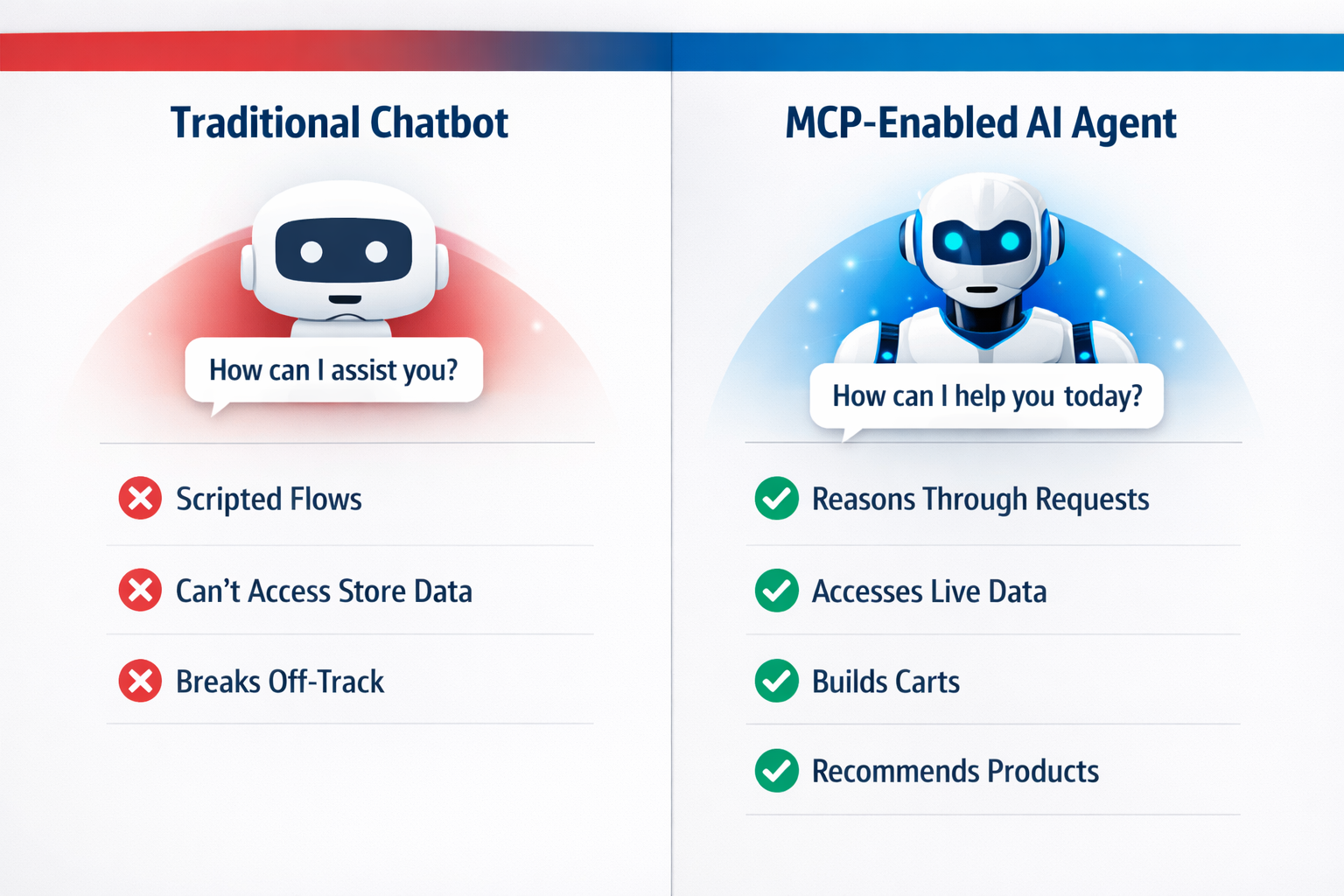 Figure: Traditional chatbots follow scripted flows and break easily, while MCP-enabled AI agents can reason through requests and interact with actual store systems.
The Shift From "Chatbots" to AI Agents
Most ecommerce chatbots today are limited. AI agents represent a fundamentally different approach to store automation.
They typically:
- Follow scripted flows
- Struggle with nuanced questions
- Can't access deeper store functionality
- Break easily when conversations go off track
MCP-enabled AI agents are different.
They can reason through requests and interact with actual store systems.
For example, a customer could ask:
"I need a modern black wall-mounted wine rack that fits a small apartment and ships fast."
An AI agent connected through Shopify MCP could:
- Search your catalog
- Filter products intelligently
- Compare styles
- Check stock availability
- Recommend matching accessories
- Build a cart
- Answer installation questions
- Guide the shopper toward conversion
That's far beyond a standard chatbot.
How Shopify MCP Works
At a high level, Shopify MCP acts as a communication layer between:
- AI models
- Your Shopify store
- External tools and services
The MCP server exposes specific store functions and data in a secure, structured format AI systems can understand.
This may include:
- Product catalogs
- Collections
- Customer data permissions
- Cart actions
- Orders
- Storefront information
- App integrations
- Business logic
The AI assistant then uses those tools dynamically during conversations.
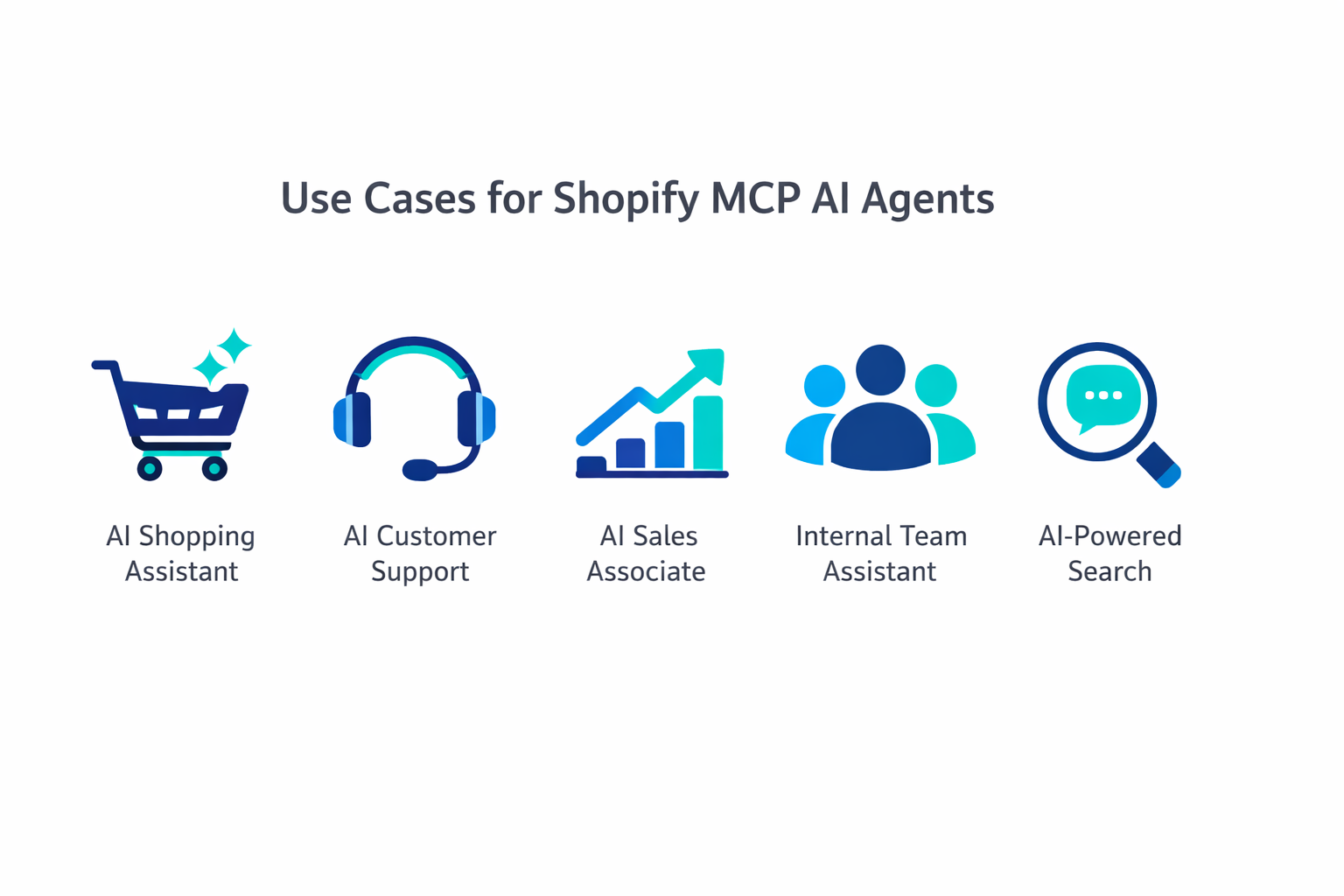 Figure: Five key use cases where Shopify MCP AI agents can transform store operations.
Potential Use Cases for Shopify Stores
AI Shopping Assistants
Guide customers through product discovery naturally instead of relying on filters and menus.
AI Customer Support
Handle order lookups, shipping questions, returns, and product education.
AI Sales Associates
Upsell related products intelligently based on shopper behavior and context.
Internal Team Assistants
Help staff manage products, inventory, reporting, or customer inquiries faster.
AI-Powered Search
Deliver conversational product discovery instead of keyword-only search results.
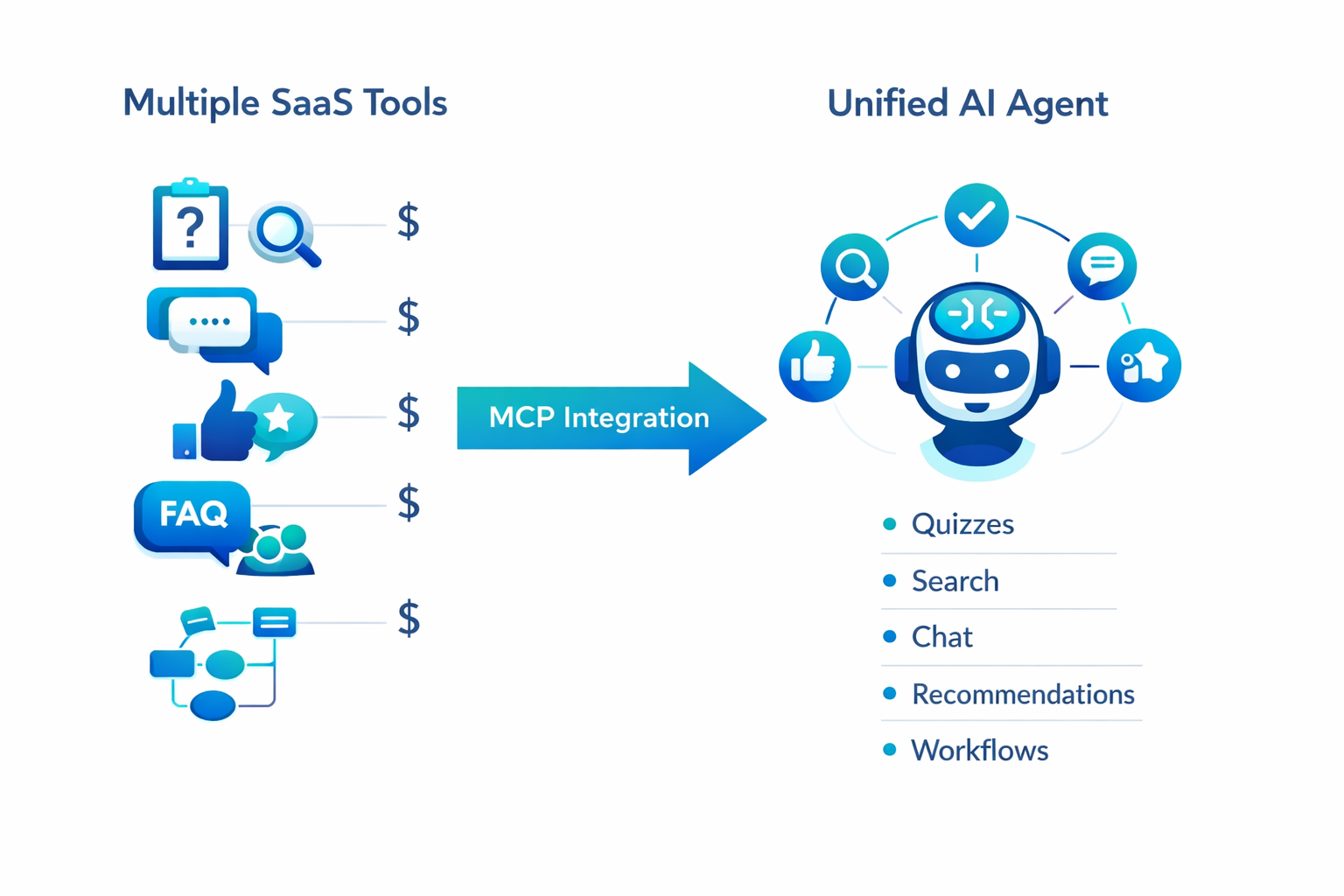 Figure: A single MCP-connected AI agent can potentially replace multiple disconnected SaaS tools, reducing costs and integration headaches.
Why This Could Replace Multiple SaaS Tools
Many Shopify stores currently stack multiple disconnected SaaS tools that add up fast:
- Quiz apps
- Search apps
- Support chat apps
- Recommendation engines
- FAQ systems
- Product finder tools
- Workflow automation apps
An advanced AI agent connected through MCP may eventually consolidate several of these functions into one intelligent system — potentially saving small businesses $60,000–$96,000 per year.
That could reduce:
- Monthly software costs
- App conflicts
- Site bloat
- Script overload
- Integration headaches
Is Shopify MCP Beginner Friendly?
Not yet — at least not fully.
Right now, implementing Shopify MCP often requires:
- Technical setup
- API understanding
- AI workflow knowledge
- Prompt engineering
- Server configuration
- Custom integrations
That's why a growing number of businesses are looking for specialists who can deploy and customize MCP-powered AI systems properly.
As the ecosystem matures, expect:
- Easier installations
- Prebuilt templates
- Plug-and-play AI agents
- Merchant-friendly dashboards
But today, there's still a significant advantage for businesses that adopt early.
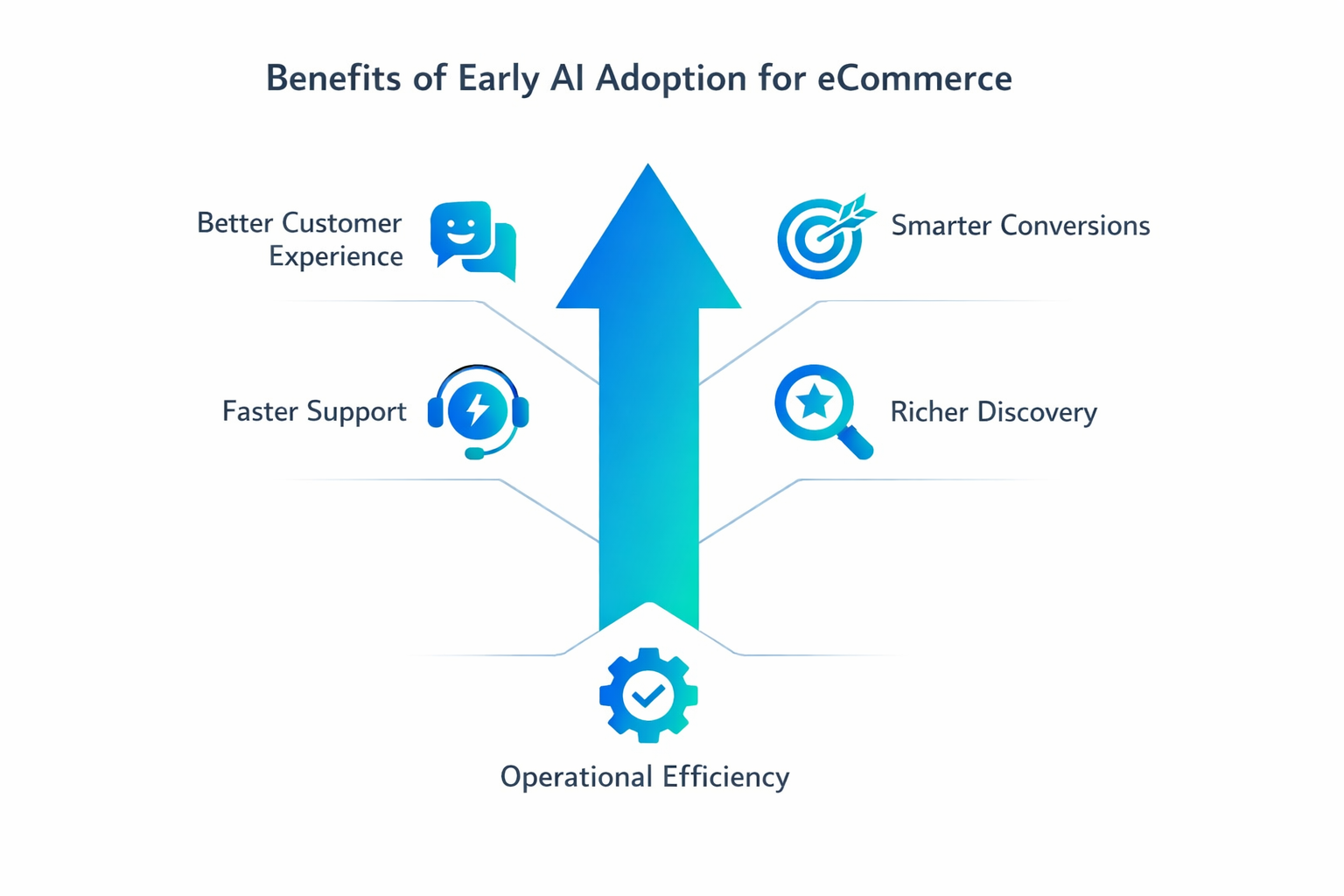 Figure: Early adopters of AI infrastructure gain compounding advantages across customer experience, support, conversions, and operations.
Why Early Adoption Matters
The stores experimenting with AI infrastructure now are building:
- Better customer experiences
- Faster support systems
- Smarter conversion flows
- Richer product discovery
- Stronger operational efficiency
And importantly: they're positioning themselves for the next generation of ecommerce search.
As AI assistants increasingly influence how consumers discover products online, stores with structured AI-ready systems may gain major visibility advantages.
Shopify MCP and the Future of Ecommerce
We're entering a phase where ecommerce stores won't just be websites.
They'll become:
- AI-accessible systems
- Conversational storefronts
- Intelligent recommendation engines
- Dynamic shopping environments
Shopify MCP is one of the foundational technologies helping make that possible. The choice of which AI model powers your system — Claude, ChatGPT, or both — will depend on your specific use cases.
The brands that understand this shift early will likely have a significant edge as AI-driven shopping behavior grows.
Final Thoughts
Shopify MCP represents a major step toward fully AI-integrated ecommerce.
While the technology is still evolving, the direction is becoming increasingly clear:
The future Shopify store won't just serve pages. It will actively collaborate with intelligent AI agents in real time.
For merchants, that opens the door to:
- Better automation
- Smarter customer experiences
- Lower operational friction
- More scalable support and sales systems
And for the ecommerce industry as a whole, it may mark the beginning of a completely new way customers interact with online stores.
Continue Learning About AI Commerce
Now that you understand what Shopify MCP is, explore how it fits into the broader AI commerce ecosystem:
- Claude vs ChatGPT for Shopify MCP — Which AI model is best for your MCP implementation? A detailed comparison of strengths, use cases, and when to use each.
- What Is Conversational Commerce? — How MCP enables the future of AI-powered shopping through natural language interactions.
- AI Agents for Shopify: Implementation Guide — A practical breakdown of what AI agents actually do when connected to your store via MCP.
- How Shopify MCP Could Replace Multiple SaaS Tools — See how one MCP-powered agent can consolidate quiz apps, chat tools, recommendation engines, and more.
- Shopify MCP Integration Explained — A deeper technical look at how MCP integration works in practice.
- The Shift from SEO to GEO — Why optimizing for AI-generated citations is the new visibility strategy for ecommerce brands.
← Back to Blog · ← Back to Home
Looking to Implement Shopify MCP?
At Shopify Agent AI, we help Shopify stores explore and implement AI-powered shopping agents, MCP integrations, and intelligent ecommerce automation systems built for the future of online retail.
Book a Discovery Call to discuss how we can help your store leverage the power of Shopify MCP.
Related Reading
The Shift from SEO to GEO: Why Generative Engine Optimization Is the Future of Ecommerce Visibility
Traditional SEO is losing ground to AI-powered search. Learn how Generative Engine Optimization (GEO) works, the technical implementation details including structured data and entity structuring, and why Shopify stores that don't adapt will become invisible.
Read articleClaude vs ChatGPT for Shopify MCP: Which AI Is Better for Ecommerce Automation?
Compare Claude and ChatGPT for Shopify MCP integrations. Detailed analysis of strengths, use cases, context windows, and why the future of ecommerce AI is multi-model.
Read articleThe 15 Best AI Agents for Automating Business Processes (2026 Buyer's Guide)
The 15 Best AI Agents for Automating Business Processes The Complete Buyer's Guide for Modern Businesses Artificial intelligence has moved far beyond simple cha
Read articleReady to Automate Your Shopify Store?
Get a personalized AI automation audit and discover how your Shopify store can leverage AI agents, MCP integrations, and intelligent workflows to save time, reduce costs, and drive growth.
- Automation opportunities identified
- SaaS consolidation analysis
- AI workflow recommendations
- No obligation, no pressure