What AI Agents Actually Do for Shopify Stores
There's a lot of noise around AI in ecommerce right now. Most of it is vague — "automate everything," "10x your revenue," "the future of shopping." That's not how implementation works.
This post breaks down what AI agents actually do when connected to a Shopify store, what the integration looks like technically, and where the real operational value comes from.
What Is a Shopify AI Agent?
An AI agent is a system that connects to your store data — products, orders, customers, policies — and performs tasks based on that data. It's not a chatbot with canned responses. It's a system that reads your catalog, understands your business rules, and acts accordingly.
The key difference: agents operate on real data, not templates.
When a customer asks "Is the blue version of this jacket available in medium?", the agent checks your live inventory through Shopify MCP (Model Context Protocol), not a static FAQ page.
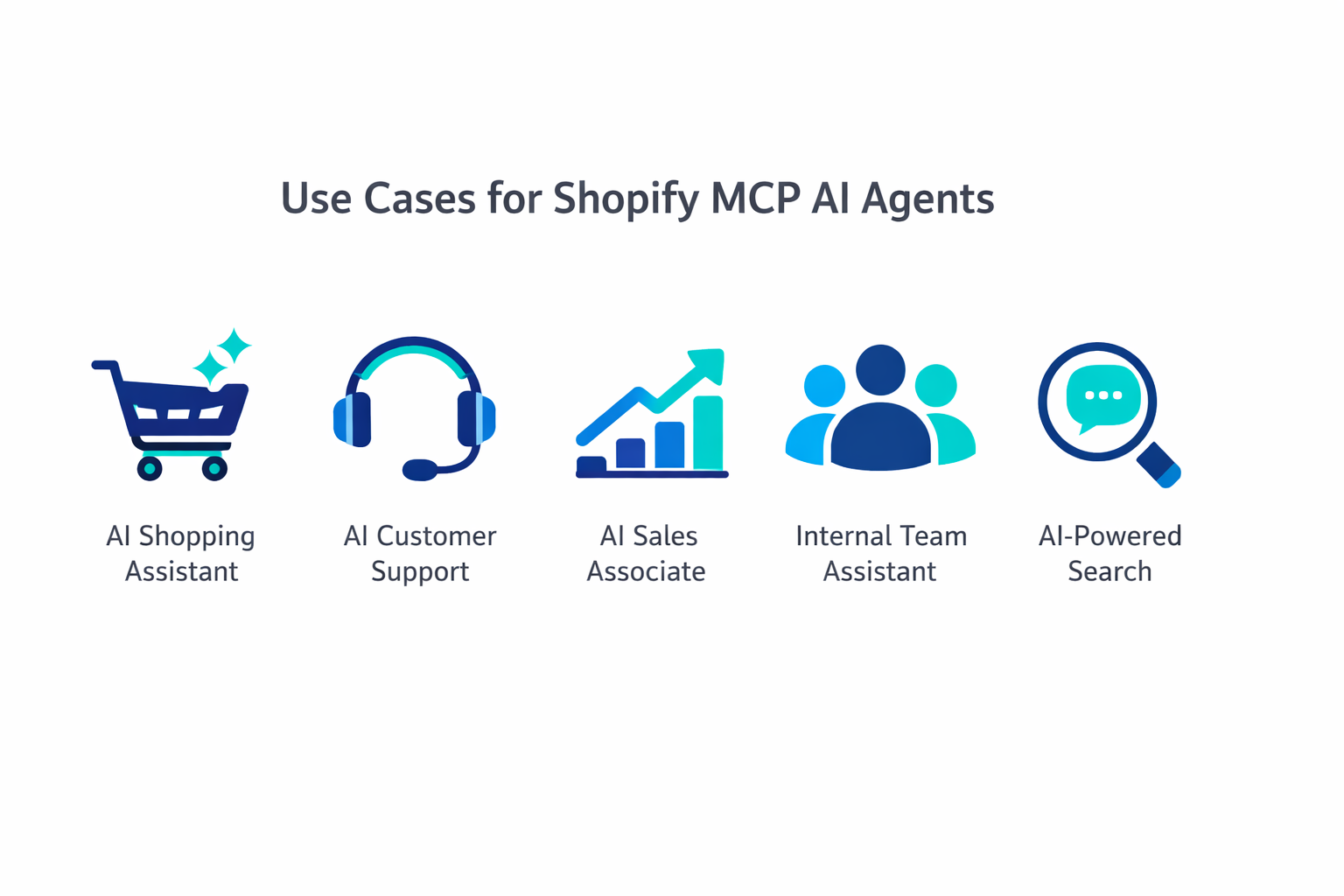 Figure: The primary areas where AI agents create measurable value for Shopify stores.
Where AI Agents Create Real Value
1. Customer Support
This is the most common starting point. An AI support agent handles:
- Order status inquiries
- Return and exchange policy questions
- Product availability checks
- Shipping timeline estimates
The agent is trained on your specific policies, not generic ecommerce rules. If your return window is 45 days instead of 30, the agent knows that.
2. Product Discovery
AI shopping assistants help customers find what they're looking for — especially in stores with large catalogs. This is the foundation of conversational commerce. Instead of browsing through filters, a customer can describe what they need:
"I need a gift for my dad who likes hiking and is hard to buy for."
The agent searches your catalog semantically, not just by keyword match.
3. Workflow Automation
Beyond customer-facing systems, AI agents can automate internal operations:
- Tagging and categorizing new products
- Routing support tickets by urgency
- Flagging orders that need manual review
- Generating product descriptions from specifications
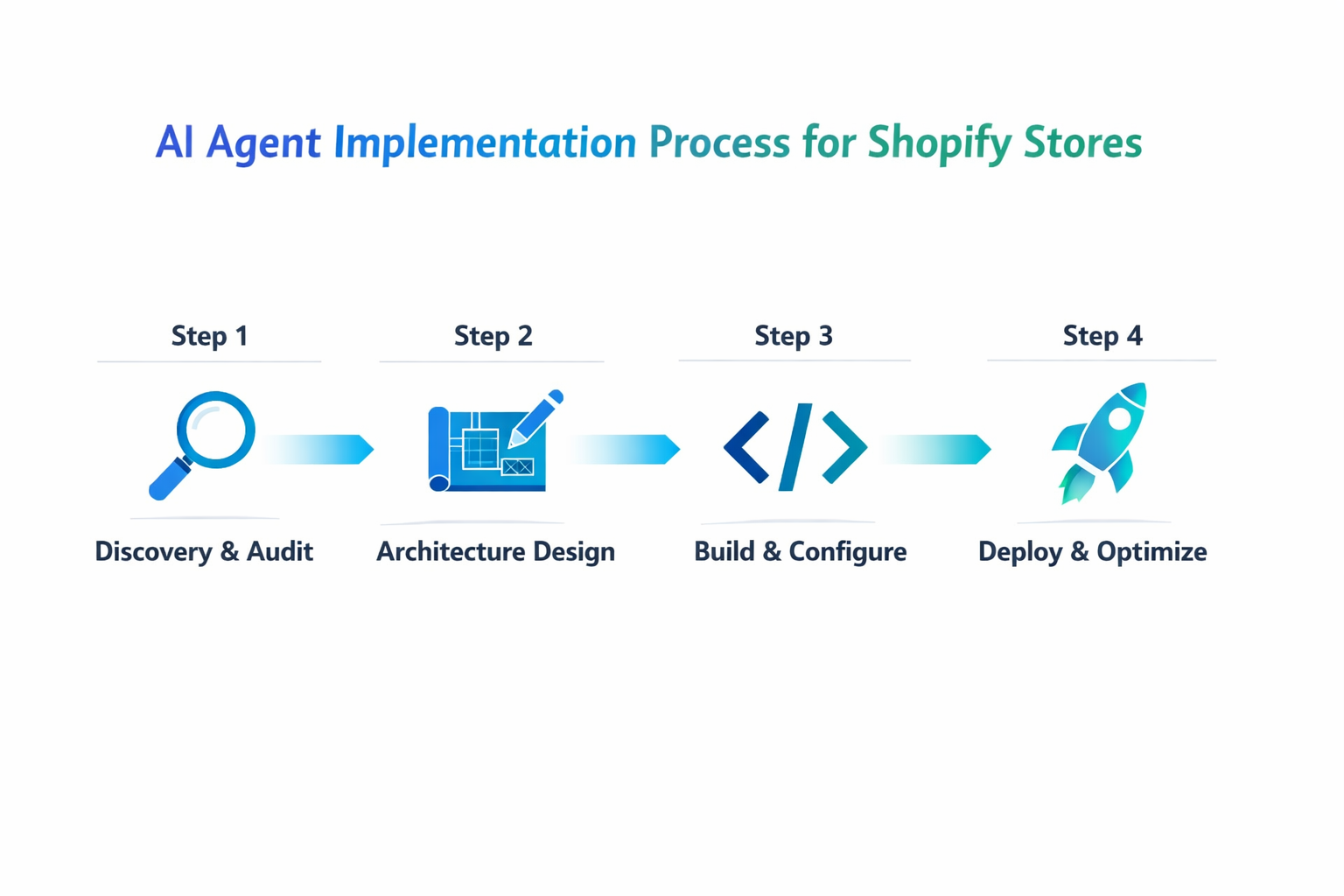 Figure: The four-phase AI agent implementation process — from initial discovery through production deployment and optimization.
What Implementation Looks Like
Implementation isn't plug-and-play. Here's what a typical engagement involves:
Week 1: Audit — We review your store structure, existing apps, customer journey, and support volume. The goal is to identify where AI creates the most leverage with the least disruption.
Week 2: Configuration — We set up the MCP connections, configure the agent's access to your store data, and define the business rules it operates under.
Week 3: Training & Testing — The agent is trained on your product catalog, brand voice, and support policies. We test against real customer scenarios before going live.
Week 4: Launch & Monitor — The system goes live with monitoring in place. We track accuracy, response quality, and customer satisfaction metrics.
Common Misconceptions
"AI will replace my support team." — Not likely, and not the goal. AI handles the repetitive, high-volume questions so your team can focus on complex issues that require human judgment.
"It works out of the box." — Every store is different. Generic AI tools give generic results. The value comes from configuration specific to your operations.
"It's too expensive for my store size." — Implementation can be scoped to match any budget. A focused support agent for a $20K/month store is a very different project than a full automation suite for a $2M/month operation.
The Bottom Line
AI agents for Shopify aren't magic. They're systems — well-configured, well-integrated systems that operate on your real store data. The difference between a good implementation and a bad one is almost entirely in the setup.
If you're considering AI for your Shopify store, the first step isn't choosing a tool. It's understanding your operations well enough to know where AI fits.
Related Reading
Explore more about AI agents and the infrastructure that powers them:
- What Is Shopify MCP? — Understand the protocol layer that gives AI agents real-time access to your store data.
- Shopify MCP Integration Explained — A technical look at how MCP connections are configured and deployed.
- Claude vs ChatGPT for Shopify MCP — Which AI model should power your store's agents? A detailed comparison.
- What Is Conversational Commerce? — How AI agents are transforming product discovery into natural conversations.
- How Shopify MCP Could Replace Multiple SaaS Tools — See how one AI agent can consolidate your entire tool stack.
- The Shift from SEO to GEO — Why optimizing for AI-generated citations is the new visibility strategy for ecommerce.
← Back to Blog · ← Back to Home
Ready to Implement AI Agents?
At Shopify Agent AI, we help Shopify stores implement production-grade AI agents that connect to your real store data through MCP — delivering measurable improvements in support, sales, and operations.
Book a Discovery Call to discuss how AI agents could work for your store.
Related Reading
What Is Shopify MCP? The New AI Layer That Could Change How Shopify Stores Operate
Learn what Shopify MCP (Model Context Protocol) is, how it works, and why it could transform how Shopify stores use AI agents for customer support, sales, and automation.
Read articleThe Shift from SEO to GEO: Why Generative Engine Optimization Is the Future of Ecommerce Visibility
Traditional SEO is losing ground to AI-powered search. Learn how Generative Engine Optimization (GEO) works, the technical implementation details including structured data and entity structuring, and why Shopify stores that don't adapt will become invisible.
Read articleClaude vs ChatGPT for Shopify MCP: Which AI Is Better for Ecommerce Automation?
Compare Claude and ChatGPT for Shopify MCP integrations. Detailed analysis of strengths, use cases, context windows, and why the future of ecommerce AI is multi-model.
Read articleReady to Automate Your Shopify Store?
Get a personalized AI automation audit and discover how your Shopify store can leverage AI agents, MCP integrations, and intelligent workflows to save time, reduce costs, and drive growth.
- Automation opportunities identified
- SaaS consolidation analysis
- AI workflow recommendations
- No obligation, no pressure