Shopify MCP + Claude: How to Connect Claude AI to Your Shopify Store (Complete 2026 Guide)
The Rise of AI-Powered Shopify Stores
Artificial intelligence is rapidly changing how ecommerce businesses operate.
Tasks that once required multiple team members—including product management, content creation, customer support, merchandising, and store analysis—can now be assisted by advanced AI systems.
One of the most powerful AI models available today is Claude, developed by Anthropic.
While Claude is incredibly capable on its own, its true potential emerges when connected directly to a Shopify store through Model Context Protocol (MCP).
Instead of providing generic ecommerce advice, Claude can work with real store information, analyze products, review collections, assist with content creation, and help merchants make better business decisions.
In this guide, we'll explain what Shopify MCP is, how Claude connects to Shopify, what Claude can do with store data, and why AI-powered commerce is becoming a competitive advantage for modern merchants.
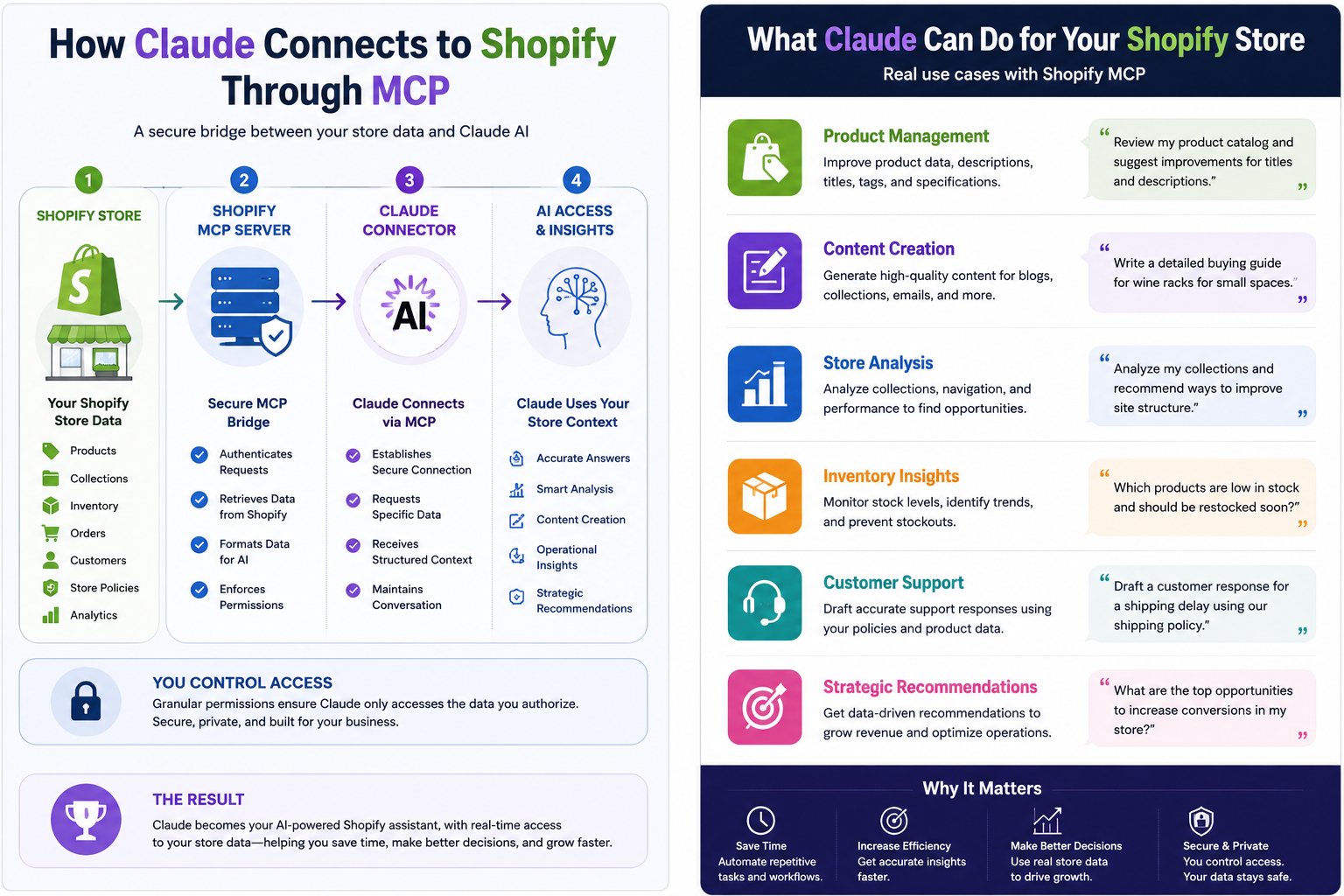
What Is Shopify MCP?
Shopify MCP stands for Shopify Model Context Protocol.
Model Context Protocol (MCP) is an open standard designed to allow AI assistants and language models to securely connect to external tools, platforms, and business systems.
In simple terms:
MCP acts as a bridge between Claude and your Shopify store.
| Scenario | Claude's Capability | Business Impact |
|---|---|---|
| Without MCP | Only knows what you manually type | Generic advice, repeated data entry |
| With MCP | Accesses approved store information directly | Store-specific insights, automated context |
Without MCP, Claude only knows what you manually type into a conversation.
With MCP, Claude can access approved information directly from your Shopify environment.
This allows Claude to understand:
- Products
- Collections
- Inventory
- Orders
- Store policies
- Customer information
- Business documentation
- Analytics data
Rather than working with isolated prompts, Claude gains business context. For a deeper technical overview of how MCP works, see Shopify MCP Server Explained.
What Is Claude?
Claude is a large language model developed by Anthropic.
| Capability | Claude's Strength | Ecommerce Application |
|---|---|---|
| Writing | Excellent long-form content | Product descriptions, blog articles |
| Research | Deep analysis and synthesis | Market research, competitor analysis |
| Data analysis | Pattern recognition | Sales trends, inventory forecasting |
| Customer support | Contextual responses | Ticket drafting, FAQ generation |
| Documentation | Comprehensive review | SOP creation, policy writing |
| Strategic planning | Long-context reasoning | Business strategy, growth planning |
| Ecommerce operations | Multi-step workflows | Catalog optimization, merchandising |
Many Shopify merchants prefer Claude because it excels at processing large amounts of information while maintaining context across lengthy conversations.
This makes Claude especially useful for stores with:
- Large product catalogs
- Complex product information
- Extensive knowledge bases
- Multiple operational workflows
For a detailed comparison with other AI platforms, see Claude vs ChatGPT for Shopify MCP.
Why Connect Claude to Shopify?
Many merchants already use Claude manually.
A typical workflow might look like:
| Step | Manual Process | Time Required |
|---|---|---|
| 1 | Export product data | 5-10 minutes |
| 2 | Copy product information | 5-15 minutes |
| 3 | Paste it into Claude | 2-5 minutes |
| 4 | Ask questions | Ongoing |
| 5 | Repeat whenever data changes | Every session |
This process quickly becomes inefficient.
MCP removes this friction by allowing Claude to access approved information directly.
Instead of spending time gathering context, Claude can immediately begin helping with meaningful business tasks — one of the many ways AI agents save time and money for ecommerce businesses.
How Shopify MCP Connects Claude to Your Store
The architecture is surprisingly straightforward.
| Layer | Component | Role |
|---|---|---|
| 1 | Shopify Store | Your ecommerce data (products, collections, inventory, customers, orders, policies) |
| 2 | Shopify MCP Server | Secure connection layer that retrieves and standardizes store data |
| 3 | Claude Connector | Connects Claude to the MCP server using approved permissions |
| 4 | AI Access | Claude gains authorized access to store information for tasks |
The result is a far more intelligent ecommerce assistant.
For step-by-step installation guidance, see our Shopify MCP Installation Guide.
What Claude Can Access Through Shopify MCP
The specific information Claude can access depends on how the MCP environment is configured.
Products
| Data Point | What Claude Can Do |
|---|---|
| Product titles | Analyze and improve for SEO/GEO |
| Product descriptions | Rewrite, expand, optimize |
| Product types | Categorize and organize |
| Product tags | Audit and recommend improvements |
| Pricing | Analyze competitiveness |
| SKUs | Track and reference |
| Variants | Compare and optimize |
This allows Claude to help improve product content and merchandising.
Collections
| Data Point | What Claude Can Do |
|---|---|
| Collection organization | Evaluate structure and hierarchy |
| Category structures | Identify gaps and overlaps |
| Navigation systems | Recommend improvements |
| Collection descriptions | Write and optimize content |
This helps merchants improve site architecture and discoverability.
Inventory
| Data Point | What Claude Can Do |
|---|---|
| Stock levels | Identify low-stock risks |
| Inventory trends | Forecast replenishment needs |
| Product availability | Flag out-of-stock issues |
This allows merchants to identify inventory risks and replenishment opportunities.
Orders
| Data Point | What Claude Can Do |
|---|---|
| Order analysis | Identify patterns and trends |
| Fulfillment workflows | Optimize shipping processes |
| Operational reporting | Generate performance summaries |
Store Documentation
| Data Point | What Claude Can Do |
|---|---|
| Return policies | Draft support responses |
| Shipping policies | Answer customer questions |
| FAQ documents | Generate and update content |
| Internal procedures | Reference for consistency |
This is especially useful for support and operational workflows.
Real-World Shopify MCP + Claude Use Cases
Product Catalog Optimization
One of the most popular use cases is product improvement.
| Task | Example Prompt | Claude's Output |
|---|---|---|
| Content audit | "Analyze my product catalog and identify thin content" | Prioritized list of products needing improvement |
| Description optimization | "Improve product descriptions for AI search" | Rewritten descriptions with structured data |
| Categorization review | "Identify product categorization issues" | Recommended taxonomy changes |
| Duplicate detection | "Find duplicate or overlapping content" | List of duplicates with merge suggestions |
AI-Powered Content Creation
Content remains one of the strongest growth channels for ecommerce businesses.
| Content Type | How Claude Helps | Business Value |
|---|---|---|
| Product descriptions | Writes using actual product data | Accurate, SEO-optimized content |
| Collection descriptions | Creates based on collection contents | Improved navigation and discovery |
| Blog articles | References real products and categories | Authentic, relevant content |
| Buying guides | Uses catalog knowledge | Helpful, conversion-focused guides |
| FAQ content | Based on store policies | Consistent, accurate answers |
| Email campaigns | Personalized to product catalog | Higher engagement rates |
When connected through MCP, content recommendations become significantly more accurate because Claude understands the actual products being sold.
Collection Analysis
Many Shopify stores struggle with collection organization.
| Analysis Area | What Claude Evaluates | Potential Impact |
|---|---|---|
| Naming conventions | Clarity and consistency | Better customer navigation |
| Navigation paths | User journey optimization | Reduced bounce rates |
| Internal linking | Cross-collection opportunities | Improved SEO and discovery |
| Collection overlap | Redundant or confusing categories | Cleaner site architecture |
This often uncovers merchandising improvements that increase conversion rates.
Customer Support Assistance
Claude can use store information and business policies to help draft support responses.
| Support Scenario | Claude's Capability | Time Saved |
|---|---|---|
| Shipping questions | References actual shipping policies | 5-10 min per ticket |
| Return requests | Applies return policy accurately | 5-15 min per ticket |
| Product recommendations | Uses catalog knowledge | 10-20 min per interaction |
| Warranty inquiries | References warranty documentation | 5-10 min per ticket |
Support teams can respond faster while maintaining consistency. This is a core component of conversational commerce.
Inventory Planning
| Analysis | What Claude Identifies | Business Action |
|---|---|---|
| Low-stock products | Items approaching zero inventory | Reorder before stockout |
| Overstock situations | Excess inventory tying up capital | Promote or discount |
| Product trends | Rising or declining demand | Adjust purchasing |
| Catalog gaps | Missing products in popular categories | Expand offerings |
This helps merchants make more informed inventory decisions.
Shopify MCP vs Using Claude Manually
| Without MCP | With Shopify MCP |
|---|---|
| Generic advice | Store-specific insights |
| Manual copy/paste | Connected data |
| Limited business context | Full store context |
| Repeated data entry | Automated access |
| Less accurate recommendations | More relevant recommendations |
| Time-consuming setup each session | Instant context every session |
| Outdated information | Real-time data access |
The difference is similar to hiring a consultant who has never seen your store versus one who understands your catalog and operations.
Claude vs ChatGPT for Shopify MCP
Both Claude and ChatGPT are capable AI systems.
However, many ecommerce operators prefer Claude for specific workflows.
| Feature | Claude | ChatGPT |
|---|---|---|
| Long-form content creation | Excellent | Excellent |
| Product catalog analysis | Excellent | Excellent |
| Documentation review | Excellent | Very Good |
| Strategic planning | Excellent | Excellent |
| Workflow analysis | Excellent | Excellent |
| Ecommerce operations | Excellent | Excellent |
| Context window size | Very Large | Large |
| Structured reasoning | Excellent | Excellent |
For most Shopify businesses, both models are valuable.
The best choice often depends on team preferences and workflow requirements. For a comprehensive comparison, see Claude vs ChatGPT for Shopify MCP: Which AI Is Better for Ecommerce Automation?
Example Shopify MCP Prompts for Claude
| Use Case | Example Prompt |
|---|---|
| Product Improvement | "Review all products in my catalog and identify opportunities to improve product descriptions for AI search and traditional SEO." |
| Collection Optimization | "Analyze my collection structure and recommend navigation improvements." |
| Inventory Analysis | "Identify products that may require restocking based on current inventory levels." |
| Customer Support | "Create a customer support response using our shipping and return policies." |
| Blog Content | "Generate a comprehensive buying guide using products from my catalog." |
| Product Comparison | "Compare products within a collection and identify opportunities for better merchandising." |
| SEO Audit | "Analyze product titles and meta descriptions for AI search optimization opportunities." |
| Competitive Analysis | "Review our pricing structure and identify products that may need price adjustments." |
Security Considerations
Whenever AI systems gain access to business information, security matters.
| Security Practice | Description | Priority |
|---|---|---|
| Authentication controls | Verify identity before granting access | Critical |
| Permission management | Define what AI can and cannot access | Critical |
| Access restrictions | Limit scope to necessary data only | High |
| Data governance | Policies for data handling and retention | High |
| Role-based access | Different permissions for different use cases | Medium |
| Audit logging | Track all AI actions and data access | Medium |
| Read-only defaults | Start with read-only, expand as needed | High |
Merchants should carefully determine which information AI systems can access.
In many cases, read-only access is sufficient for most workflows.
Why Shopify MCP Matters for AI Commerce
The way consumers discover products is changing.
| Traditional Commerce Path | AI-Powered Commerce Path |
|---|---|
| Customer → Search Engine → Website | Customer → AI Assistant → Product Recommendation → Purchase |
| Keyword-based discovery | Conversational discovery |
| Multiple page visits | Single interaction |
| Manual comparison | AI-assisted comparison |
| Self-directed research | AI-guided research |
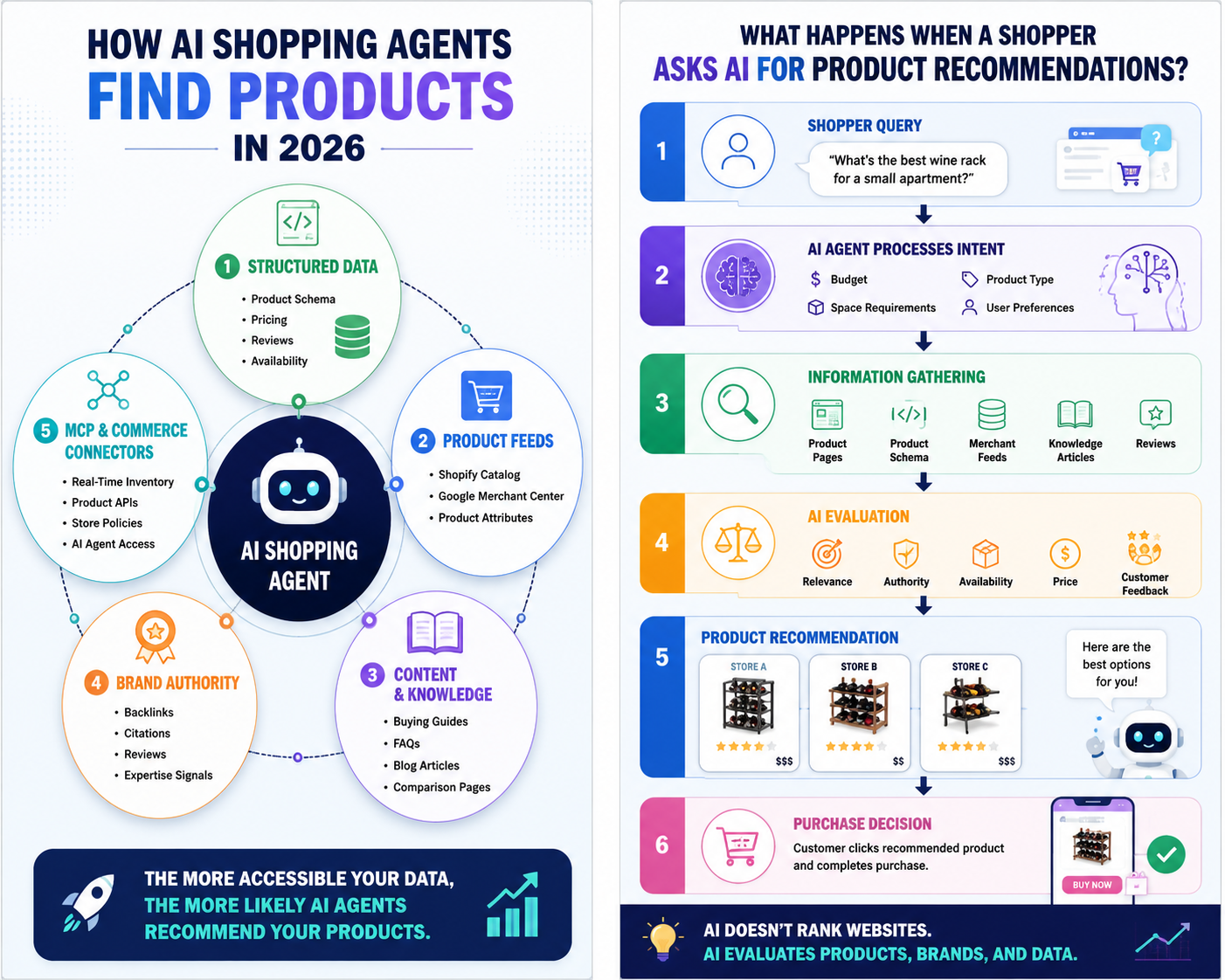
AI systems are becoming a discovery layer between consumers and merchants.
This means businesses must optimize not only for search engines but also for AI systems that interpret and recommend products.
Shopify MCP helps make store information more accessible, accurate, and useful for AI-powered workflows. Understanding how AI shopping agents discover products is critical for merchants preparing for this shift.
The Future of Claude-Powered Shopify Stores
Over the next several years, we can expect AI to become more deeply integrated into ecommerce operations.
| Future Use Case | Current Status | Expected Timeline |
|---|---|---|
| AI merchandising assistants | Early adoption | 2025-2026 |
| AI inventory planners | Emerging | 2025-2026 |
| AI customer support agents | Growing rapidly | 2025-2026 |
| AI content teams | Active use | Available now |
| AI shopping assistants | Consumer adoption growing | 2025-2027 |
| AI operations managers | Experimental | 2026-2028 |
Rather than replacing ecommerce professionals, these tools will increasingly help teams operate more efficiently and make better decisions.
Businesses that begin experimenting with AI workflows today will be better positioned as adoption accelerates. For merchants evaluating their technology approach, understanding how much ecommerce companies can save with AI automation helps prioritize investments.
Frequently Asked Questions
What is Shopify MCP?
Shopify MCP is an implementation of Model Context Protocol that allows AI systems to securely access Shopify store information.
Can Claude connect directly to Shopify?
Not by default. Claude typically requires an MCP server, connector, or approved integration to access Shopify data.
Is Shopify MCP secure?
Yes. MCP environments are designed with permissions and access controls that allow merchants to determine what information AI systems can access.
Can Claude manage Shopify products?
Claude can assist with product analysis, content creation, merchandising recommendations, and catalog optimization when connected through Shopify MCP.
Can Claude access inventory information?
If inventory access is configured within the MCP environment, Claude can analyze inventory data and provide recommendations.
Do I need technical knowledge to install Shopify MCP?
Some Shopify MCP implementations require technical configuration, API setup, authentication, and connector management. Many businesses choose to work with specialists to ensure proper implementation. See our Shopify MCP Installation Guide for step-by-step details.
How Shopify Agent AI Helps
Connecting Claude to your Shopify store through MCP requires careful planning and implementation.
| Service Area | What's Involved |
|---|---|
| MCP server deployment | Secure hosting and configuration |
| Connector setup | Claude-to-Shopify authentication |
| Permission design | Defining appropriate access levels |
| Workflow creation | Building useful AI-powered processes |
| Security review | Ensuring data protection |
| AI readiness assessment | Evaluating store preparedness |
| GEO optimization | Preparing for AI search visibility |
At Shopify Agent AI, we help ecommerce businesses connect Claude and other AI systems to their Shopify stores through properly configured MCP implementations.
Whether you're exploring AI-powered product optimization, customer support automation, or preparing your store for AI shopping agents, the goal remains the same:
Use AI to create more efficient, scalable, and discoverable ecommerce businesses.
Related Reading
What Is Shopify MCP? — Introductory overview of Model Context Protocol and what it means for Shopify merchants.
Shopify MCP Server Explained: What It Is, How It Works, and Which Connectors You Need — Technical overview of MCP server architecture and implementation patterns.
Claude vs ChatGPT for Shopify MCP: Which AI Is Better for Ecommerce Automation? — Detailed comparison of leading AI platforms for MCP-powered ecommerce workflows.
Shopify MCP Installation Guide (Step-by-Step Setup for 2026) — Complete guide to installing and configuring Shopify MCP.
Shopify MCP Required Connectors Explained (2026 Guide) — Which connectors are essential for AI agent workflows.
How AI Shopping Agents Discover Shopify Products — Understanding how AI agents find and recommend products.
How Shopify MCP Could Replace Multiple Ecommerce SaaS Tools — Analysis of how MCP-connected AI can consolidate fragmented tool stacks.
The Many Ways AI Agents Save Time and Money for Ecommerce — Comprehensive breakdown of AI automation ROI across ecommerce operations.
Frequently Asked Questions
Quick answers to common questions about this topic.
Shopify MCP is an implementation of Model Context Protocol that allows AI systems to securely access Shopify store information.
Not by default. Claude typically requires an MCP server, connector, or approved integration to access Shopify data.
Yes. MCP environments are designed with permissions and access controls that allow merchants to determine what information AI systems can access.
Claude can assist with product analysis, content creation, merchandising recommendations, and catalog optimization when connected through Shopify MCP.
If inventory access is configured within the MCP environment, Claude can analyze inventory data and provide recommendations.
Some Shopify MCP implementations require technical configuration, API setup, authentication, and connector management. Many businesses choose to work with specialists to ensure proper implementation. See our [Shopify MCP Installation Guide](/blog/shopify-mcp-installation-guide/) for step-by-step details.
Related Reading
What Is Shopify MCP? The New AI Layer That Could Change How Shopify Stores Operate
Learn what Shopify MCP (Model Context Protocol) is, how it works, and why it could transform how Shopify stores use AI agents for customer support, sales, and automation.
Read articleThe Shift from SEO to GEO: Why Generative Engine Optimization Is the Future of Ecommerce Visibility
Traditional SEO is losing ground to AI-powered search. Learn how Generative Engine Optimization (GEO) works, the technical implementation details including structured data and entity structuring, and why Shopify stores that don't adapt will become invisible.
Read articleClaude vs ChatGPT for Shopify MCP: Which AI Is Better for Ecommerce Automation?
Compare Claude and ChatGPT for Shopify MCP integrations. Detailed analysis of strengths, use cases, context windows, and why the future of ecommerce AI is multi-model.
Read articleReady to Optimize Your Store for AI?
Get a personalized AI readiness audit and discover how your Shopify store can leverage AI agents, MCP integrations, and automation to drive growth.