Shopify MCP Integration: What It Is and Why It Matters
If you've been following AI developments in ecommerce, you've probably seen "MCP" mentioned. Model Context Protocol is becoming the standard way AI agents connect to external systems — including Shopify stores.
Here's what it actually means for your business.
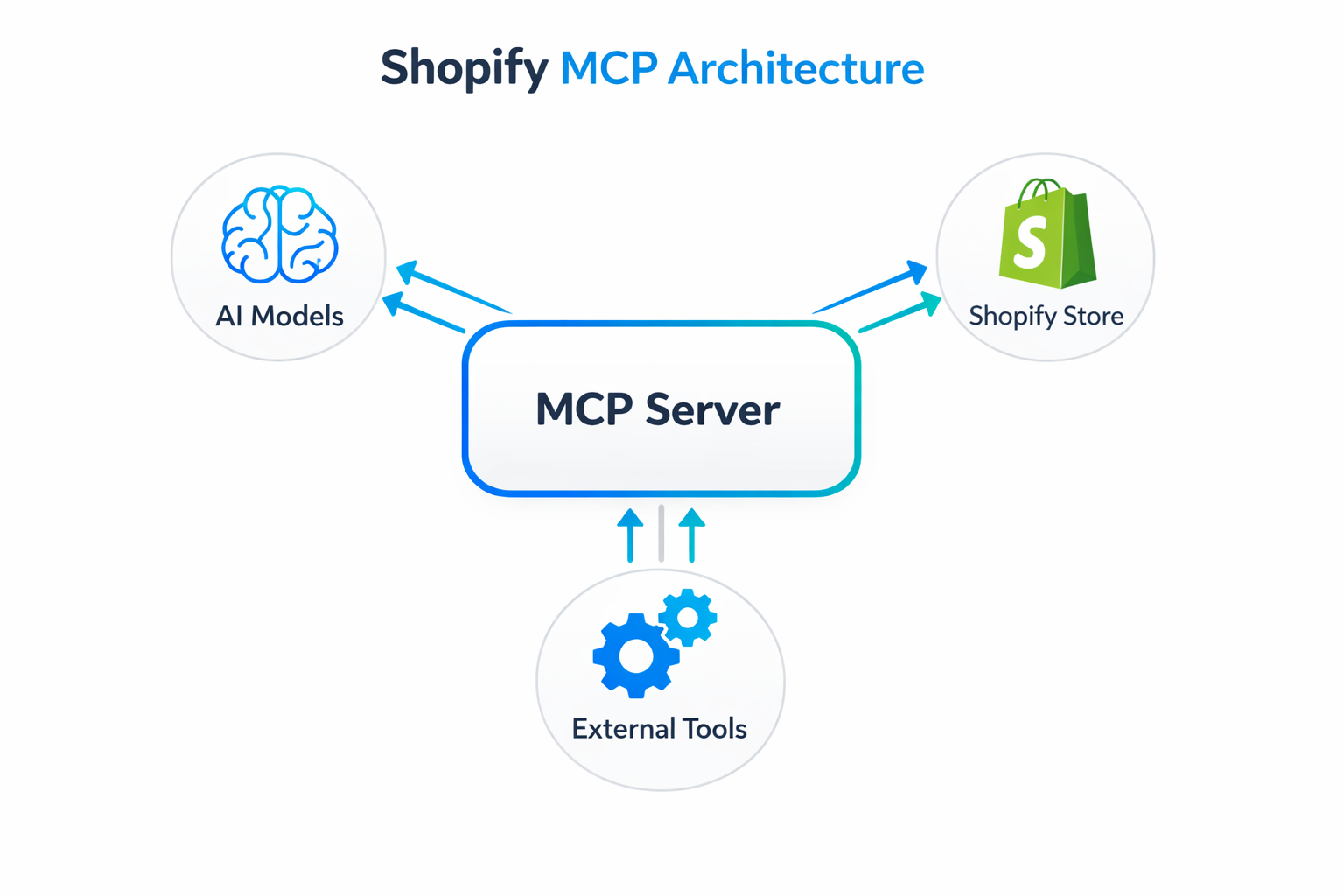 Figure: The Model Context Protocol creates a standardized bridge between AI models and your Shopify store data.
What Is MCP?
Model Context Protocol (MCP) is a standardized way for AI models to access external data and tools. Think of it as a structured bridge between an AI agent and your Shopify store. For a broader overview of MCP's role in ecommerce, see our complete guide on What Is Shopify MCP.
Without MCP, connecting an AI agent to your store means custom API integrations, manual data syncing, and brittle connections that break when your store changes — leading to the kind of SaaS tool sprawl that costs merchants thousands per month. With MCP, the agent has a standardized, reliable way to:
- Read your product catalog
- Check inventory levels
- Access order history
- Review customer data
- Understand your store's structure
Why This Matters for Shopify Stores
Reliable Data Access
The biggest problem with early AI integrations was stale data. An agent trained on last month's catalog doesn't know about your new arrivals. MCP provides real-time access to your current store state.
Reduced Integration Complexity
Before MCP, every AI tool needed its own custom integration with Shopify. That meant more code, more maintenance, and more things that could break. MCP standardizes the connection layer.
Better Agent Performance
When an AI agent has structured access to your complete store data, its responses are more accurate. It's the difference between an agent that guesses and one that knows. This is what enables true conversational commerce — shopping experiences powered by AI that understands your entire catalog.
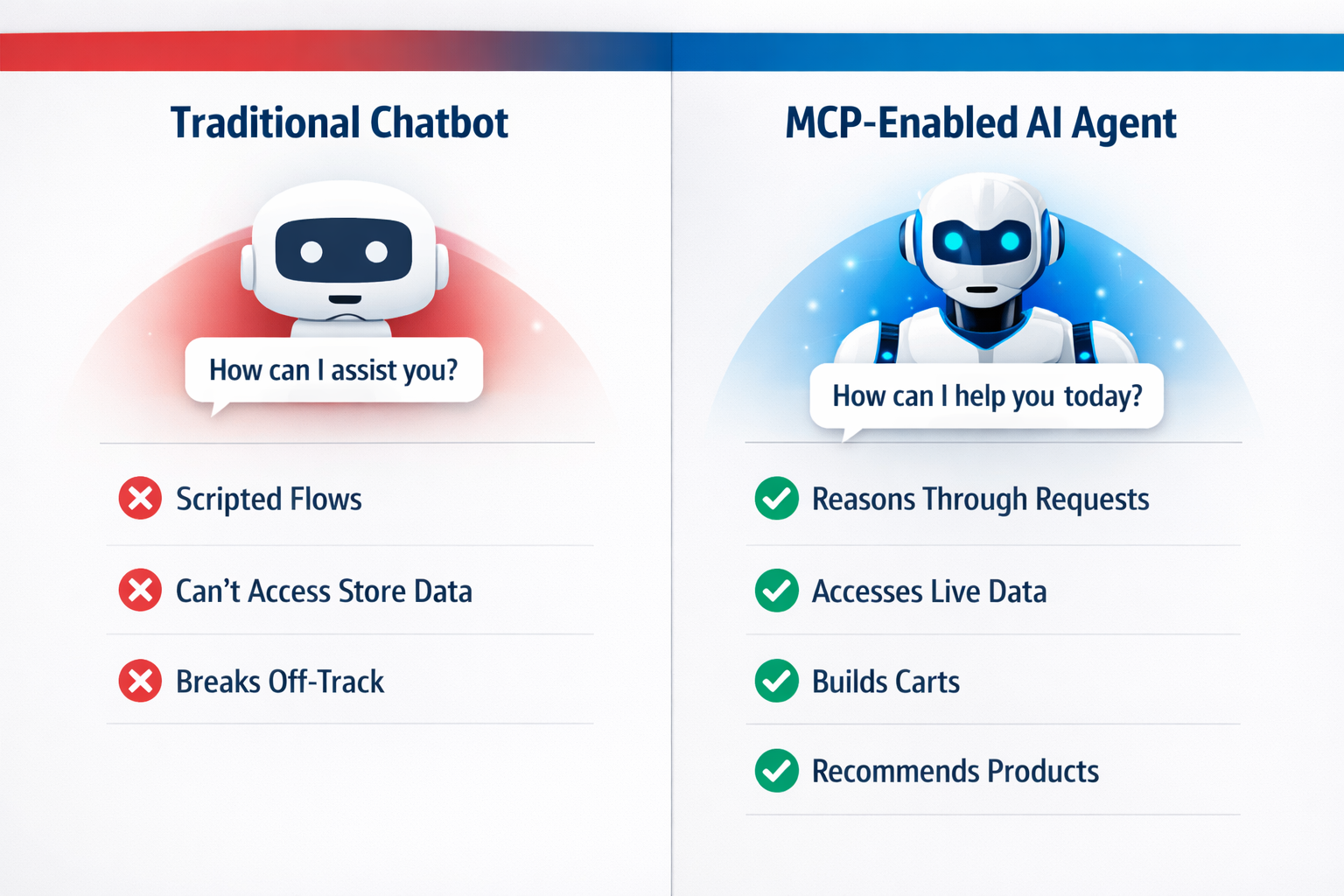 Figure: MCP-enabled agents outperform traditional chatbots by accessing real store data and reasoning through complex requests.
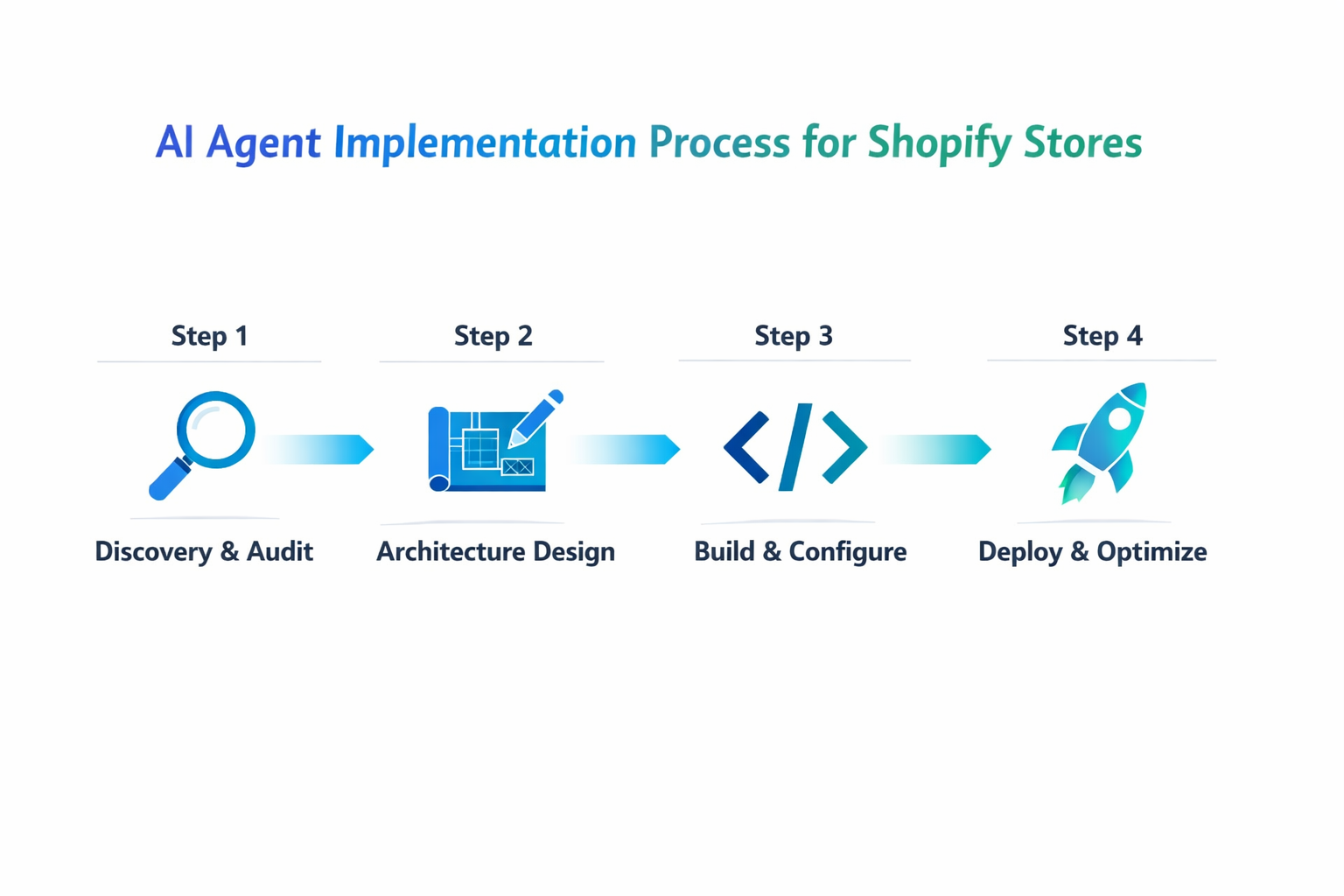 Figure: A typical MCP integration follows a structured process from initial configuration through testing and deployment.
What MCP Integration Looks Like in Practice
A typical Shopify MCP setup involves:
- Connection Configuration — Setting up the MCP server that bridges your Shopify store and the AI agent
- Data Mapping — Defining which store data the agent can access and how it's structured
- Permission Scoping — Controlling what the agent can read vs. write
- Testing — Verifying data accuracy across different scenarios
The technical setup is handled by the implementation team. From your perspective, the result is an AI agent that understands your store as well as your best employee does.
When to Consider MCP Integration
MCP integration makes sense when:
- You want AI agents that work with your real-time store data
- You're tired of AI tools that give generic, inaccurate responses
- You need multiple AI systems to share the same data source
- You want a future-proof integration that scales with new AI capabilities
The Practical Takeaway
MCP isn't a product you buy — it's an integration standard. The value comes from how it's implemented for your specific store. A well-configured MCP integration means your AI agents always have access to accurate, current data. That's the foundation everything else is built on.
Related Reading
Dive deeper into how MCP fits into the broader AI commerce ecosystem:
- What Is Shopify MCP? — A comprehensive overview of Model Context Protocol, its capabilities, and why it matters for ecommerce.
- What AI Agents Actually Do for Shopify Stores — See how AI agents use MCP connections to deliver real operational value.
- Claude vs ChatGPT for Shopify MCP — Compare which AI model works best for different MCP use cases.
- How Much Can Small E-Commerce Companies Save? — The financial case for AI-powered tech stack optimization.
- What Is Conversational Commerce? — How MCP enables natural language shopping experiences.
- The Shift from SEO to GEO — How generative engine optimization changes visibility for MCP-powered stores in AI search results.
← Back to Blog · ← Back to Home
Ready to Explore MCP Integration?
At Shopify Agent AI, we handle the full technical scope of MCP integration — from initial configuration through testing and deployment.
Book a Discovery Call to discuss how MCP integration could transform your store's AI capabilities.
Related Reading
What Is Shopify MCP? The New AI Layer That Could Change How Shopify Stores Operate
Learn what Shopify MCP (Model Context Protocol) is, how it works, and why it could transform how Shopify stores use AI agents for customer support, sales, and automation.
Read articleThe Shift from SEO to GEO: Why Generative Engine Optimization Is the Future of Ecommerce Visibility
Traditional SEO is losing ground to AI-powered search. Learn how Generative Engine Optimization (GEO) works, the technical implementation details including structured data and entity structuring, and why Shopify stores that don't adapt will become invisible.
Read articleClaude vs ChatGPT for Shopify MCP: Which AI Is Better for Ecommerce Automation?
Compare Claude and ChatGPT for Shopify MCP integrations. Detailed analysis of strengths, use cases, context windows, and why the future of ecommerce AI is multi-model.
Read articleReady to Automate Your Shopify Store?
Get a personalized AI automation audit and discover how your Shopify store can leverage AI agents, MCP integrations, and intelligent workflows to save time, reduce costs, and drive growth.
- Automation opportunities identified
- SaaS consolidation analysis
- AI workflow recommendations
- No obligation, no pressure