The Ultimate Shopify AI Toolkit
Everything You Need to Build, Automate, and Scale an AI-Powered Shopify Store
Artificial intelligence is transforming ecommerce faster than any technology since Shopify itself.
What started as AI-generated product descriptions has evolved into intelligent agents capable of automating customer support, optimizing marketing campaigns, analyzing business performance, coordinating workflows, and even preparing online stores for AI-powered shopping experiences.
The challenge?
Most Shopify merchants aren't struggling to find AI tools—they're overwhelmed by them.
There are now hundreds of AI-powered apps, assistants, automation platforms, and integrations claiming to save time and increase sales. Unfortunately, installing more software doesn't automatically create a smarter business.
A successful Shopify AI strategy isn't about using the most tools.
It's about choosing the right tools, connecting them intelligently, and building an AI ecosystem that grows with your business.
That's exactly what this guide is designed to help you do.
Whether you're launching your first Shopify store or managing an established ecommerce brand, this comprehensive Shopify AI Toolkit will show you how to build a modern AI-powered operation without creating unnecessary complexity.
What You'll Learn
- ✔ What a Shopify AI Toolkit actually is
- ✔ The essential categories every Shopify business should have
- ✔ The best AI tools for each business function
- ✔ How Shopify MCP changes AI automation
- ✔ How AI shopping agents discover products
- ✔ Beginner vs. advanced AI stacks
- ✔ Common implementation mistakes
- ✔ How to future-proof your Shopify business
- ✔ How ShopifyAgentAI helps merchants implement AI strategically
💡 ShopifyAgentAI Insight: The goal isn't to collect more AI apps—it's to create an intelligent system where your existing software works together seamlessly. In many cases, the biggest productivity gains come from connecting the tools you already use rather than replacing them.
What Is a Shopify AI Toolkit?
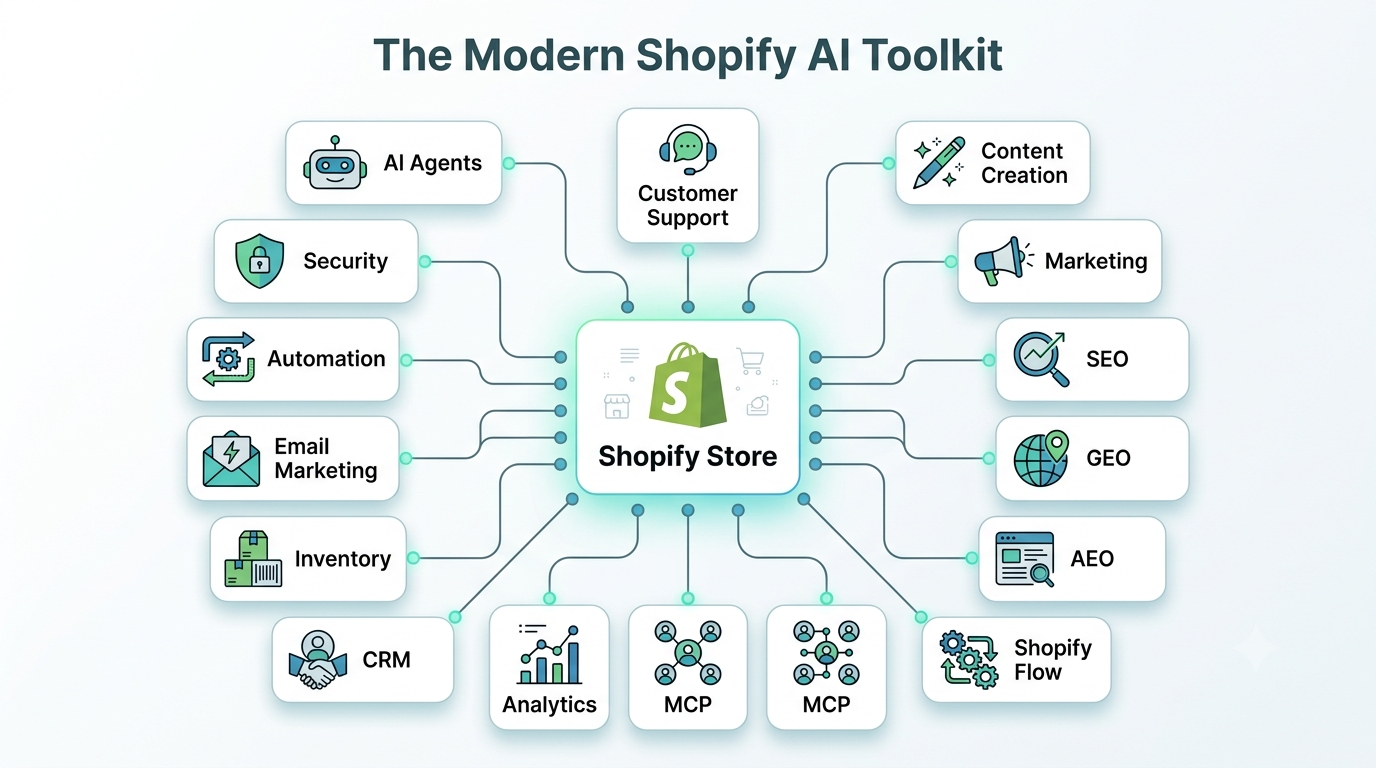
Think of your Shopify AI Toolkit as the operating system behind your ecommerce business.
Rather than being one application, it's a collection of carefully selected AI technologies that work together to support every stage of your business.
A complete toolkit typically includes solutions for:
- Customer support
- Marketing
- Product content
- Analytics
- Inventory management
- Workflow automation
- CRM integration
- AI-powered search optimization
- Reporting
- Team collaboration
- AI shopping readiness
Instead of handling each process manually, AI helps automate repetitive work, surface valuable insights, and improve decision-making across your business.
The result isn't replacing your team.
It's allowing your team to spend less time on repetitive tasks and more time growing the business.
Why Every Shopify Store Needs an AI Toolkit
Five years ago, ecommerce success depended largely on having a well-designed website and effective digital marketing.
Today, merchants face a much more complex landscape.
Customers expect:
- Instant support
- Personalized recommendations
- Fast shipping updates
- Accurate inventory
- Helpful product information
- Seamless buying experiences
At the same time, business owners are expected to produce more content, analyze more data, manage more channels, and respond faster than ever.
Without automation, growth eventually creates operational bottlenecks.
That's where AI becomes transformational.
Instead of hiring additional employees to perform repetitive work, AI can automate many operational tasks while keeping your existing team focused on higher-value activities.
What Can AI Actually Help With?
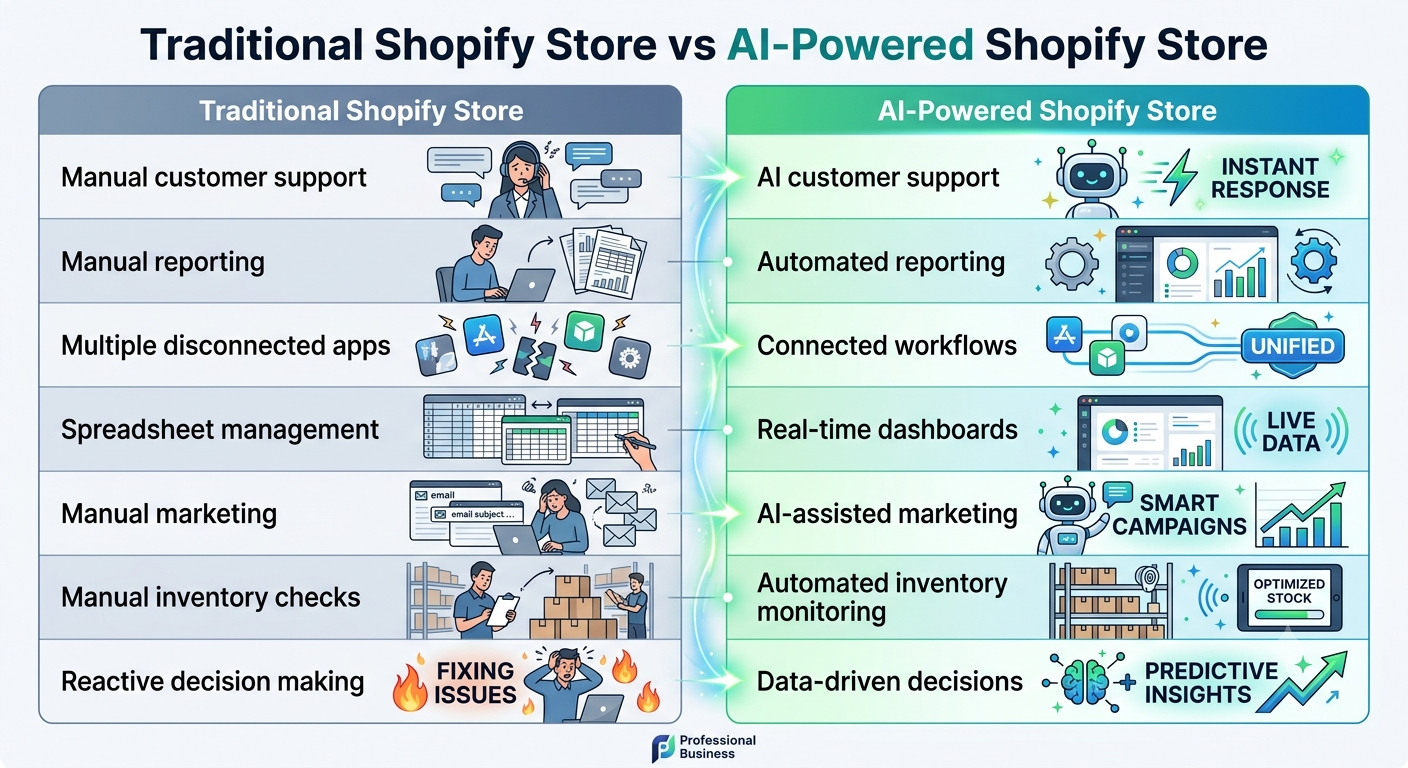
Here's just a sample of what modern Shopify AI tools can accomplish.
| Business Area | Traditional Process | AI-Powered Process |
|---|---|---|
| Customer Support | Respond manually | AI answers FAQs and routes complex issues |
| Product Descriptions | Write individually | Generate optimized content in minutes |
| Marketing | Build campaigns manually | AI drafts emails, ads, and social content |
| Analytics | Review dashboards | AI summarizes insights automatically |
| Inventory | Monitor stock manually | AI predicts shortages and alerts teams |
| CRM | Manual updates | Customer records sync automatically |
| Blog Content | Write from scratch | AI assists with research, outlines, and optimization |
| Reporting | Weekly spreadsheets | Automated executive summaries |
| Team Collaboration | Manual communication | AI creates tasks and notifications |
As AI capabilities continue to evolve, this list is only growing.
⚡ Pro Tip: Don't try to automate everything at once. The highest ROI usually comes from eliminating repetitive administrative work first, then expanding into marketing, customer experience, and predictive automation.
The Eight Essential Categories Every Shopify AI Toolkit Needs
Rather than thinking about individual software, think about business functions.
Every mature Shopify AI Toolkit should include these eight categories.
1. AI Models
These are the "brains" of your toolkit.
Popular examples include:
- ChatGPT
- Claude
- Gemini
These models help with:
- Product descriptions
- Blog writing
- Customer communication
- Data analysis
- Workflow planning
- Coding assistance
- Research
- Marketing copy
Different models excel at different tasks, which is why many businesses use more than one depending on the project.
2. Workflow Automation
Automation platforms connect your business systems.
Examples include:
- Shopify Flow
- Make
- Zapier
- n8n
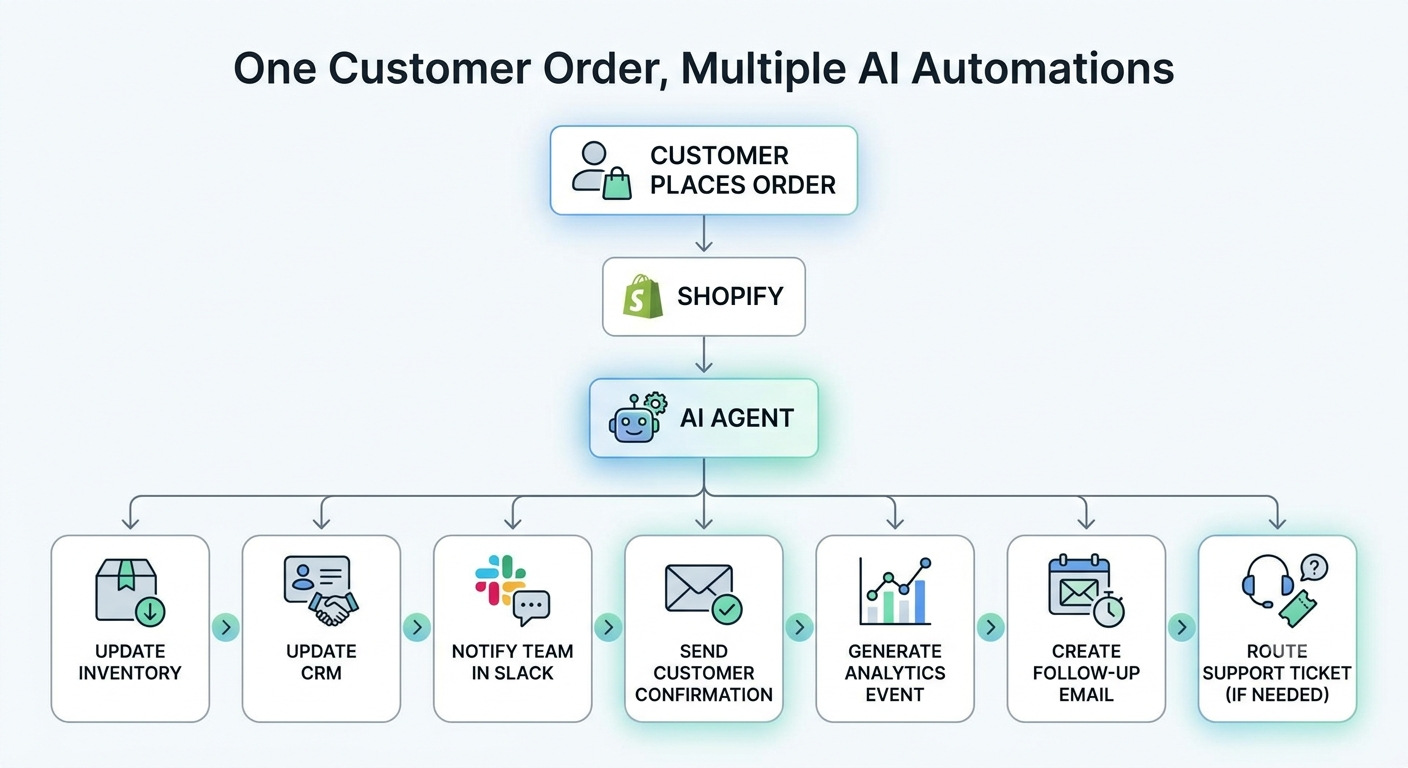
Instead of employees copying information between systems, automations move information automatically.
Common examples include:
- Sending order notifications
- Assigning leads
- Updating CRM records
- Creating support tickets
- Triggering marketing campaigns
- Inventory alerts
3. CRM Integration
Customer relationships shouldn't exist in isolated systems.
A modern AI toolkit connects Shopify with your CRM so customer information flows automatically between platforms.
Popular CRM platforms include:
- HubSpot
- Salesforce
- Zoho CRM
- Pipedrive
- Microsoft Dynamics
- ActiveCampaign
- GoHighLevel
AI can then:
- Enrich customer profiles
- Route leads automatically
- Score opportunities
- Trigger follow-up workflows
- Summarize customer interactions
- Recommend next actions
💡 ShopifyAgentAI Insight: Your CRM isn't just a database—it's one of the most valuable sources of customer intelligence. Connecting it to your AI workflows unlocks better personalization, smarter follow-up, and more informed decision-making.
4. Customer Experience AI
Customer expectations continue to rise.
AI can help Shopify stores deliver faster, more consistent experiences without sacrificing quality.
Examples include:
- AI-powered chat assistants
- Intelligent ticket routing
- Personalized product recommendations
- Order status automation
- Self-service knowledge bases
- AI-generated support responses
When implemented thoughtfully, AI handles repetitive questions while your team focuses on the conversations that truly require a human touch.
5. Shopify MCP: The Missing Link in Most AI Toolkits
One of the biggest advancements in ecommerce AI is Model Context Protocol (MCP).
If AI models are the brains of your toolkit, Shopify MCP acts as the bridge that allows those models to securely interact with your business systems.
Instead of simply answering questions, AI can retrieve data, analyze business information, recommend actions, and perform approved workflows across connected platforms.
Think of Shopify MCP as the connective tissue that transforms individual AI tools into a coordinated system.
With the right implementation, an AI assistant can:
- Retrieve product information
- Analyze inventory levels
- Review customer orders
- Generate reports
- Access CRM data
- Trigger workflow automations
- Coordinate multiple connected systems
Rather than juggling disconnected software, merchants gain an intelligent layer capable of understanding the context of their entire business.
💡 ShopifyAgentAI Insight: Many businesses believe they need more AI software. In reality, they often need better communication between the software they already use. Shopify MCP helps create those intelligent connections.
6. AI Marketing Tools
Marketing has become one of the biggest beneficiaries of AI.
Instead of spending hours creating campaigns from scratch, merchants can use AI to accelerate production while maintaining quality and consistency.
AI can assist with:
- Email campaigns
- Product launches
- Promotional calendars
- Meta ad copy
- Google Ads
- Blog content
- Social media captions
- Landing pages
- Audience segmentation
- Performance analysis
Rather than replacing marketers, AI removes repetitive production work and gives teams more time for creative strategy and optimization.
7. AI SEO, GEO & AEO
Traditional SEO remains important.
But modern Shopify stores should also optimize for:
SEO — Helping search engines understand your website.
AEO (Answer Engine Optimization) — Helping AI assistants answer customer questions using your content.
GEO (Generative Engine Optimization) — Helping large language models understand, trust, and recommend your products.
As AI-powered search continues to grow, successful ecommerce businesses will optimize for all three.
Your toolkit should include:
- Structured Data
- Product Schema
- FAQ Schema
- Clean Site Architecture
- Internal Linking
- Helpful Educational Content
- AI-readable Product Information
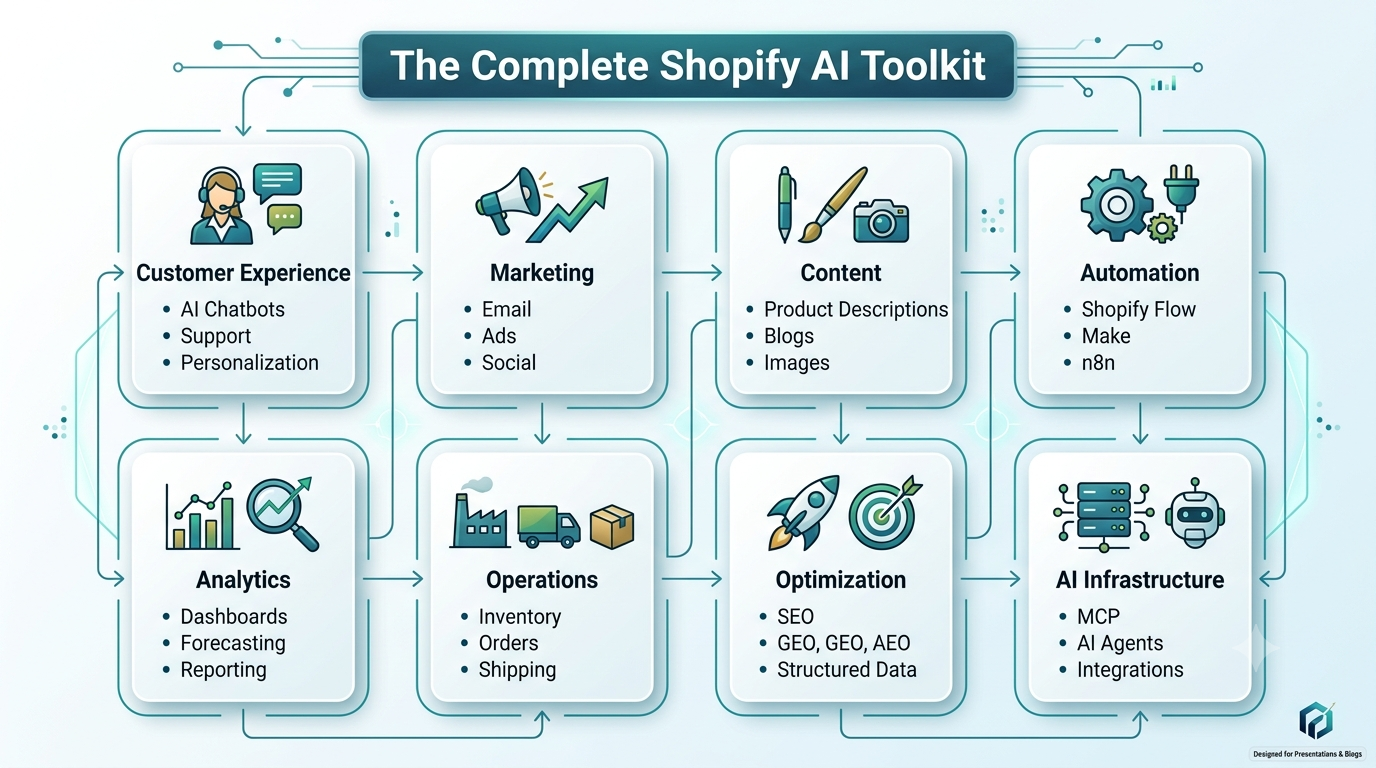
8. AI Shopping Optimization
Increasingly, customers aren't beginning their buying journey with Google.
They're asking:
- "What's the best standing desk?"
- "Recommend a wine fridge under $2,000."
- "What are the best wall-mounted wine racks?"
AI assistants then recommend products based on the information they understand.
That means your Shopify store should be optimized for:
- Structured product data
- Complete product specifications
- Helpful buying guides
- Rich FAQs
- Clear category organization
- Product comparisons
- Consistent branding
- Trust signals
Preparing your store for AI shopping today positions your business for the next generation of ecommerce discovery.
9. Analytics & Business Intelligence
Data is only valuable if you can act on it.
Modern AI analytics tools help merchants:
- Summarize performance
- Identify trends
- Detect anomalies
- Forecast inventory
- Predict demand
- Measure marketing effectiveness
- Highlight revenue opportunities
Rather than manually reviewing dashboards every morning, AI can deliver actionable insights automatically.
10. Security & Fraud Prevention
AI also plays an increasingly important role in protecting ecommerce businesses.
Modern AI security tools help detect:
- Fraudulent orders
- Bot traffic
- Account abuse
- Fake customer accounts
- Suspicious checkout behavior
- Payment anomalies
Protecting your Shopify store is just as important as growing it.
The ShopifyAgentAI Recommended AI Toolkit
Every business is different.
Rather than recommending dozens of random apps, we recommend building your toolkit around business functions.
| Business Function | Recommended Category |
|---|---|
| AI Brain | ChatGPT, Claude, Gemini |
| Ecommerce Platform | Shopify |
| Workflow Automation | Shopify Flow, Make, n8n |
| CRM | Your preferred CRM platform |
| Email Marketing | Your preferred email platform |
| Analytics | GA4, dashboards, BI tools |
| Marketing | AI-assisted campaign tools |
| Customer Support | AI-enabled support platform |
| AI Infrastructure | Shopify MCP |
| Search Optimization | SEO + GEO + AEO |
| Team Collaboration | Communication platform |
| Security | Fraud & bot protection |
Notice that this isn't tied to a specific vendor.
A strong AI toolkit adapts to your business—not the other way around.
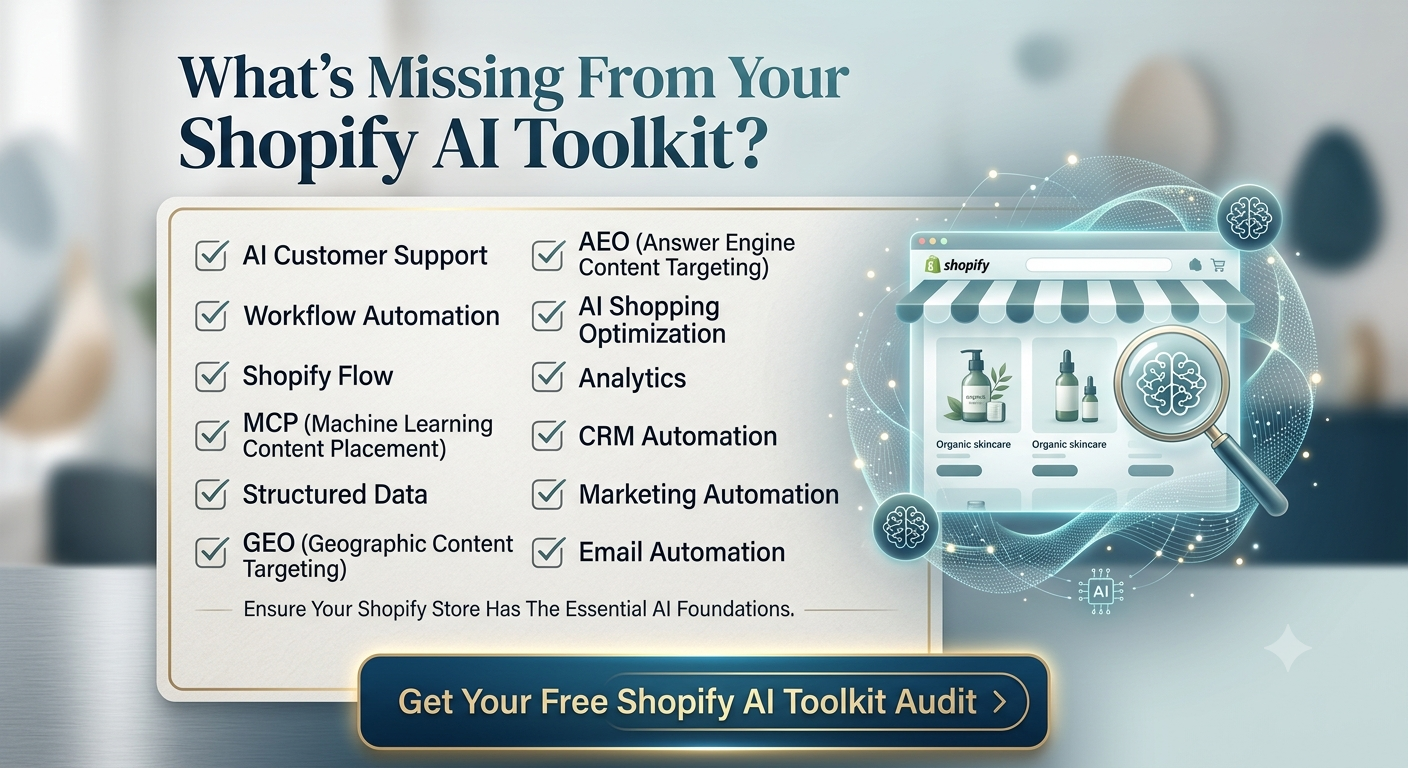
Beginner vs. Advanced Shopify AI Toolkits
Beginner
Ideal for newer stores.
- AI writing assistant
- Shopify Flow
- Basic customer support AI
- Email automation
- Analytics dashboard
Focus on saving time through simple automations.
Growing Business
As revenue grows, merchants often expand into:
- CRM automation
- Advanced email personalization
- Marketing automation
- AI reporting
- Structured data
- Better analytics
The goal shifts from saving time to improving decision-making.
Enterprise & High-Growth Brands
Larger organizations often invest in:
- Shopify MCP
- AI agents
- Multi-step workflows
- Cross-platform integrations
- Predictive analytics
- Customer personalization
- AI shopping optimization
- GEO strategy
- Advanced reporting
At this stage, AI becomes part of the business infrastructure rather than an isolated tool.
⚠️ Common Mistake: Many businesses purchase AI subscriptions before defining a workflow. Start with the business problem first. Then choose the AI tools that solve it.
How to Build Your Shopify AI Toolkit
A successful implementation doesn't happen overnight.
Instead, build your toolkit in stages.
Step 1: Audit Your Current Software
Identify:
- Duplicate tools
- Manual processes
- Bottlenecks
- Time-consuming tasks
Step 2: Prioritize Quick Wins
Look for repetitive tasks like:
- Customer support
- Reporting
- Content creation
- Order notifications
- CRM updates
Step 3: Connect Your Systems
Instead of replacing software, focus on helping existing tools communicate more effectively.
Step 4: Expand Strategically
As confidence grows, introduce:
- MCP
- AI agents
- Predictive analytics
- AI shopping optimization
The ShopifyAgentAI Framework
At ShopifyAgentAI, we believe AI implementation should follow a structured roadmap—not a collection of disconnected software purchases.
Our framework focuses on six stages:
1. Assess — Evaluate your existing technology, workflows, and business goals.
2. Optimize — Improve the systems already in place before adding new tools.
3. Connect — Create intelligent integrations between Shopify, CRM, marketing, analytics, and operations.
4. Automate — Remove repetitive manual work with practical AI workflows.
5. Scale — Expand automation as your business grows.
6. Prepare for AI Commerce — Optimize your store for AI search, AI shopping assistants, and the future of ecommerce.
This structured approach helps merchants avoid unnecessary software costs while building an AI ecosystem that grows alongside their business.
Common Mistakes When Building a Shopify AI Toolkit
Artificial intelligence can dramatically improve ecommerce operations—but only when implemented strategically.
Here are some of the most common mistakes we see merchants make.
Mistake #1: Buying Too Many AI Apps
One of the biggest misconceptions is that every new challenge requires another subscription.
In reality, many Shopify businesses already have the tools they need—they simply aren't connected effectively.
Before purchasing additional software, evaluate whether your existing platforms can be integrated through automation or AI workflows.
Mistake #2: Automating Broken Processes
AI accelerates existing workflows.
If your current process is inefficient, automation can simply make an inefficient process happen faster.
Always optimize the workflow before automating it.
Mistake #3: Ignoring Data Quality
AI performs best when it has access to accurate, organized information.
Messy product data, inconsistent inventory records, incomplete customer profiles, and outdated content reduce the effectiveness of AI systems.
Mistake #4: Forgetting About AI Search
Many merchants focus exclusively on automation while overlooking how AI models discover products.
Optimizing for SEO, AEO, GEO, structured data, and AI-readable product information is becoming just as important as traditional marketing.
Mistake #5: Expecting AI to Replace People
The goal isn't replacing your team.
The goal is helping your team spend less time on repetitive administrative work and more time serving customers, improving products, and growing the business.
💡 ShopifyAgentAI Insight: The best AI implementations feel almost invisible. Customers experience faster service, employees spend less time on repetitive work, and business owners gain better insights without dramatically changing how they operate.
The Future of Shopify AI
AI is evolving far beyond chatbots and content generation.
Over the next several years, merchants can expect to see:
Autonomous AI Agents
AI systems capable of coordinating multiple workflows independently while keeping humans in control of approvals.
AI Shopping Assistants
Customers increasingly discovering products through AI recommendations instead of traditional search results.
Predictive Inventory Management
AI forecasting inventory needs before shortages occur.
Personalized Shopping Experiences
Dynamic product recommendations, pricing strategies, and customer experiences based on behavior and preferences.
Multi-Agent Collaboration
Specialized AI agents working together across marketing, operations, customer service, analytics, and merchandising.
Smarter Business Intelligence
Instead of dashboards filled with charts, AI will increasingly answer questions like:
- Why did sales decline this week?
- Which products should I promote?
- What marketing campaign generated the highest ROI?
- Where am I losing customers?
Businesses that begin preparing today will have a significant competitive advantage as these technologies mature.
Frequently Asked Questions
What is a Shopify AI Toolkit?
A Shopify AI Toolkit is a collection of AI-powered tools, workflows, and integrations that help automate operations, improve customer experiences, optimize marketing, and streamline business processes across a Shopify store.
What are the best AI tools for Shopify?
The best tools depend on your goals, but most modern Shopify AI toolkits include AI models, workflow automation, CRM integration, analytics, marketing automation, customer support, and Shopify MCP.
Do I need Shopify Plus to use AI?
No. Many AI tools and automations work exceptionally well on standard Shopify plans.
What is Shopify MCP?
Shopify MCP (Model Context Protocol) allows AI models to securely interact with business systems using structured tools, making AI assistants significantly more useful than traditional chatbots. Learn more in our Shopify MCP guide.
Can AI automate my Shopify store?
Yes. AI can automate customer support, reporting, marketing, lead routing, inventory monitoring, product content, email campaigns, and many repetitive operational tasks.
Will AI replace ecommerce employees?
No. Most successful businesses use AI to eliminate repetitive work while allowing employees to focus on strategy, customer relationships, merchandising, and growth.
Can AI improve Shopify SEO?
Absolutely. AI can help create content, improve structured data, generate FAQs, strengthen internal linking, optimize metadata, and support both AEO and GEO strategies.
What is the difference between SEO, AEO, and GEO?
SEO focuses on search engines. AEO focuses on helping answer engines provide accurate responses. GEO helps AI models understand and recommend your business within generative search experiences. Read our full breakdown: SEO vs AEO vs GEO.
What CRM works best with AI?
Most modern CRM platforms—including HubSpot, Salesforce, Zoho CRM, Pipedrive, Microsoft Dynamics, ActiveCampaign, and GoHighLevel—can participate in AI-powered workflows. The best choice depends on your business requirements.
How much does Shopify AI implementation cost?
Implementation costs vary depending on business size, existing software, workflow complexity, and automation goals. Most businesses benefit from beginning with an AI audit to identify the highest-return opportunities.
Is AI worth it for small Shopify stores?
Yes. Even small businesses can automate repetitive work, improve customer support, accelerate content creation, and reduce administrative tasks with relatively simple AI implementations. See our guide on AI agents for small businesses.
How do AI shopping assistants find products?
AI shopping assistants evaluate structured product information, helpful content, product specifications, reviews, trust signals, and website authority when recommending products. Learn more: How AI Shopping Agents Discover Products.
Should I build my own AI workflows?
Some merchants successfully build simple automations themselves. More advanced implementations involving MCP, AI agents, multiple integrations, and complex workflows often benefit from working with experienced implementation specialists. Read our DIY guide.
Can AI reduce software costs?
In many cases, yes. By connecting existing platforms more intelligently, businesses often reduce duplicate software subscriptions and eliminate unnecessary manual processes. See how: How Shopify MCP Could Replace Multiple SaaS Tools.
How do I know where to start?
The best first step is understanding your current business processes. An AI audit helps identify repetitive tasks, disconnected systems, automation opportunities, and areas where AI can deliver the greatest return.
Ready to Build Your Shopify AI Toolkit?
Every Shopify business is different.
Some stores need stronger automation. Others need better analytics. Some are preparing for AI-powered shopping. Others want to reduce software costs.
The most effective AI strategy isn't about using the most tools.
It's about implementing the right tools in the right places.
At ShopifyAgentAI, we help merchants design practical AI ecosystems that improve efficiency, reduce operational overhead, and prepare businesses for the future of ecommerce.
Whether you're just getting started or looking to expand an existing AI strategy, we'll help you build a toolkit that fits your business—not someone else's template.
Get Your Free Shopify AI Toolkit Audit
Our complimentary AI Toolkit Audit helps identify opportunities specific to your store.
We'll review:
- ✅ Current software stack
- ✅ Manual processes
- ✅ Automation opportunities
- ✅ CRM integration potential
- ✅ Shopify MCP readiness
- ✅ AI shopping optimization
- ✅ SEO, AEO & GEO opportunities
- ✅ Structured data implementation
- ✅ Workflow improvements
- ✅ Opportunities to reduce software costs
You'll receive practical recommendations and a prioritized roadmap designed around your business goals.
Continue Building Your Shopify AI Knowledge
If you're ready to dive deeper into Shopify AI, these resources are a great next step:
- What Is Shopify MCP? — Learn how Model Context Protocol connects AI to your Shopify store.
- Shopify MCP Installation Guide — Follow a step-by-step implementation process.
- Shopify MCP Connectors Explained — Understand how AI integrates with your existing tools.
- Best Shopify AI Agents — Compare the leading AI assistants and use cases.
- How AI Shopping Agents Discover Shopify Products — Learn how to prepare your store for AI-powered commerce.
- SEO vs. AEO vs. GEO — Understand the future of search optimization for ecommerce.
- Hire an AI Agent Service for Shopify Automation — Explore how expert implementation can accelerate results.
Final Thoughts
Artificial intelligence is rapidly becoming part of the foundation of modern ecommerce.
The merchants who succeed over the next decade won't necessarily be the ones using the most AI tools—they'll be the ones using AI intentionally.
A thoughtfully designed Shopify AI Toolkit helps eliminate repetitive work, improve customer experiences, connect existing software, and prepare your business for a future where AI plays a larger role in how customers discover, evaluate, and purchase products.
Whether you're exploring automation for the first time or planning a complete AI transformation, the key is building a connected ecosystem—not a collection of disconnected apps.
That's the philosophy behind every implementation we deliver at ShopifyAgentAI.
Frequently Asked Questions
Quick answers to common questions about this topic.
A Shopify AI Toolkit is a collection of AI-powered tools, workflows, and integrations that help automate operations, improve customer experiences, optimize marketing, and streamline business processes across a Shopify store.
The best tools depend on your goals, but most modern Shopify AI toolkits include AI models, workflow automation, CRM integration, analytics, marketing automation, customer support, and [Shopify MCP](/blog/what-is-shopify-mcp/).
No. Many AI tools and automations work exceptionally well on standard Shopify plans.
Shopify MCP (Model Context Protocol) allows AI models to securely interact with business systems using structured tools, making AI assistants significantly more useful than traditional chatbots. Learn more in our [Shopify MCP guide](/blog/what-is-shopify-mcp/).
Yes. AI can automate customer support, reporting, marketing, lead routing, inventory monitoring, product content, email campaigns, and many repetitive operational tasks.
No. Most successful businesses use AI to eliminate repetitive work while allowing employees to focus on strategy, customer relationships, merchandising, and growth.
Absolutely. AI can help create content, improve structured data, generate FAQs, strengthen internal linking, optimize metadata, and support both [AEO and GEO strategies](/blog/answer-engine-optimization-aeo-shopify-ai-2026/).
SEO focuses on search engines. AEO focuses on helping answer engines provide accurate responses. GEO helps AI models understand and recommend your business within generative search experiences. Read our full breakdown: [SEO vs AEO vs GEO](/blog/seo-vs-aeo-vs-geo-ecommerce-future-of-search/).
Most modern CRM platforms—including HubSpot, Salesforce, Zoho CRM, Pipedrive, Microsoft Dynamics, ActiveCampaign, and GoHighLevel—can participate in AI-powered workflows. The best choice depends on your business requirements.
Implementation costs vary depending on business size, existing software, workflow complexity, and automation goals. Most businesses benefit from beginning with an AI audit to identify the highest-return opportunities.
Yes. Even small businesses can automate repetitive work, improve customer support, accelerate content creation, and reduce administrative tasks with relatively simple AI implementations. See our guide on [AI agents for small businesses](/blog/best-ai-agents-small-business-2026/).
AI shopping assistants evaluate structured product information, helpful content, product specifications, reviews, trust signals, and website authority when recommending products. Learn more: [How AI Shopping Agents Discover Products](/blog/how-ai-shopping-agents-discover-shopify-products/).
Some merchants successfully build simple automations themselves. More advanced implementations involving MCP, AI agents, multiple integrations, and complex workflows often benefit from working with experienced implementation specialists. Read our [DIY guide](/blog/can-you-set-up-shopify-mcp-yourself-diy-guide/).
In many cases, yes. By connecting existing platforms more intelligently, businesses often reduce duplicate software subscriptions and eliminate unnecessary manual processes. See how: [How Shopify MCP Could Replace Multiple SaaS Tools](/blog/shopify-mcp-replace-ecommerce-saas-tools/).
The best first step is understanding your current business processes. An AI audit helps identify repetitive tasks, disconnected systems, automation opportunities, and areas where AI can deliver the greatest return.
Related Reading
What Is Shopify MCP? The New AI Layer That Could Change How Shopify Stores Operate
Learn what Shopify MCP (Model Context Protocol) is, how it works, and why it could transform how Shopify stores use AI agents for customer support, sales, and automation.
Read articleThe Shift from SEO to GEO: Why Generative Engine Optimization Is the Future of Ecommerce Visibility
Traditional SEO is losing ground to AI-powered search. Learn how Generative Engine Optimization (GEO) works, the technical implementation details including structured data and entity structuring, and why Shopify stores that don't adapt will become invisible.
Read articleClaude vs ChatGPT for Shopify MCP: Which AI Is Better for Ecommerce Automation?
Compare Claude and ChatGPT for Shopify MCP integrations. Detailed analysis of strengths, use cases, context windows, and why the future of ecommerce AI is multi-model.
Read articleReady to Automate Your Shopify Store?
Get a personalized AI automation audit and discover how your Shopify store can leverage AI agents, MCP integrations, and intelligent workflows to save time, reduce costs, and drive growth.
- Automation opportunities identified
- SaaS consolidation analysis
- AI workflow recommendations
- No obligation, no pressure